 AI-generated analysis published under the editorial responsibility of Rohit Sinnas. How it works →
One Story. Many Angles.
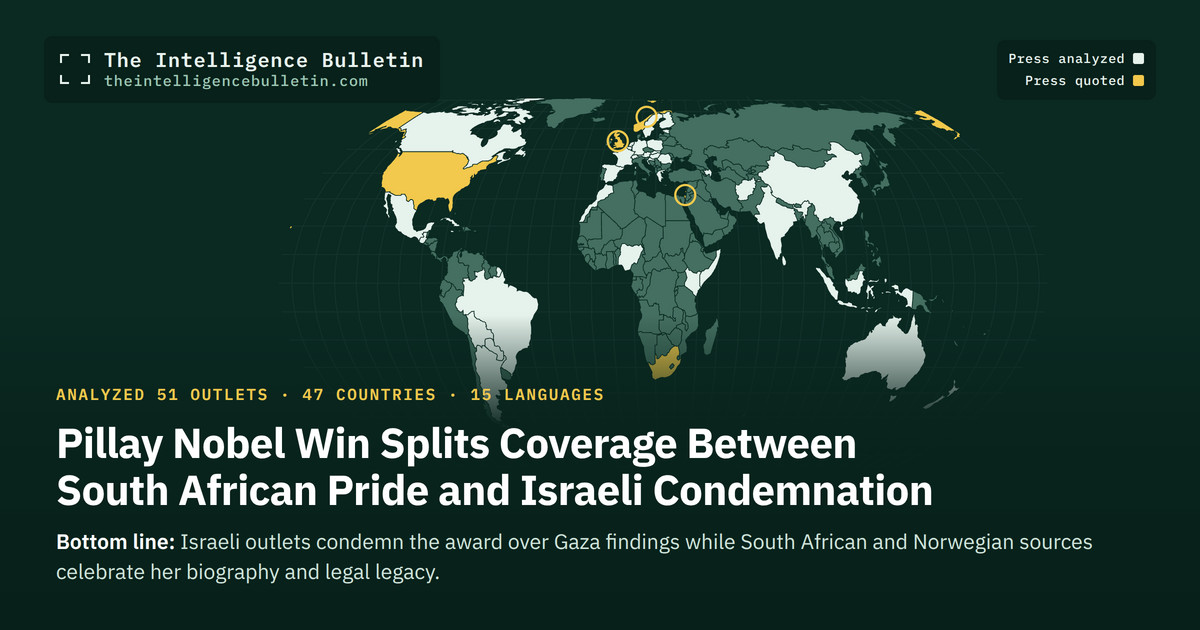
Israeli outlets condemn the award over Gaza findings while South African and Norwegian sources celebrate her biography and legal legacy.
The reporting reveals a clear fault line between biographical celebration of Pillay’s South African roots and sharp geopolitical pushback tied to her Gaza findings. The South African outlet frames her win as a national triumph from Durban’s Clairwood to Oslo, detailing her apartheid-era defense of Mandela and first non-white woman High Court appointment. Norwegian coverage from the ceremony site treats it as local news, quoting the committee chair on threats to international institutions while noting the panel avoided taking a stance on Gaza itself. US reporting via New York Times wire presents a neutral baseline, recording Israeli rejection of the genocide conclusion and the award’s timing amid attacks on justice bodies. Israeli coverage centers the Foreign Ministry’s denunciation, calling the prize a grotesque weaponization and invoking Goebbels, directly tying the decision to Pillay’s 2025 commission report. UK political commentary highlights Trump’s snub and Pillay’s joke about sharing the prize, underscoring how the award lands in a polarized environment where one nation’s human rights champion is another’s target. The divergence shows how the same facts—her career, the Gaza inquiry and the Oslo announcement—produce incompatible narratives depending on national stakes in international accountability.
Perspective Analysis
South African judge Navanethem Pillay received the 2026 Nobel Peace Prize on October 9 in Oslo. The Norwegian Nobel Committee cited her long record of advancing prosecutions for war crimes, crimes against humanity and genocide. At 85, Pillay had already served as president of the International Criminal Tribunal for Rwanda from 1999 to 2003, where her court helped establish rape as an act of genocide. She later sat as a judge at the International Criminal Court from 2003 to 2008 and as United Nations High Commissioner for Human Rights. She currently serves as an ad hoc judge at the International Court of Justice in the case brought by The Gambia against Myanmar over alleged genocide against the Rohingya.
The committee chair, Jørgen Watne Frydnes, said the award recognized Pillay’s commitment to universal legal principles at a moment when international law faces “tremendous pressure” and its institutions are under attack. He described the rule of law as an absolute necessity for resolving conflicts without force. The prize, worth 12 million Swedish kronor, will be presented in Oslo on December 10. Pillay was selected from 287 nominations. She reacted to the news while attending a human rights conference in Nuremberg, Germany, first thinking it must be a joke and later joking during a standing ovation that further applause might lead her to share the prize with US President Donald Trump.
Pillay’s career began in apartheid-era South Africa. Born in 1941 in the working-class Durban neighborhood of Clairwood to a family of Indian Tamil origin, she became the first woman to open a law practice in what was then Natal province in 1967. She defended Nelson Mandela and other anti-apartheid activists and contributed to the equality clause in South Africa’s post-apartheid constitution. She became the first non-white woman appointed to the High Court of South Africa. In 2025 she chaired the UN Independent International Commission of Inquiry on the Occupied Palestinian Territory, which concluded that Israel had committed genocide in Gaza. The commission found reasonable grounds that Israel had carried out four of the five acts listed under the Genocide Convention and that senior Israeli officials had incited genocide. Israel rejected the report as scandalous and politically motivated.
Israeli officials responded sharply to the Nobel announcement. The Foreign Ministry stated that if there were an award for lies, hatred and blood libels, Pillay would be a frontrunner. It described the decision as the grotesque weaponization of the prize to legitimize anti-Israel hatred and added that Joseph Goebbels would be applauding from hell. The ministry tied the award directly to Pillay’s role in the Gaza commission. The Nobel Committee itself made no mention of Gaza or Israel in its official citation, though Frydnes later told reporters that her work on the commission formed an important part of the reasoning.
Coverage of the award diverged sharply along national lines. The South African outlet emphasized Pillay’s origins in Durban and her progression from defending political prisoners under apartheid to becoming the first South African woman to win the prize, placing her alongside Albert Luthuli, Desmond Tutu, Nelson Mandela and FW de Klerk. Norwegian reporting from the ceremony location focused on the committee’s statements about threats to international institutions and noted that the panel had avoided taking a direct stance on the Gaza findings. US coverage, drawn from New York Times reporting, recorded the Israeli rejection of the genocide conclusion and the award’s timing amid broader attacks on justice institutions, without adding national biographical framing. Israeli coverage centered the government’s condemnation and framed the prize as rewarding the biggest lie of the 21st century. UK political commentary highlighted Trump’s unsuccessful bid and Pillay’s quip about sharing the prize, situating the decision within transatlantic political dynamics.
A reader limited to any single national source would therefore miss key dimensions. South African readers would encounter a story of national pride and constitutional achievement but little of the Israeli government’s explicit rejection or the committee’s careful separation of Pillay’s Gaza work from its citation. Israeli readers would encounter a detailed account of official condemnation and the commission’s conclusions but little of Pillay’s South African legal pioneering or the committee’s emphasis on the broader defense of international law. Norwegian readers would receive a localized account of the Oslo announcement and committee remarks on institutional pressure, with the Gaza dimension noted but not foregrounded. US readers would see a neutral record of the facts and Israeli reaction but without the personal biographical depth or the political Trump angle developed elsewhere. UK readers would encounter the award primarily through the lens of Trump’s disappointment and Pillay’s joke, with less attention to the legal substance that united the other accounts.
The Norwegian and US accounts align most closely with the corroborated record across independent reporting chains. They accurately reflect the committee’s stated rationale, the existence and content of the 2025 Gaza commission report, and Israel’s on-record condemnation without inflating or diminishing any element. South African coverage correctly details Pillay’s biography but subordinates the geopolitical reaction that the Israeli source places at the center. Israeli coverage accurately quotes the Foreign Ministry but presents the award as illegitimate without acknowledging the committee’s focus on Pillay’s earlier work on Rwanda and the ICC. The Trump-focused commentary correctly records Pillay’s remark but treats the award chiefly as a political snub rather than a recognition of prosecutorial precedents.
What to Watch
Israel has a clear interest in readers viewing the prize as a reward for anti-Israel activism, given the commission’s conclusions about its conduct in Gaza. South Africa has an interest in readers viewing it as validation of its post-apartheid legal tradition. The committee’s decision to honor Pillay while explicitly declining to rule on Gaza itself suggests the award will intensify rather than resolve debates over whether international justice mechanisms can remain credible when major powers reject their findings. The next public test will come at the December 10 ceremony in Oslo, where any remarks by Pillay or committee members will reveal whether the prize functions as a platform for further confrontation or as an attempt to reinforce norms under pressure.
That’s how the world told the story.
Get our daily open-source intelligence on world events in your inbox — one email a day, up to six stories.
Subscribe freeNo spam. One-click unsubscribe. See the latest email →