 AI-generated analysis published under the editorial responsibility of Rohit Sinnas. How it works →
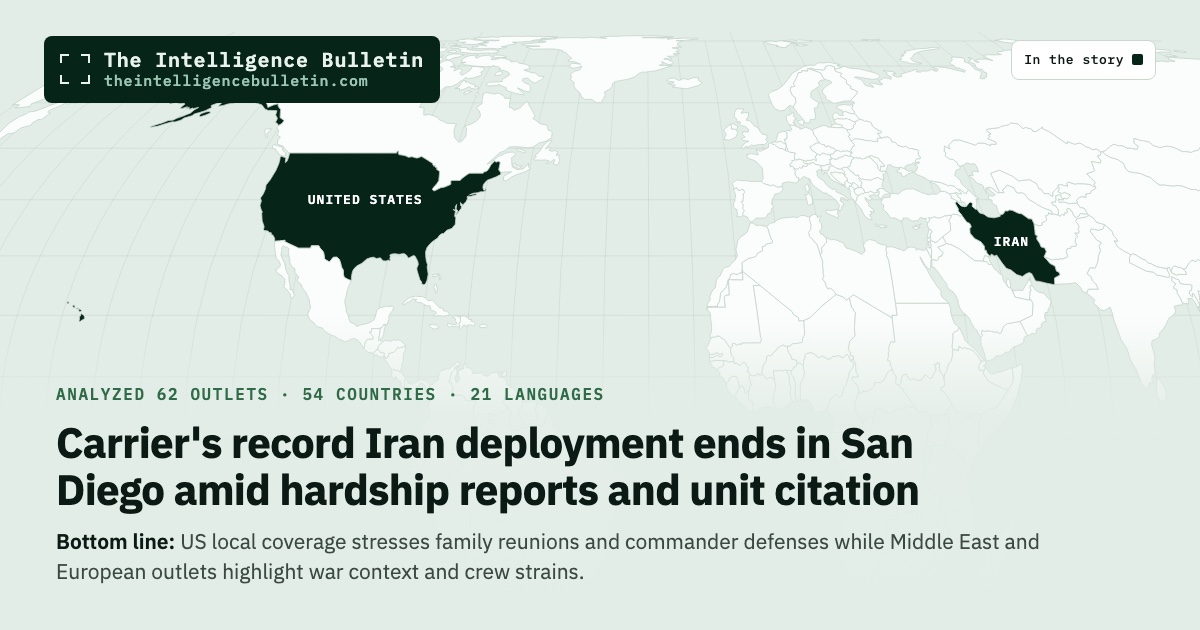
| Press analyzed | 62 outlets · 54 countries · 21 languages |
| Press quoted | 5 sources · 4 independent accounts |
See the 54 countries
Afghanistan, Argentina, Australia, Austria, Azerbaijan, Belgium, Bosnia and Herzegovina, Brazil, Canada, China, Cuba, Czech Republic, Denmark, Egypt, Finland, Germany, Greece, Hungary, India, Indonesia, Iran, Iraq, Ireland, Israel, Italy, Jordan, Kuwait, Lebanon, Malaysia, Mexico, Morocco, Netherlands, New Zealand, Nigeria, Norway, Oman, Pakistan, Philippines, Poland, Qatar, Romania, Russia, Singapore, Slovakia, South Africa, Spain, Sri Lanka, Switzerland, Syria, Tuvalu, United Arab Emirates, United Kingdom, United States, Vietnam
US local coverage stresses family reunions and commander defenses while Middle East and European outlets highlight war context and crew strains.
- Independently reportedThe USS Abraham Lincoln completed a 322-day deployment including a record 265 consecutive days at sea supporting operations against Iran.Source: All five outlets, citing Navy statements and crew accounts
- Independently reportedDefense Secretary Pete Hegseth awarded the Lincoln strike group a Presidential Unit Citation for combat actions including 3,693 sorties and strikes on Iranian targets.Source: San Bernardino Sun, Al Jazeera, Globe and Mail, Dagbladet; citing Hegseth’s speech
- Independently reportedCrew faced food shortages, mental health issues and eight suicide attempts during the deployment.Source: Al Jazeera, Globe and Mail, Dagbladet; citing Navy letters to lawmakers and media reports
- Independently reportedShip commander Capt. Daniel Keeler stated conditions were within the normal spectrum for combat deployments and denied missed meals or serious infrastructure failures.Source: San Bernardino Sun, Globe and Mail, Dagbladet; citing direct interview
- What specific combat actions by the Lincoln strike group are independently verified beyond the citation text?
- How many additional carriers will rotate into the Iran theater before the conflict ends?
Press quoted
Full analysis
The aircraft carrier USS Abraham Lincoln pulled into its home port at Naval Air Station North Island in San Diego on October 8, 2026, after 322 days at sea. The roughly 5,000 sailors and Marines on board had spent a record 265 consecutive days without a port call during the final stretch of operations that began with the ship’s redirection from the Indo-Pacific to the Arabian Sea in January. The deployment had started in November 2025 with a planned return in May, but successive extensions kept the carrier in the combat zone through the period of US and Israeli strikes on Iran that opened on February 28.
Thousands of family members waited at the pier under a hot sun. At least 67 crew members on the ship itself met infants born while they were away; the total reached 122 when aviation units assigned to the carrier were included. One sailor from Texas walked off grinning and headed straight for his parents who had driven from home. Another, newly returned from his first deployment, said there had been a point when he never thought he would come off the ship. Crew members described looking forward to fresh meals after months of limited options, with one wife recounting her husband’s list of cravings that included oxtail, barbecue chicken, broccoli and shrimp empanadas.
On the day before the return, Defense Secretary Pete Hegseth flew aboard and presented the Presidential Unit Citation, the highest award given to an entire military unit. The citation credited the Lincoln strike group with executing 3,693 combat sorties, delivering 1.37 million pounds of ordnance, launching 450 Tomahawk land-attack cruise missiles, shooting down 77 one-way attack drones, sinking 64 Iranian warships and destroying 21 anti-ship cruise missiles. Hegseth told the crew that no other carrier strike group had ever done what they had done. The ship’s commanding officer, Capt. Daniel Keeler, said the number that mattered most to him was zero: zero lost aircraft, zero combat damage to the ship, zero lives lost.
Multiple accounts of the deployment also recorded strains on the crew. Letters to lawmakers and reporting by Stars and Stripes and other outlets described food shortages that at times reduced meal options, problems with hot water and laundry facilities, and eight suicide attempts among members of the strike group. One family member at the pier said her daughter had lost weight during periods when supplies ran low. Acting Navy Secretary Hung Cao had earlier told Congress that adequate food supplies were maintained but that combat conditions had limited resupply opportunities for a time. Keeler stated in an interview aboard the ship that the difficulties fell within the normal spectrum for a long combat deployment and that there had been no missed meals or unaddressed infrastructure failures. He acknowledged that information to families had been tightly controlled during active operations and that some crew members had expressed frustration with press accounts that did not match their own experience on board.
The Lincoln’s return comes after another carrier, the USS Gerald R. Ford, completed a 326-day deployment earlier in the year and also received the Presidential Unit Citation. The Lincoln is scheduled for roughly two months in San Diego before moving to Bremerton, Washington, for an 18-month dry-dock period that will include hull inspection for cumulative rust damage.
The accounts diverge most clearly in what they place at the center of the story. The San Bernardino Sun article, written from the home-port city with direct access to the pier, foregrounds the reunions, the new fathers, the cheering families and the commander’s emphasis on zero losses. It includes the citation details but balances them with Keeler’s defense that conditions were within expected bounds for combat. The Globe and Mail, carrying Associated Press copy, gives comparable weight to the record length of the deployment, the emotional homecoming and the hardship reports while adding a comparison to the Ford’s earlier record. It avoids explicit framing of the operations as a “war on Iran” in its headline.
Middle East Eye, Al Jazeera and Dagbladet place the Iran operations and the reported crew strains in sharper relief. Middle East Eye notes the war context and circulating reports of shortages and low morale alongside Hegseth’s praise. Al Jazeera links the deployment’s length to broader criticisms of the war effort, includes Trump administration statements dismissing negative coverage as fake news, and reports a Pew Research Center poll showing 65 percent of Americans disapproved of Trump’s handling of the conflict. Dagbladet, relaying Norwegian wire material, details the 322 days, the war against Iran, the suicide attempts and rationing, and adds the detail of the crew’s first port call in Pattaya, Thailand, after more than 250 days at sea. These three accounts treat the same Navy statements about the citation and the commander’s assessment as evidence of the costs of sustained operations rather than as counterweight to hardship claims.
The length of the deployment and the existence of hardship reports appear in independent reporting chains that reach across the US local piece, the Canadian wire account and the Middle East and European outlets. The specific combat figures in the citation are carried by the San Bernardino Sun, Al Jazeera, the Globe and Mail and Dagbladet. Keeler’s on-record statement that conditions remained within normal bounds is quoted directly in the San Bernardino Sun, the Globe and Mail and Dagbladet. No independent Iranian account of the strikes or the blockade appears in the selected sources, so the citation’s claims about Iranian losses stand without counter-narrative from that side.
What to Watch
The local San Diego reporting supplies the concrete human detail of families traveling from Maine and Texas, of sailors planning immediate stops at McDonald’s or proposing marriage on the pier, that is absent from the shorter regional and European summaries. The Middle East-focused and European accounts supply the explicit connection to the ongoing conflict and to domestic US polling that the local piece treats more lightly. The Canadian wire account occupies the middle ground by recording both the operational record and the hardship reports without the political overlay. The most consistent element across all five is that the deployment’s duration itself turned a routine carrier rotation into a measurable marker of force tempo, with the costs now recorded both in ordnance expended and in documented effects on the crew. That convergence on the length and on the existence of hardship reports gives the reader a clearer picture of sustained operations than any single national framing supplies on its own.
That’s how the world told the story.
Get our daily open-source intelligence on world events in your inbox — one email a day, up to six stories.
Subscribe freeNo spam. One-click unsubscribe. See the latest email →