 AI-generated analysis published under the editorial responsibility of Rohit Sinnas. How it works →
Press quoted
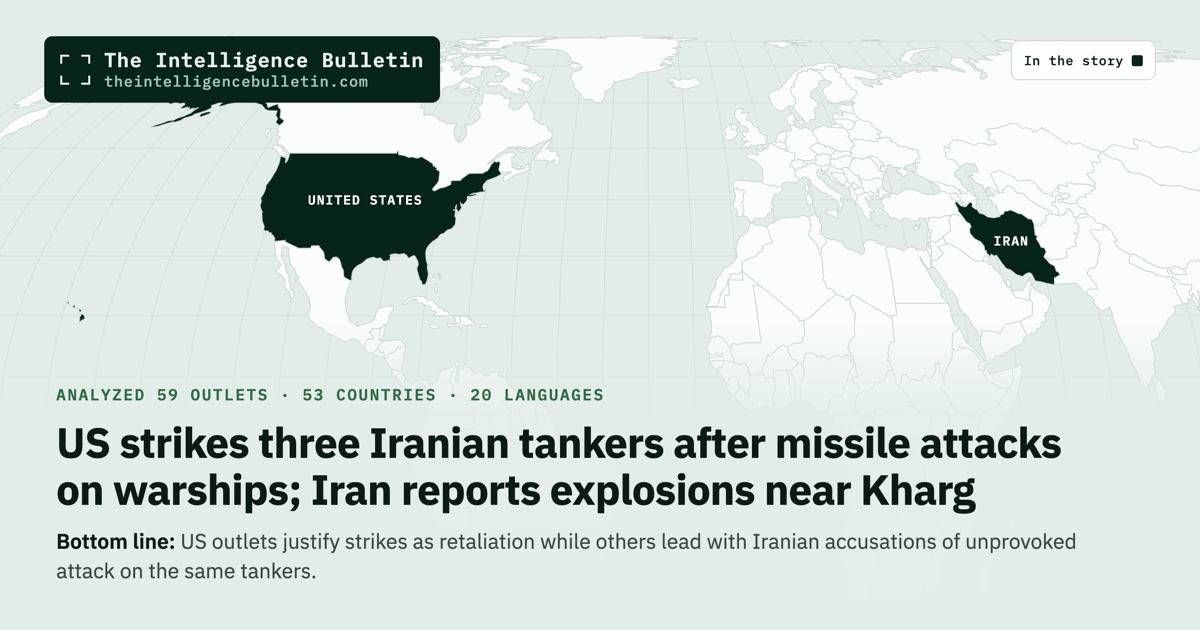
US outlets justify strikes as retaliation while others lead with Iranian accusations of unprovoked attack on the same tankers.
US-sourced reporting frames the strikes as precise retaliation that imposed an economic cost on Iran’s oil fleet after unprovoked missile launches, quoting Centcom commander Brad Cooper directly and naming specific vessels disabled or destroyed. Turkish and Argentine coverage instead leads with Iranian state media accounts of unexplained explosions and a tanker hit near Kharg Island, treating the US claim as one side in an unconfirmed exchange. Spanish reporting relays the detailed US account of multiple impacts on defenseless tankers belonging to a shadow network, while Pakistani headlines echo the destruction claim without additional sourcing. The selected outlets converge on the locations and the absence of immediate Iranian official confirmation yet split sharply on agency: US outlets present verified defensive action while others foreground Iranian accusations of aggression. This pattern shows how the same core facts—missile exchanges and tanker damage near a key export terminal—produce opposing narratives of justification versus escalation depending on the first reporting chain each outlet follows. The result leaves readers with corroborated locations and timing but conflicting attributions of who initiated the latest round.
Full analysis
US Central Command reported on September 5 that its forces had permanently disabled two Iranian oil tankers and completely destroyed a third after ballistic missiles were launched toward a US aircraft carrier and a guided-missile destroyer in the region. The command said the strikes occurred near Kharg Island, the Strait of Hormuz and the Gulf of Oman. It described the vessels as part of a multibillion-dollar shadow network that funds the Islamic Revolutionary Guard Corps and its proxies. Admiral Brad Cooper, the command’s leader, stated that the response imposed a higher economic cost on the Guard Corps by removing three of its tankers for every two ships targeted. No US personnel were harmed, the command said, and the strikes followed multiple attacks that US ships had successfully evaded.
Iranian state media outlets reported explosions near Kharg Island on the same day. The semi-official Tasnim agency, citing a correspondent near the island, said a tanker was struck by four US missiles about six miles from the coast at the island’s anchorage. It added that the crew was being evacuated and that no casualties had been reported. Other Iranian agencies, including Fars and Nournews, carried accounts of blasts heard in the area, though some noted the absence of visible smoke or confirmed the source. State-affiliated Nournews and the Asr Iran site described an Iranian tanker hit by projectiles and being unloaded. Iranian authorities issued no formal statement confirming or denying the US account of missile attacks on American warships.
Kharg Island serves as Iran’s main crude oil export terminal. Before the current conflict, it handled roughly 90 percent of the country’s crude shipments. Those exports have already faced disruption from a US naval blockade imposed in mid-April. The reported tanker strikes add direct pressure on that infrastructure at a moment when shipping through the Strait of Hormuz, which carries about one-fifth of global oil supply in normal times, remains contested.
The US account names three specific vessels: the M/T Downy near Kharg, the M/T Stark 1 near Jask, and the empty M/T Kylo, also known as Noxen, in the Gulf of Oman. It states that the tankers lacked defensive means and that multiple critical impacts rendered the third vessel inoperable after the crew was ordered to abandon ship. The command tied the action to the Guard Corps, saying the message was clear that attacks on two US ships would bring the removal of three Iranian ones.
Iranian reporting, by contrast, centers on the physical effects near Kharg without addressing the US claim of prior missile launches against American warships. Accounts from Tasnim and Fars describe the incident as an attack on a tanker or unexplained blasts, leaving the sequence of events open. No independent confirmation of either side’s version appears in the coverage examined.
US-sourced accounts, including the detailed Centcom statement carried by Yahoo News and relayed through Europa Press in La Tribuna de Toledo, present the strikes as a measured defensive response that targeted an economic asset tied directly to the Guard Corps. They quote Cooper on the economic cost and the decision not to hesitate in defending American forces. Spanish reporting adds operational specifics on the number of impacts and the order to abandon ship. ARY News headlines the destruction claim but carries little beyond the US military assertion.
Turkish and Argentine coverage reverses the emphasis. Daily Sabah opens with Iranian accusations of a US missile strike on a tanker near Kharg and details the reports from Tasnim and Fars on four projectiles and crew evacuation. It notes the lack of immediate US response to requests for comment and the absence of an official Iranian statement. Infobae similarly foregrounds Iranian state media descriptions of explosions near the island and a possible tanker attack, placing the event in the context of recent cross-strikes without endorsing the US retaliation narrative.
The outlets converge on the locations around Kharg Island and the timing on September 5. They also agree that Iranian authorities had not issued a formal response by the time of publication. They diverge on the initiating action. The US Central Command statement, carried in three of the five pieces, asserts that Iranian missiles targeted US warships first. Iranian media reports, carried in the other two, describe the tanker damage as the primary event without reference to prior attacks on American vessels. No source in the set reconciles the two sequences.
A reader limited to US-origin reporting would see a clear defensive strike against an adversary’s funding network. A reader limited to Iranian-state-media accounts would see an unprovoked attack on a commercial vessel near a key export hub. The shared facts—the three locations, the reported damage to tankers, and the lack of official Iranian confirmation—sit beneath both framings.
The retaliation claim rests on a single reporting chain from US Central Command. The account of explosions and possible tanker damage near Kharg rests on multiple Iranian agencies cited across Turkish and Argentine outlets. The physical outcome of strikes on three tankers appears in US military statements carried by three sources. Interests shape the presentation: the US account stresses protection of its forces and economic pressure on an adversary; Iranian media accounts stress the impact on an export facility without conceding prior provocation. Both sides have reason to present the sequence in ways that support their broader positions in the conflict.
What to Watch
The event tightens pressure on Iran’s oil exports at a time when global energy routes already face disruption. Further exchanges risk additional closures or blockades that would affect supply volumes measured in millions of barrels per day. The absence of an immediate official Iranian response in the reporting leaves open whether the next step will come through state channels or additional military or proxy action.
That’s how the world told the story.
Get our daily open-source intelligence on world events in your inbox — one email a day, up to six stories.
Subscribe freeNo spam. One-click unsubscribe. See the latest email →