 AI-generated analysis published under the editorial responsibility of Rohit Sinnas. How it works →
Press quoted
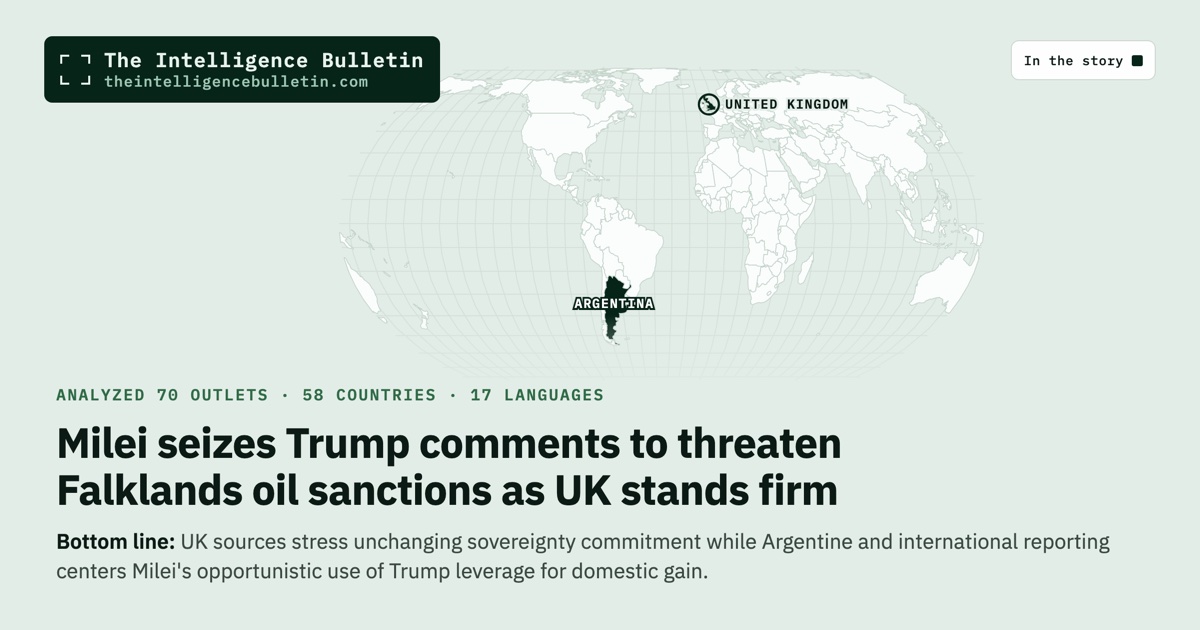
UK sources stress unchanging sovereignty commitment while Argentine and international reporting centers Milei’s opportunistic use of Trump leverage for domestic gain.
Reporting across outlets shows Milei’s speech as opportunistic timing rather than a fundamental policy shift, leveraging Trump’s personal grievance with Britain to advance Argentina’s sovereignty claim without altering his core alignment with Washington. The Guardian frames the episode as Trump using the Falklands as leverage for retribution against the UK over Iran, exposing British vulnerability in the special relationship. Argentine coverage in Ámbito details Milei’s strategic pivot to sanctions on the Sea Lion project and rejection of islander self-determination, presenting it as capitalizing on external pressure while maintaining domestic nationalist consensus. Al Jazeera and SCMP emphasize analysts’ view that Trump’s remarks originated as Pentagon leverage over UK defense spending, not a deliberate sovereignty reversal, yet provide Milei symbolic room to maneuver ahead of 2027 elections. Daily Maverick, relaying Reuters, highlights the economic focus on oil sanctions and London’s dismissal of the rhetoric as Argentine domestic politics. The consistent UK response across sources—that islanders determine their future—contrasts with Milei’s explicit invalidation of any referendum, revealing the core irreconcilable positions that external comments have not altered.
Full analysis
Milei delivered a nationally televised address on 4 September 2026 in which he announced new sanctions targeting companies involved in the Sea Lion offshore oil project and additional funding for a naval base in Tierra del Fuego. The project lies roughly 220 kilometres north of the Falkland Islands, known in Argentina as the Malvinas. Rockhopper Exploration of the United Kingdom holds a 35 percent stake and Israel’s Navitas Petroleum holds 65 percent. Drilling is scheduled to begin in coming months with first production targeted for 2028. Milei described any further advance on the islands as a violation of Argentine national security and said Argentina would not stand idly by.
He tied the measures directly to comments by US President Donald Trump. Trump told GB News that Britain had not supported the United States in its conflict with Iran and said he was reviewing every position, including the longstanding US stance on the islands. In a separate BBC interview Trump said the same. Milei presented the remarks as evidence that Washington now viewed Argentina as a reliable partner aligned with Western values and therefore open to reconsidering its position. He called the Malvinas a national cause that rises above partisan differences.
The United Kingdom responded within hours. Defence Secretary Wes Streeting stated that the commitment to the Falklands was absolute and unshakeable. A spokesperson for Prime Minister Andy Burnham said the islanders had the right to determine their own future and that the UK’s commitment remained unwavering. Both statements repeated the British position that the roughly 2,000 residents had chosen to remain a British overseas territory in a 2013 referendum.
The islands have been administered by Britain since 1833. Argentina maintains it inherited sovereignty from Spain in the nineteenth century. The two countries fought a 74-day war in 1982 after Argentine forces seized the territory. British forces retook the islands at a cost of 255 British and 649 Argentine lives. An uneasy peace followed, with Argentina never renouncing its claim.
Milei’s earlier public statements had been more measured. He had praised Margaret Thatcher, the British prime minister during the 1982 conflict, and had spoken of solutions that took account of the islanders’ wishes. In the September address he rejected self-determination for the islanders on the grounds that they constitute an implanted population and declared any referendum invalid. He also linked the renewed push to Argentina’s broader review of its southern maritime strategy, including concepts of deterrence and control of the South Atlantic.
Four of the five outlets that covered the speech reported the sanctions announcement and the naval-base funding in nearly identical terms. The Guardian placed the episode inside Trump’s pattern of personal grievances, noting his irritation that Britain had declined to send ships during the Iran conflict and framing the Falklands comments as potential leverage for higher UK defence spending. Ámbito described the speech as an upgrade in intensity that allowed Milei to harden the claim while preserving his alignment with Washington. Al Jazeera and the South China Morning Post both carried analyst assessments that the Pentagon had floated the idea of reviewing US support as bargaining pressure over NATO contributions rather than as a considered shift on sovereignty itself. The Daily Maverick, carrying Reuters copy, focused on the immediate market reaction: Rockhopper shares fell 8 percent on the day of the speech.
The accounts converge on the same sequence of public statements and on the unchanged British reply. They diverge on emphasis. The Guardian foregrounds the risk to the special relationship and to the new British government. Ámbito stresses the domestic political opening for Milei and the cross-party consensus that the sovereignty claim enjoys inside Argentina. Al Jazeera and the South China Morning Post treat the episode as a limited window created by personal alignment rather than a durable change in US policy. The Daily Maverick treats the sanctions and the stock reaction as the central development.
A reader who saw only the Guardian would conclude that Britain faces a genuine diplomatic squeeze from its closest ally. A reader who saw only Ámbito would conclude that Milei has successfully converted an external opening into a strengthened domestic position on a long-standing national issue. A reader who saw only the Al Jazeera or South China Morning Post pieces would conclude that the episode is largely symbolic and unlikely to alter the legal or military facts on the ground. The Daily Maverick piece would leave the impression that the story is chiefly about investment risk in the South Atlantic.
The evidence across the reporting chains points to the narrower reading. Every outlet that quoted the British response recorded the same language of unshakeable commitment and islander self-determination. No outlet reported any indication that the United States had altered its formal position or that Washington intended to do so. The sanctions themselves target companies and their suppliers; they cannot physically halt drilling already under contract. Rockhopper’s share-price reaction shows that investors registered the political signal, yet the project’s resource estimate of 1.7 billion barrels remains unchanged in the coverage.
What to Watch
The most probable near-term outcome is therefore continued diplomatic friction without material alteration of control or investment plans. Milei gains a visible nationalist credential that may help him with domestic audiences ahead of the 2027 election cycle. Britain faces no immediate requirement to negotiate because its legal and military position rests on the islanders’ expressed preference and on its own administration since 1833. The United States retains the option to treat the episode as one more item of personal leverage rather than a policy commitment. The South Atlantic dispute therefore remains what it has been since 1982: a frozen conflict whose temperature can be raised by external actors but whose underlying claims have not moved.
That’s how the world told the story.
Get our daily open-source intelligence on world events in your inbox — one email a day, up to six stories.
Subscribe freeNo spam. One-click unsubscribe. See the latest email →