 AI-generated analysis published under the editorial responsibility of Rohit Sinnas. How it works →
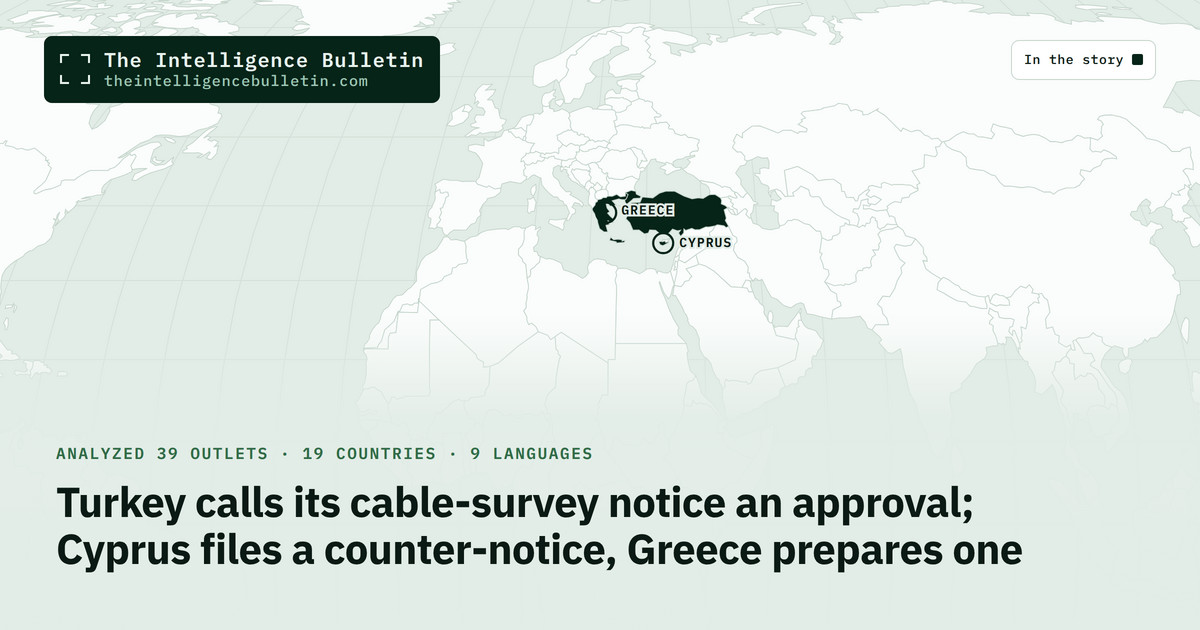
See the 19 countries
Afghanistan, Austria, Azerbaijan, Canada, Cyprus, Germany, Greece, India, Indonesia, Kenya, Libya, Nigeria, Pakistan, Romania, Switzerland, Syria, Turkey, Tuvalu, United States
Turkey’s 10 November NAVTEX asserts the Abeille Marengo survey runs on Turkish continental shelf with Ankara’s consent, which CNN Türk calls approval; Greece and Cyprus say no permit was requested and the notice has no legal effect, with Cyprus countering formally.
Across the press: CNN Türk calls Ankara’s notice a resolution; Naftemporiki and Cyprus Mail call it no legal consequence; only Cyprus Mail reports the formal anti-NAVTEX already filed.
Source base: 4 outlets read in full (Turkey, Greece, Cyprus, Albania), selected from 39 analyzed.
- 1 of 4 · Cyprus Mail onlyCyprus’s JRCC filed an anti-NAVTEX on Wednesday rejecting Turkey’s Navtex 352/26 as not coordinated with the Republic of Cyprus and declaring Larnaca the only approved station in its Navtex area.Cyprus Mail, citing the JRCC statement and the Cypriot government.
- 1 of 4 · Naftemporiki onlyGreece will follow with an appropriate response under international law to the Turkish NAVTEX.Naftemporiki, citing Greek Foreign Ministry circles.
- 4 of 4 · reported separatelyTurkey issued a NAVTEX on 10 November covering the Abeille Marengo’s survey from 10 November 2026 to 19 March 2027, asserting the work would take place in Turkey’s NAVTEX service area and continental shelf on routes coordinated with and approved by Turkish authorities.CNN Türk reports the issuance directly; Naftemporiki quotes the NAVTEX text; Cyprus Mail names it Navtex 352/26; 24 Ore reports it via Ekathimerini.
- 3 of 4 · reported separatelyThe Abeille Marengo sailed from Heraklion on the night of 10 November after Greece and Cyprus had issued their own NAVTEX permits, with Turkey’s naval notice published only afterwards.Naftemporiki reports Greek Foreign Ministry circles; Cyprus Mail quotes government spokesman Konstantinos Letymbiotis; 24 Ore notes the Turkish NAVTEX came hours after the ship departed and that Greek and Cypriot warnings preceded it.
- 3 of 4 · reported separatelyGreek and Cypriot officials say Turkey’s NAVTEX has no legal consequence because no request for permission was ever submitted to the Turkish side.Naftemporiki reports Greek Foreign Ministry circles; Cyprus Mail quotes Konstantinos Letymbiotis; CNN Türk reports the Greek Foreign Ministry called the Turkish NAVTEX unimportant.
- Within days of 11 November 2026Greece issues its formal counter-response to Turkey’s NAVTEX, testing whether Athens matches Nicosia’s filing.
- Through 19 March 2027The survey permit window runs its course, showing whether the work completes without the interruption Mitsotakis predicted.
- If Turkey disputes the counter-noticesWhether the Paris-Ankara diplomatic channel holds or the dispute moves from paper to sea.
Full analysis
What happened Why it matters How each country tells it Where accounts conflict Room for disagreement Our assessment Sources and evidence
What happened
On the night of 10 November 2026, the French survey vessel Abeille Marengo sailed from Heraklion, Crete, to begin charting the seabed for the Great Sea Interconnector, a submarine electricity cable that will link Cyprus to Greece’s grid, with an initial capacity of 1,000 megawatts. The ship had waited in port since 27 October and departed after Greece and Cyprus had each issued their own maritime permits for the survey. Hours later, Turkey issued its own notice — Navtex 352/26, covering the vessel’s work from 10 November 2026 to 19 March 2027. The Turkish notice asserted the research would take place in Turkey’s NAVTEX service area and on its continental shelf, along routes "coordinated with the competent Turkish authorities and for which the consent of the Turkish authorities has been obtained," Naftemporiki reports, quoting the text.
CNN Türk presents the notice as the untangling of a days-long "knot" between France, the project’s lead backer, and Turkey: with Ankara’s approval, the project’s uncertainty "is removed." In that account, the Greek Foreign Ministry emerges "relieved but anxious to tell its own public that Ankara’s permission was not obtained," and so called the notice unimportant.
Greece and Cyprus reject that reading. Greek Foreign Ministry circles, quoted by Naftemporiki, say Greece and Cyprus are the only countries to which any permit request was submitted, and the only ones that issued permits; the Turkish notice appeared only after the ship was at sea, and — the point they press — it "does not refer anywhere to the issuance of a permit, because there was no such request to the Turkish side." On Wednesday, Cyprus went further: its Search and Rescue Coordination Centre filed an anti-NAVTEX formally rejecting Navtex 352/26 as "not made in coordination with the competent authorities of the Republic of Cyprus," declaring Larnaca "the only approved station" in the Cypriot Navtex area, Cyprus Mail reports. Government spokesman Konstantinos Letymbiotis called the Turkish notice "of no consequence": only Greece and Cyprus received and granted permits, and the ship sailed under those, not the Turkish one. Greece has so far stopped short of a filing; its ministry says only that "the appropriate reaction of the Greek side under international law will follow," Naftemporiki reports.
The interconnector is 66 percent owned by France’s Meridiam and will carry electricity in both directions between Cyprus and continental Europe. 24 Ore, relaying Ekathimerini, reports Ankara had initially opposed the project, claiming parts of the eastern Mediterranean seabed as its own; Greece and Cyprus issued their warnings, Ankara responded with a counter-notice, and back-channel contacts between Paris and Ankara followed. CNN Türk likewise describes days of diplomacy concluding with the notice. Before it landed, Greek Prime Minister Kyriakos Mitsotakis said Tuesday he was optimistic the EU-funded project would finish without interruption, 24 Ore reports. The Abeille Marengo is expected to calibrate instruments, then run a research operation of several weeks, 24 Ore reports; CNN Türk says the ship left "for test purposes" and was expected to begin work off the island of Kasos within about a day.
Why it matters
The dispute is not really about a ship’s itinerary but about which state may authorize research on the seabed the cable will cross — a proxy for the larger contested boundary in the eastern Mediterranean. Turkey’s notice invokes its continental shelf as notified to the United Nations in March 2020; Greece and Cyprus call that an illegal claim. By stating the survey proceeds on Turkish-approved routes, Ankara asserts jurisdiction over part of the cable’s path without physically blocking it — a marker for future negotiations and delimitation. For Cyprus, the stakes are direct: the cable promises to end the island’s electrical isolation. 24 Ore’s account adds the EU dimension — the project is funded by the European Union — and Mitsotakis’s optimism that day signals Athens is betting the cable’s momentum carries it through. Naftemporiki frames the Turkish notice as a "provocative" revival of illegal claims, placing the exchange inside the longer pattern of Aegean notice wars; CNN Türk frames it as the settlement, with Greek objections reduced to domestic politics. What all four accounts agree on is the practical bottom line: the survey is proceeding.
How each country tells it
- CNN Türk · Turkey · original reportingFrames Ankara’s new NAVTEX as the resolution of a cable ‘knot’ and a lawful Turkish approval of the survey, with Greek objections dismissed as domestic political anxiety.
- Naftemporiki · Greece · original reportingTreats Turkey’s NAVTEX as a provocative revival of illegal continental-shelf claims, quotes the notice’s own text to show it never mentions granting a permit, and relays Greek Foreign Ministry circles saying the notice has no legal consequence.
- Cyprus Mail · Cyprus · original reportingReports that Cyprus’s JRCC has filed an anti-NAVTEX rejecting Turkey’s notice, and quotes government spokesman Konstantinos Letymbiotis that Turkey’s NAVTEX is ‘of no consequence’ because only Greece and Cyprus received and granted permit requests.
- 24 Ore · Albania · carries EkathimeriniRelays that Turkish authorities issued a NAVTEX approving the Abeille Marengo’s work, while also noting Ankara’s earlier opposition and back-channel Paris-Ankara contacts, and foregrounding the EU-funded project’s ownership and capacity.
Where accounts conflict
One substantive point divides the reporting. CNN Türk reports Ankara’s notice is an approval that resolved the standoff; Naftemporiki and Cyprus Mail report it has no legal consequence, because it never mentions a permit and because no request for one was ever made to Turkey. Both readings rest on the same text. CNN Türk’s rests on the notice’s own assertion that the survey runs on routes coordinated with and approved by Turkish authorities, and on the Franco-Turkish diplomacy it says preceded publication. The Greek and Cypriot accounts rest on the sequence — the ship sailed under Greek and Cypriot warnings before Turkey’s notice appeared — and on the wording Naftemporiki quotes, which never uses the word "permit." The camps are not describing different events; they are assigning opposite legal meanings to the same document. A second difference in emphasis: only CNN Türk and 24 Ore report the Paris-Ankara contacts; Naftemporiki and Cyprus Mail make no mention of them, their accounts resting on the legal rebuttal alone.
Room for disagreement
The strongest case that this escalates rather than settles comes from the Greek and Cypriot framing and from what Cyprus has already done. Naftemporiki calls the notice a "provocative" revival of illegal claims; Cyprus Mail documents that Nicosia has moved beyond words to a formal counter-filing. Greece’s ministry says its reaction "will follow" — a promise not yet kept, which could signal a matching legal move being drafted. If Athens files, three states will be formally contesting the same stretch of sea, and the predictable next act is the one both Naftemporiki’s framing and the region’s recent history point to: notice met by counter-notice, sovereignty claims met by naval presence, NATO allies tested. Ankara has placed a jurisdictional marker it cannot easily withdraw; if it later treats the Greek and Cypriot rejections as defiance of that marker, the "knot" CNN Türk declares resolved could tighten once the ship is on station. The ship is at sea now; diplomacy has produced a notice, not an agreement Greece or Cyprus recognizes.
Our assessment
It is very likely the Abeille Marengo completes its survey without physical interruption, while the legal contest continues and Greece in time files the counter-notice its ministry has promised. The warrant is the convergence of the reported facts rather than the framing: all four accounts confirm the ship sailed under Greek and Cypriot permits before Turkey’s notice appeared, all four confirm no permit request ever reached Ankara, and the Turkish notice itself — as quoted by Naftemporiki — describes the work as proceeding on routes with Turkish "coordination" and "consent," not as blocked or conditional. A state intending to stop the survey does not publish a notice describing it as already consented to; a state intending to record a jurisdiction claim does exactly that. Cyprus’s anti-NAVTEX is the concrete escalation on the other side, and Naftemporiki’s report that Greece’s response "will follow" hands Athens the next move. The outlets with an interest in settlement — CNN Türk and, via Ekathimerini, 24 Ore — note the Paris-Ankara contacts and Mitsotakis’s optimism; the outlets with an interest in resistance — Naftemporiki and Cyprus Mail — note the legal rebuttal and, in Cyprus’s case, the filing.
What would change this: if Turkey’s navy moves to enforce the claimed shelf by shadowing or intercepting the Abeille Marengo, the survey would become a physical confrontation and this call would shift accordingly.
Sources and evidence
Press quoted
- Has Greece actually issued its own counter-NAVTEX, and what does it say, given Naftemporiki reports only that an appropriate reaction ‘will follow’ while Cyprus has already filed one?
- Do the coordinates in Turkey’s NAVTEX overlap with the Greek and Cypriot-licensed survey route, or do they cover a separate area, since none of the articles publish the coordinates?
- What exactly did the back-channel contacts between Paris and Ankara produce, and has any Turkish official or the French operator confirmed that Turkey’s consent was requested or granted?
That’s how the world told the story.
Get our daily open-source intelligence on world events in your inbox — one email a day, up to six stories.
Subscribe freeNo spam. One-click unsubscribe. See the latest email →