 AI-generated analysis published under the editorial responsibility of Rohit Sinnas. How it works →
See the 63 countries
Afghanistan, Albania, Armenia, Australia, Azerbaijan, Bangladesh, Belarus, Belgium, Bosnia and Herzegovina, Bulgaria, Canada, Croatia, Cyprus, Czech Republic, Denmark, Egypt, Estonia, Finland, Germany, Greece, India, Ireland, Israel, Italy, Japan, Kazakhstan, Kyrgyzstan, Latvia, Lebanon, Lithuania, Macedonia, Malawi, Moldova, Montenegro, Nigeria, Norway, Oman, Pakistan, Philippines, Poland, Qatar, Romania, Russia, Saudi Arabia, Senegal, Serbia, Singapore, Slovakia, Somalia, South Africa, South Korea, Spain, Sri Lanka, Sweden, Switzerland, Taiwan, Turkey, Tuvalu, Uganda, Ukraine, United Arab Emirates, United Kingdom, United States
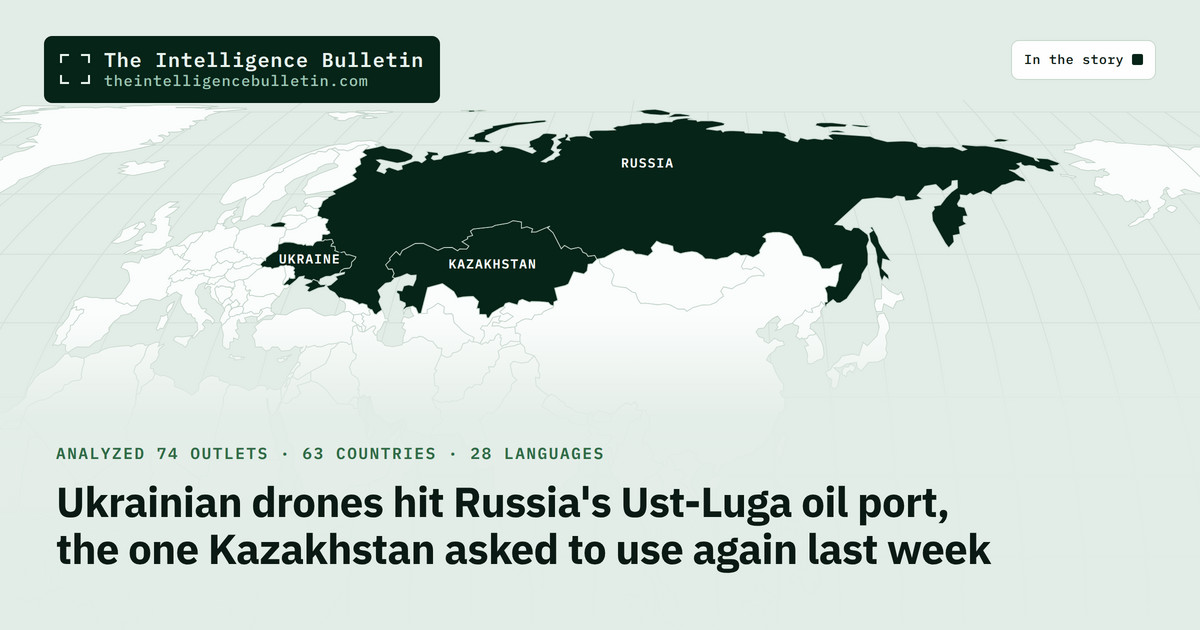
Ukrainian drones set Ust-Luga port alight overnight, Leningrad Governor Drozdenko says, wounding three workers and downing a substation; St. Petersburg’s Pulkovo airport briefly closed. The port ships Russian crude — and Kazakhstan had asked Russia six days earlier to resume its own.
Across the press: Ukraine’s UNIAN omits Drozdenko’s three wounded workers; Russia’s AiF omits the oil exports; the Kazakh oil request appears only in Ak Zhayik.
Source base: 5 outlets quoted (Russia, Ukraine, Kazakhstan, Estonia, Turkey), selected from 74 analyzed. 4 read in full, 1 by its headline only.
- 5 of 5 · reported separatelyUkrainian drones attacked the port of Ust-Luga in Leningrad region overnight into November 11, causing a fire in the port zone.Drozdenko via Argumenty i Fakty, UNIAN and Evrensel; Ak Zhayik relays RBK-Ukraine and eyewitness video; Postimees reports it in its war blog.
- 2 of 5 · reported separatelyThree port workers were injured in the Ust-Luga strike, with no threat to their lives.Governor Drozdenko, reported by Argumenty i Fakty and Evrensel.
- 3 of 5 · reported separatelyA transformer substation in Ust-Luga was knocked offline in the attack.Drozdenko, reported by Argumenty i Fakty, UNIAN and Evrensel.
- 4 of 5 · reported separatelySt. Petersburg’s Pulkovo airport temporarily suspended arrivals and departures because of the drone threat, then resumed operations later in the morning.Rosaviatsiya, reported by Argumenty i Fakty, UNIAN, Ak Zhayik and Evrensel.
- 3 of 5 · reported separatelyUst-Luga is a major Russian export port for oil, oil products and other raw materials, and Kazakhstan previously shipped crude through it.UNIAN’s background note, Evrensel’s overview and Ak Zhayik’s account of Kazakh shipments.
- As damage assessment completesDrozdenko or the port operator releases the damage and operational-impact report; it will show whether loading infrastructure was touched.
- Any dayRussia’s energy ministry answers Kazakhstan’s November 5 letter on resuming Druzhba transit and Ust-Luga loadings; a yes would signal the fire changed nothing commercially.
- Within weeksWhether Ukrainian drones strike Ust-Luga or a Baltic neighbor again tests whether the port is inside the strike campaign or was a one-off.
- Still openWhat is the true death toll and number of people still trapped in Komyshuvakha, given the selected sources report 26, 29, 33 or 37 dead and 27, 38 or more than 50 missing? · How does this barrage alter the Nov. 10-11 Abu Dhabi talks, and have Washington or Moscow linked the strikes to negotiation leverage?
Full analysis
What happened Why it matters How each country tells it Room for disagreement Our assessment Sources and evidence
What happened
Shortly after midnight on November 11, Ukrainian drones reached Ust-Luga, a Russian port on the Baltic Sea coast of Leningrad region, and set parts of the port zone alight. At around 00:30 the region declared a drone-danger regime, and Governor Alexander Drozdenko spent the night updating a running tally on Telegram: 42 drones shot down by 01:51, 92 by 02:52, 141 by 04:50, 146 by 05:36, and a preliminary 150 at his 07:22 all-clear — the figure Argumenty i Fakty and Turkey’s Evrensel both carried. Ukraine’s UNIAN and Kazakhstan’s Ak Zhayik, publishing earlier snapshots of the governor’s feed, carried 42 and 92 respectively.
The target, Drozdenko said, was the port zone in the settlement of Ust-Luga, in Kingisepp district. Several drones struck home and started a fire, and three port workers were injured, with no threat to their lives, the governor reported — a detail carried by Argumenty i Fakty and Evrensel and absent from UNIAN’s account. A transformer substation in Ust-Luga was knocked offline, the governor added, according to all three outlets.
The fire was large enough to be seen from afar. Ukrainian monitoring channels described a blaze visible for tens of kilometers, UNIAN reported, and NASA’s FIRMS satellite service recorded heat hotspots in the port and in the water area. Ak Zhayik relayed RBK-Ukraine and eyewitness video showing a strong glow over what was presumed to be port infrastructure, with monitoring channels reporting possible hits on oil-terminal facilities; there was no official confirmation of the damage’s scale.
The drone threat also reached St. Petersburg’s airspace. At 00:47, Russia’s federal aviation agency Rosaviatsiya said Pulkovo airport was neither receiving nor releasing flights. Two aircraft bound for St. Petersburg diverted to Helsinki, according to UNIAN. By 07:13 the airport was operating under coordination with the authorities, and at 07:27 the temporary restrictions were fully lifted, Argumenty i Fakty reported.
Fire crews responded and damage assessment was continuing, Evrensel noted; no detailed statement on the fire’s effect on port operations or shipments had been made by the time the outlets published.
Ust-Luga is one of Russia’s largest export ports on the Baltic, shipping oil, oil products, coal, fertilizers and other cargo, and sits under Western sanctions for its role in moving Russian crude, UNIAN’s background note and Evrensel’s overview both state. For Kazakhstan, the port is more than Russian infrastructure: Ak Zhayik reports that in April 2026 Kazakhstan’s energy ministry planned to redirect 100,000 tonnes of crude to Ust-Luga after restrictions on the Druzhba pipeline; those shipments were suspended from May on Russian technical grounds; and on November 5, six days before the drones arrived, the ministry said it had written to Russia’s energy ministry asking to resume Druzhba transit and Ust-Luga loadings, and was awaiting Moscow’s reply. Meanwhile the volumes ran through the Caspian Pipeline Consortium, Ak Zhayik adds.
Estonia’s Postimees, whose border sits close to the port, led its 1,722nd-day war blog with the proximity: a massive fire in the Ust-Luga port located next to Estonia.
Why it matters
The strike puts a seaborne export chokepoint inside a war that has already ranged across refineries, depots and airfields. Ust-Luga is not one more storage fire: it is one of the ports through which Russian crude and oil products reach the world market, and Ukrainian drones that reach it change the risk calculation for every tanker and insurer touching the Russian Baltic. Evrensel states the point directly — the attack matters for the security of Russia’s exports and energy shipments through the Baltic — while no selected source reports the port’s operations as uninterrupted, only that damage assessment was continuing.
The timing also lands on a live commercial question. Kazakhstan had asked Russia, six days before the drones arrived, to resume its own crude loadings through Ust-Luga; the request sat unanswered. A fire at the port makes resumption harder to schedule and easier to delay, and gives Astana a reason to keep volumes on the Caspian Pipeline Consortium route.
The Pulkovo closure shows the cost beyond the target: Russia’s second city briefly stopped receiving and releasing flights while air defenses handled the inbound drones.
How each country tells it
- Argumenty i Fakty · Russia · original reportingTreats the strike as a regional Russian emergency to be managed, reporting the port fire, substation outage and three wounded through Governor Alexander Drozdenko’s rolling Telegram updates and Rosaviatsiya’s Pulkovo closures, with no mention of the port’s export importance.
- UNIAN · Ukraine · original reportingFrames the fire as proof of a successful Ukrainian drone strike on a strategically important, Western-sanctioned Russian oil-export port, adding NASA FIRMS hotspot evidence and background on what the port ships.
- Ak Zhayik · Kazakhstan · original reportingReads the attack through Kazakhstan’s own stake in Ust-Luga, noting that the port previously exported Kazakh crude and that Astana had asked Russia only days earlier to resume Druzhba transit and loadings there.
- Postimees · Estonia · original reportingFrames the strike in its rolling 1,722nd-day war blog as a massive fire in a port located next to Estonia, making proximity and Baltic security the lede.
- Evrensel · Turkey · original reportingReports the attack straightforwardly as an act of war with human cost, stating the UAVs came from Ukraine, leading with the three wounded, and then discussing the port’s role in Russian energy exports.
Room for disagreement
The strongest case against reading Ust-Luga as newly opened and its Baltic exports as newly vulnerable is that the strike’s yield looks thin. Every casualty and damage figure comes from Governor Drozdenko, the official whose job is to show the region coping: three workers hurt, none at risk of life; one substation offline; a fire already being handled by crews. Ak Zhayik records that there was no official confirmation of the damage’s scale, and Evrensel notes that no statement had been made on the effect on port operations or shipments. If the fire touched storage or office areas rather than loading infrastructure, the port can resume exports as soon as power is restored.
The claimed interception count reinforces the case. Russia’s air defenses say they shot down 150 drones over the region, which suggests most of the attacking force never reached its target; if that is right, the strike was largely defeated rather than a newly useful capability.
Our assessment
Ukraine’s strike on Ust-Luga is very likely the first of a repeated pattern against Russia’s Baltic export ports rather than a one-off, and the strategic effect is real even though the reported damage this time appears limited.
The warrant is corroboration across independent reporting chains: UNIAN, Evrensel and AiF record the same attack, the same fire, the same substation and the same governor’s account, differing only in which snapshot of his rolling drone count they carried and what each chose to foreground. What UNIAN frames as a strike on a strategic, sanctioned oil-export port, Evrensel frames as a threat to the security of Russia’s Baltic energy shipments, and AiF frames as a regional emergency under control; together they describe a hit that landed on the export system’s periphery and announced that the system itself is now in range. Drozdenko, a regional governor, wants the incident to look managed; UNIAN, reporting its own military’s hit, wants it to look strategic.
The Kazakh stake, reported only by Ak Zhayik, adds a third interested party: Astana’s unanswered request to resume Ust-Luga loadings is, in practice, suspended by a fire rather than answered by Moscow. The near-term change to expect is not a halt to Russian exports — the reported damage does not support that — but a rise in the cost of insuring and scheduling them, and a longer silence on the Kazakh request.
What would change this: a resumed Kazakh loading schedule at Ust-Luga, agreed by Moscow, would show the strike changed nothing about the port’s export function — and that answer would move this call more than any further drone footage would.
Sources and evidence
Press quoted
- What exactly was hit inside Ust-Luga, and has any loading or export operation been interrupted?
- Why do the selected accounts carry different drone-interception totals of 42, 92 and 150, and which is the final confirmed overnight count for Leningrad region?
- Has Kazakhstan’s request to resume its own oil shipments through Ust-Luga been affected by the damage, or could it now be reconsidered by either side?
That’s how the world told the story.
Get our daily open-source intelligence on world events in your inbox — one email a day, up to six stories.
Subscribe freeNo spam. One-click unsubscribe. See the latest email →