One Story. Many Angles.
Chinese accounts stress strategic cooperation while US and Taiwanese ones emphasize empty pageantry and security risks.
The reporting across these outlets reveals that the summit produced more visible ceremony than concrete agreements, yet each national lens extracted a different meaning from the same events. Chinese state-linked coverage presented the meetings as delivering new strategic guidance and a foundation for future cooperation, particularly on AI where Xi urged leveraging strengths rather than competition. Indian reporting echoed the forward-looking AI element while noting Trump’s description of the talks as very productive. In contrast, the US critical outlet dismissed the entire affair as pomp without circumstance, highlighting the absence of deliverables on trade, Iran oil purchases or Taiwan. The Australian analysis read subtle Chinese advantage in Xi’s framing and gift-giving that placed Trump on the defensive in a geopolitical contest. Taiwan’s account centered the visit’s immediate implications for its security, treating the red-carpet treatment as a distraction from unresolved tensions. What unites the accounts is the shared recognition that dialogue continued without resolving core disputes; what divides them is whether that continuation itself constitutes progress or merely delays reckoning.
Perspective Analysis
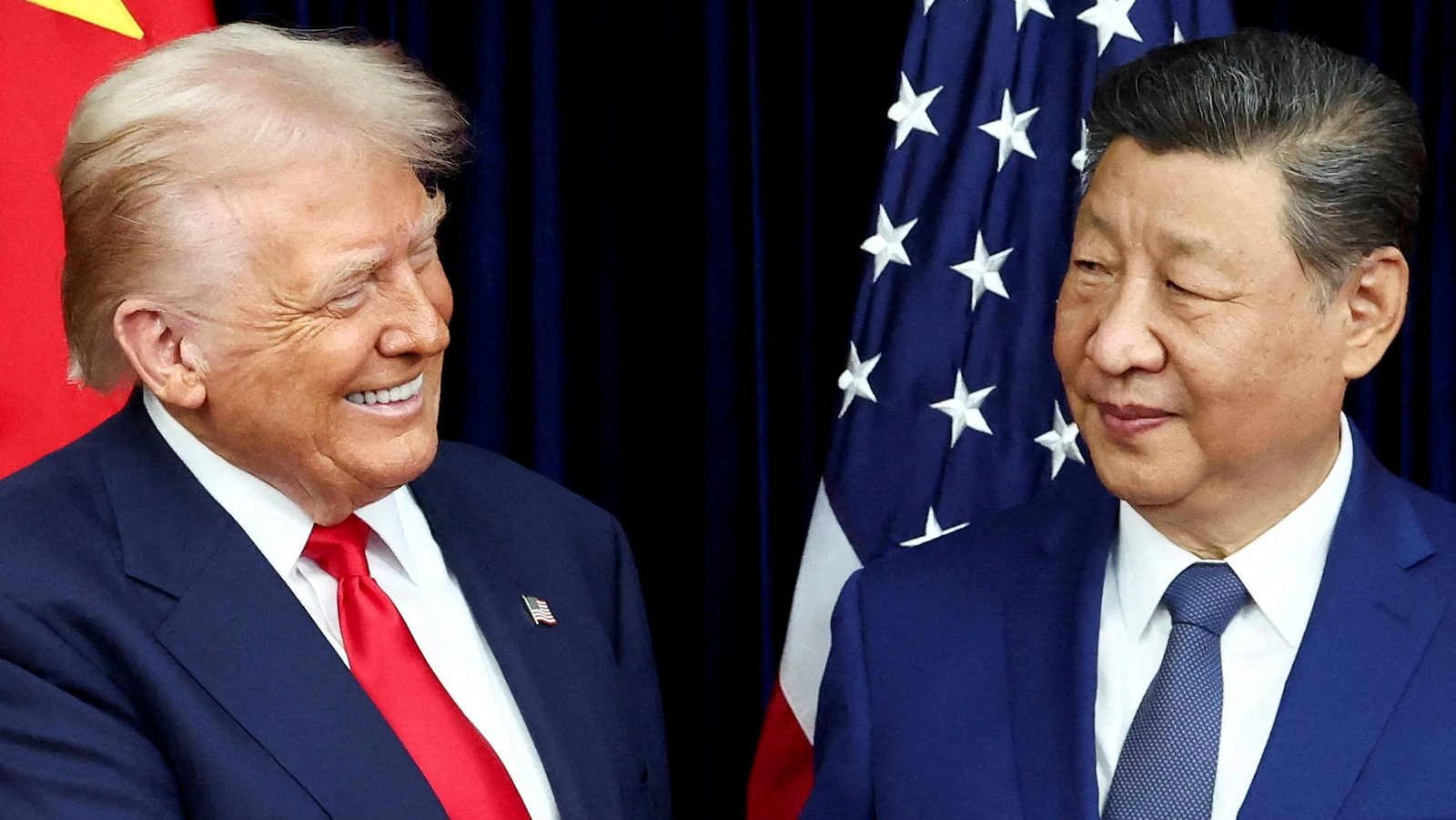
US President Donald Trump hosted Chinese President Xi Jinping for a three-day state visit that ended on September 25, 2026, in Washington. The schedule included a formal arrival ceremony on the South Lawn featuring 479 military personnel, national anthems, a military review, and a flyover by a B-2 bomber and four F-22 Raptors. The two leaders met behind closed doors for 90 minutes, attended a black-tie state dinner with technology executives including Nvidia’s Jensen Huang and Tesla’s Elon Musk, and toured the National Archives to examine the Declaration of Independence and the Constitution. Xi and his wife Peng Liyuan also visited the Smithsonian’s National Museum of Asian Art with Melania Trump. At the welcome ceremony Xi announced that two giant pandas, Ping Ping and Fu Shuang, would arrive at Zoo Atlanta and that China would host 100,000 American students on exchange programs over the next five years. The leaders agreed to extend an existing trade arrangement by two months. No further substantive trade deals were announced.
Trump posted on Truth Social that the meeting had been “very productive” and that Xi appeared receptive to rebranding artificial intelligence as “super intelligence.” Xi stated at the state dinner that the two countries should treat cooperation as the mainstay of their relationship while managing competition and differences, and he called for keeping AI under human control to serve human progress. Chinese state-linked reporting described the exchanges as adding new substance to a constructive relationship of strategic stability and providing fresh strategic guidance for future ties. Indian coverage noted both Trump’s positive assessment and Xi’s emphasis on AI cooperation as the forward element. American critical reporting observed that the visit produced no concrete movement on Chinese oil purchases from Iran or on Taiwan, and described the rebranding remark as the single laughable takeaway from an otherwise ceremonial affair. Australian analysis interpreted Xi’s gift presentation and framing as a subtle geopolitical dig that positioned Trump defensively in a contest of narratives. Taiwanese reporting framed the red-carpet treatment as heavy on pomp and light on substance, with direct implications for Taiwan’s security position amid unresolved tensions.
The closed-door talks covered the Middle East, Ukraine, and the Korean Peninsula according to the official Chinese readout, though the White House released no parallel account of the substance. Press questions shouted on the South Lawn about halting Chinese oil purchases from Iran received no on-the-record reply from Trump. The state dinner menu and decor incorporated red elements noted for their cultural significance in China, and performances included an opera tenor favored by Trump. Earlier in the visit Trump had shown Xi a personal copy of the Declaration of Independence kept in the Oval Office and a new 30-meter granite helicopter landing pad on White House grounds. Xi recalled historical exchanges including Ping-Pong diplomacy and wartime cooperation against Japanese forces, while Trump spoke of enduring people-to-people ties despite differing systems.
Accounts diverge most clearly on whether the continuation of high-level contact itself constitutes measurable progress. Chinese state-linked coverage treats the rapid sequence of reciprocal state visits within six months as historic in itself and as evidence that the two largest economies can maintain harmony while competing. Indian reporting extracts the AI discussion as the element carrying wider global relevance. American critical coverage treats the same sequence as pageantry without deliverables, noting that an existing trade truce was merely prolonged rather than expanded and that core disputes on Iran and Taiwan remained untouched. Australian analysis reads the same ceremonies as evidence that Xi advanced a strategic narrative advantage through calibrated gestures. Taiwanese coverage centers the absence of any shift in Washington’s posture on Taiwan independence or arms sales as the operative outcome for an affected party.
A reader limited to one national lens would therefore miss the shared factual spine that no major breakthroughs occurred on trade, Taiwan independence, or Chinese oil purchases from Iran, while receiving sharply different interpretations of what the absence of those breakthroughs means. The Chinese account presents ongoing dialogue as the headline achievement. The American and Australian accounts present the same dialogue as insufficient to alter competitive realities. The Taiwanese account presents it as a potential distraction from security risks. The Indian account isolates the AI element as the one area where both sides signaled possible future coordination.
What to Watch
The accounts that stress limited substance align most closely with the record because three independent reporting chains, from the United States, Australia, and Taiwan, each document the same narrow set of outcomes: a two-month trade extension, student and panda exchanges, and an AI terminology suggestion from Trump. Chinese state-linked reporting, drawn from official readouts, has an institutional interest in framing the visit as advancing strategic stability. American critical coverage has an interest in highlighting the gap between ceremony and results under the current administration. Taiwanese coverage has an interest in foregrounding any development that could affect its security margin. Australian analysis benefits from distance that allows emphasis on power dynamics over immediate domestic stakes. The corroborated absence of breakthroughs on the three core issues means the next phase of engagement will likely consist of continued technical consultations on trade and technology rather than a decisive reset, leaving supply-chain and tech-competition pressures intact for global markets.
That’s how the world told the story.
Get tomorrow’s bulletin by email — one briefing, up to six stories.
Subscribe freeNo spam. One-click unsubscribe. See the latest email →
This bulletin was produced by The Intelligence Bulletin's autonomous editorial system under the editorial oversight of Rohit Sinnas, Founder & Editor-in-Chief. How it works →