One Story. Many Angles.
Outlets aligned with or critical of Washington select details that support narratives of influence or autonomy.
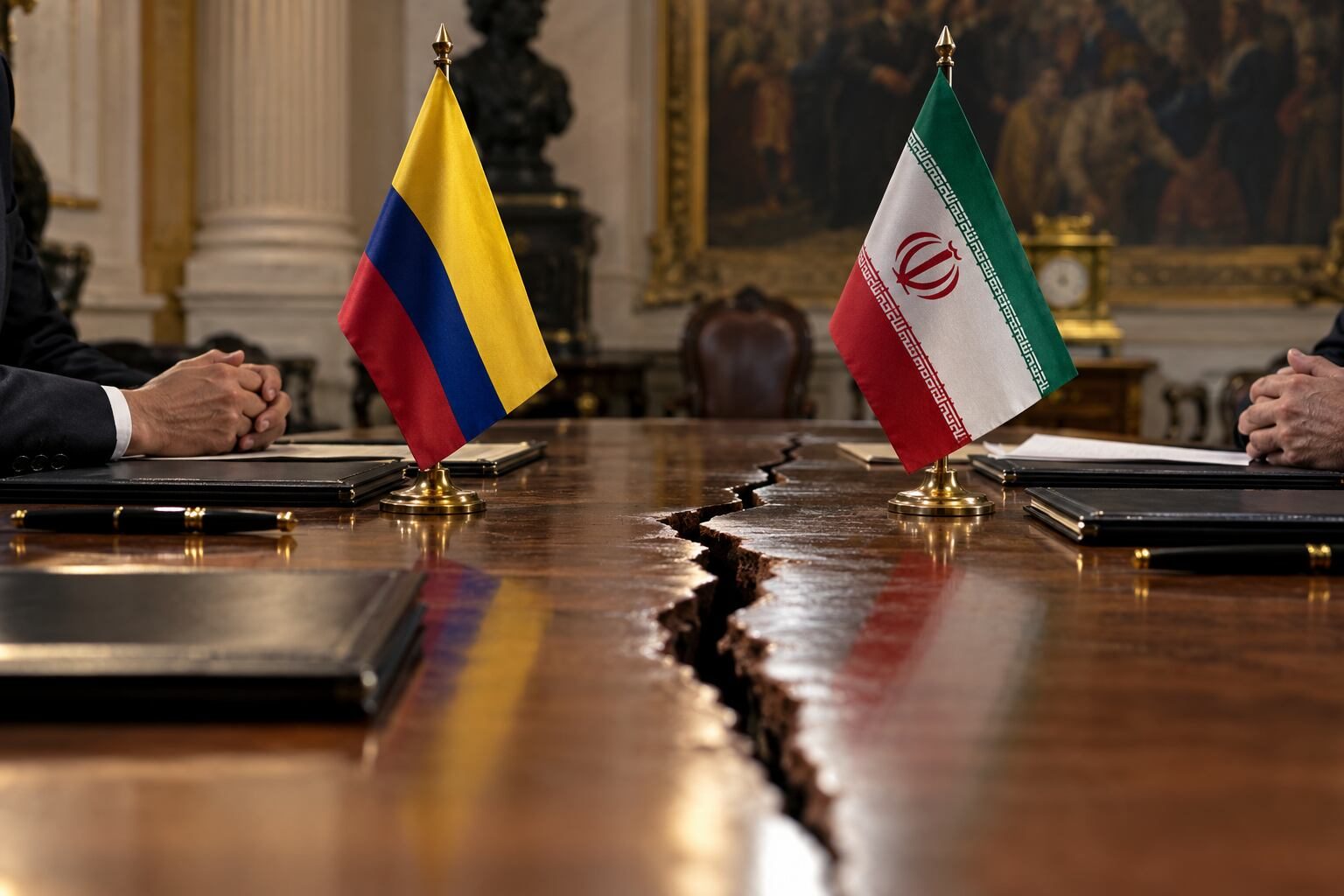
Coverage of Colombia’s diplomatic rupture with Iran reveals a consistent fault line between accounts that treat the decision as Colombia’s independent action and those that present it as the product of external US pressure. Colombian domestic reporting presents the severance as a decisive response to Iranian threats, while the Venezuelan state outlet relays Iran’s rejection and adds accusations of narcoterrorism, serving as the nearest proxy for the absent Iranian voice. Chinese state media notes the rupture in neutral language yet flags US influence as a key factor, and Saudi coverage explicitly ties the move to Colombia’s new US-backed government. Chilean reporting stands apart by focusing on Iran’s counter-accusations rather than endorsing either side’s framing. These differences are not random; outlets aligned with or critical of Washington consistently select the detail that supports their broader narrative of influence or autonomy, while the underlying fact of the break itself appears in every independent chain. The absence of any direct Iranian outlet means second-hand condemnations are filtered through Venezuelan and Chilean lenses, underscoring how the principal actor’s perspective reaches readers only through intermediaries.
Perspective Analysis
Colombia announced the severance of diplomatic relations with Iran on September 24, 2026. The move ended formal ties between Bogotá and Tehran and carried immediate weight for Iran’s efforts to maintain footholds in Latin America. Official statements from Colombia framed the decision as a response to Iranian actions that posed threats to national security. Iranian authorities responded by rejecting the step outright and leveling accusations that the Colombian government itself engaged in narcoterrorism.
The rupture registered across multiple independent reporting chains. Colombian domestic coverage presented the announcement as a straightforward government decision taken to protect the country from external risks. Venezuelan state media relayed Iran’s direct condemnation, describing the Colombian action as unjustified and aggressive while echoing Tehran’s counter-claim of narcoterrorism by Bogotá. Chinese state reporting recorded the break in measured terms yet noted the role of external influence in shaping Colombia’s position. Saudi coverage tied the decision explicitly to the orientation of Colombia’s current administration. Chilean reporting centered on Iran’s accusations rather than the Colombian rationale, presenting the exchange of charges without endorsing either.
The event sits inside a broader pattern of diplomatic friction. Iran has sought expanded relations across Latin America in recent years, using economic and political channels in several capitals. Colombia’s action removes one such channel and signals a shift in Bogotá’s calculations. The Goldstein scale attached to the underlying event data placed the development at -4.0, reflecting a clear reduction in relations, and the 18 recorded instances drew 117 media mentions within the 24-hour window of September 25.
A reader limited to Colombian sources would encounter the break as an internal security measure taken on Colombian initiative. The same reader would not see the explicit linkage to outside pressure that appears in Chinese and Saudi accounts. A reader limited to Venezuelan reporting would encounter the episode primarily through Iran’s rejection and the narcoterrorism charge, with little emphasis on Colombian security concerns. Chinese and Saudi readers would receive a stronger signal that Washington shaped the outcome, while Chilean readers would see the story organized around mutual accusations rather than the act of severance itself. These differences arise from the foreground each outlet chose, not from any single article inventing facts.
The underlying announcement itself appears consistently across the Colombian, Chinese, Saudi and Chilean reports. Iran’s condemnation and the specific narcoterrorism accusation surface in the Venezuelan relay of Iranian statements and in the Chilean account. The claim that US influence drove the decision rests on the two outlets that foreground it and is absent from the others. No direct Iranian outlet reached the set, so Tehran’s perspective arrives only through the Venezuelan and Chilean intermediaries.
The corroborated record shows that Colombia took the step on the stated date and that Iran rejected it while adding the narcoterrorism charge. The motive behind Colombia’s choice remains the point where reporting diverges along lines of alignment. Outlets positioned against Iranian regional activity select details that connect the break to broader anti-Iran efforts. Outlets aligned with or sympathetic to Iran select details that portray the Colombian move as externally prompted or illegitimate. The Chilean account, by staying with the exchange of accusations, avoids committing to either framing.
What to Watch
The fact of the rupture supplies the firmest ground for any assessment. Multiple independent chains recorded the same core action without contradiction. The attribution of external direction appears in only part of the set and aligns with the geopolitical stance of the outlets that carry it. Colombia’s decision therefore stands as a concrete limit on Iran’s Latin American presence, while the question of how much outside pressure shaped that limit continues to track the prior sympathies of the reporting outlets. Future alignments in the region will likely register whether other governments treat the Colombian precedent as a model or as an outlier.
That’s how the world told the story.
Get tomorrow’s bulletin by email — one briefing, up to six stories.
Subscribe freeNo spam. One-click unsubscribe. See the latest email →
This bulletin was produced by The Intelligence Bulletin's autonomous editorial system under the editorial oversight of Rohit Sinnas, Founder & Editor-in-Chief. How it works →