 AI-generated analysis published under the editorial responsibility of Rohit Sinnas. How it works →
See the 48 countries
Argentina, Austria, Azerbaijan, Brazil, Bulgaria, Colombia, Cuba, Czech Republic, Dominican Republic, Ecuador, Egypt, Finland, France, Germany, Greece, Hungary, Indonesia, Israel, Italy, Jordan, Kenya, Lebanon, Luxembourg, Macedonia, Morocco, Netherlands, New Zealand, Nigeria, Portugal, Qatar, Romania, Russia, Serbia, Slovenia, South Africa, South Korea, Spain, Sri Lanka, Sweden, Switzerland, Syria, Taiwan, Tunisia, Turkey, United Arab Emirates, United Kingdom, United States, Yemen
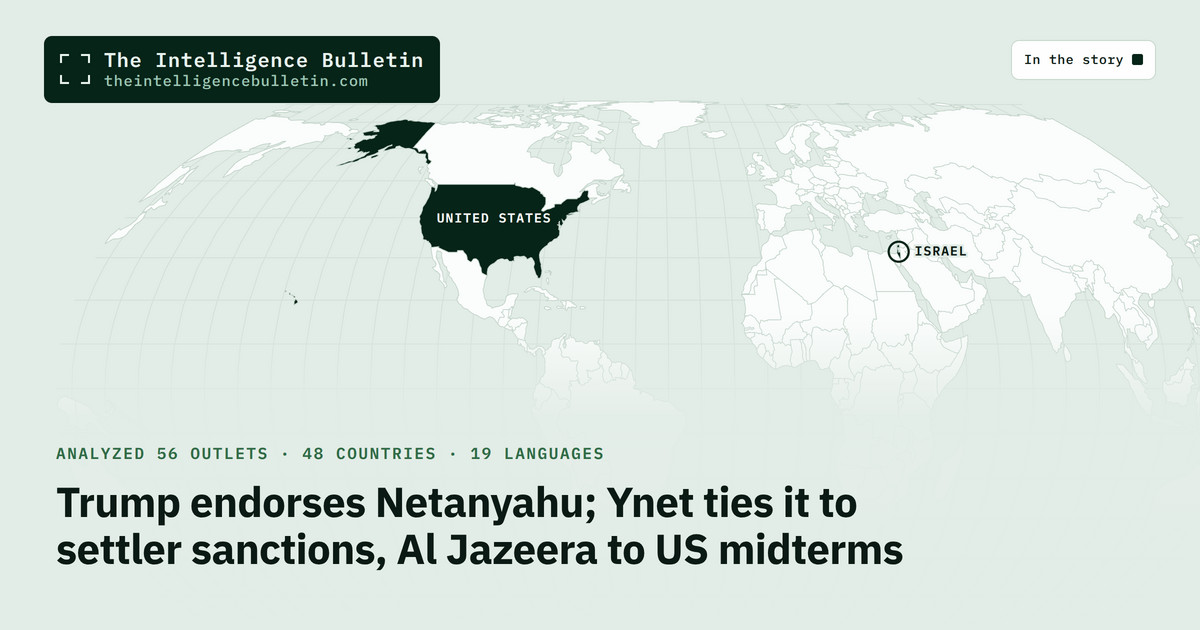
Trump posted his "Complete and Total Endorsement" of Netanyahu nine days before Israel’s Oct. 27 vote, warning he may not act against Iran under another leader. Ynetnews reports opposition figures call it compensation; Trump told Axios he always intended it.
Across the press: Ynetnews and Al Jazeera both report the endorsement, but only Ynetnews adds Israeli officials warning that settler attacks may force European sanctions.
Source base: 5 outlets read in full (Israel, United States, Qatar, Slovenia, Indonesia), selected from 56 analyzed.
- DisputedThe endorsement was a late reversal prompted by Netanyahu’s pleas and offered as compensation for Trump blocking an Israeli strike on Iran.Source: Ynetnews, citing unnamed Israeli opposition figures.
- DisputedTrump says he always intended to endorse Netanyahu and had simply not wanted to do it too soon.Source: Al Jazeera, reporting Trump’s Sunday interview with Axios.
- 5 of 5 · reported separatelyTrump posted a "Complete and Total Endorsement" of Netanyahu on Truth Social on Sunday, nine days before Israel’s October 27 election.Reported by Ynetnews, NPR, Al Jazeera, Delo citing Euronews and Metro TV citing The New York Times.
- 5 of 5 · reported separatelyTrump had withheld the endorsement for months, demurring in a Time interview while relations with Netanyahu strained over Iran and Gaza.Reported independently by NPR and Al Jazeera; Delo relays Euronews and Metro TV relays The New York Times with the same chronology.
- 3 of 5 · reported separatelyTrump wrote that if Israel chooses "anyone other than Bibi," America may have to act against Iran itself, "and I am not inclined to do so."NPR, Al Jazeera and Delo all quote the post directly.
- Oct 27, 2026Israel votes; the outcome will show whether Trump’s endorsement rescued Netanyahu or repeated the failed Orbán push.
- Nov 3, 2026US midterm elections; Ynetnews says Democrats gaining the House or Senate could make Congress far harder for Israel from January.
- If settler violence continuesYnetnews reports Israeli officials expect EU sanctions on the West Bank, with Germany possibly abandoning its veto.
- If Iran does not change its ways rapidlyTrump has threatened the US will finish the job against Iran, and the Israeli election result may decide whether he stays inclined to do it.
- Still openWill Netanyahu consider military action against Iran after the Oct 27 election? · What specific recent discussions occurred between Netanyahu and Washington on Iran?
- 15 Oct · Netanyahu s radio interview rules out Iran strike before election while warning Tehran
- 17 Oct · Trump claims Israel already helps Saudi Arabia fight Houthis, but only Kan-backed intelligence report says how
- 18 Oct · Israel s police blame the diplomats while Netanyahu demands evidence as settlers beat a French mayor
Full analysis
What happened Why it matters How each country tells it Where accounts conflict Room for disagreement Our assessment Sources and evidence
What happened
On Sunday, October 18, 2026, U.S. President Donald Trump posted a "Complete and Total Endorsement" of Israeli Prime Minister Benjamin Netanyahu on Truth Social, nine days before Israel’s October 27 parliamentary election. He called Netanyahu "a Great Warrior Prime Minister, and an even greater Partner for Peace in combatting the Islamic Republic of Iran," and wrote that if Israel chose "anyone other than Bibi," America would have to act against Iran itself, "and I am not inclined to do so." Netanyahu thanked him in Hebrew on X, and his Likud Party attached a 35-second video of the two leaders. The endorsement landed after months in which Trump had pointedly withheld it, telling Time magazine in an interview published this month that "I’m not involved in politics anymore" despite continuing to endorse American politicians, and avoiding even a meeting with Netanyahu at the United Nations General Assembly last month, according to Ynetnews. Relations had strained over the nearly eight-month war with Iran, which the two countries launched jointly on February 28, 2026: Trump criticized Israel’s attack on a key Iranian gas field, called Netanyahu "crazy" in June, and saw his Gaza ceasefire proposal rejected by Netanyahu in August.
Two irreconcilable explanations for why the endorsement came now are already in circulation. Al Jazeera reports that Trump told Axios on Sunday he "was always going to do that. I just didn’t want to do it too soon," adding, "It is important that Israel has a person they can count on." Ynetnews, citing unnamed Israeli opposition figures, reports the opposite: that Netanyahu pleaded with Trump and his advisers for a public endorsement, and that the statement was compensation for Trump’s refusal to allow Israel to strike Iran before the vote. A senior opposition figure quoted by Ynetnews said the framing matters: "If the public understands that this is compensation at the expense of security, and that Trump is not allowing Bibi to attack Iran, it could actually hurt him."
What Ynetnews adds is the diplomatic context that other outlets treat separately: the same weekend, Jewish extremists attacked European diplomats in the West Bank village of Taybeh, a day after an assault on American photojournalist Heidi Levine. Senior Israeli officials warn, according to Ynetnews, that these attacks are accelerating European pressure for sanctions, and that Germany may abandon its traditional EU veto, with one official saying, "The Germans might actually do it." Sanctions, the officials warn, would start with West Bank settlements but inevitably spread to Israeli banks, trade, flights, and academia. Netanyahu himself acknowledged Sunday that Israel could lose American support after Trump’s presidency ends.
Why it matters
The election is the first Israeli national vote since Hamas’s October 7, 2023, attack, and it is widely seen as a referendum on Netanyahu’s leadership through the Gaza war and the diplomatic isolation that followed, Metro TV reports, relaying The New York Times. The endorsement therefore makes the Iran war part of the Israeli campaign. Trump’s post explicitly conditions his willingness to "soon finish the job" against Iran on Netanyahu’s re-election: if Israel chooses the wrong leader, he wrote, America would have to do the work itself, and he is not inclined to. That turns the October 27 result into a decision point for whether the United States escalates.
The consequences run beyond the Israeli ballot. Al Jazeera reports a Pew Research Center poll this month found roughly two-thirds of U.S. voters disapprove of Trump’s handling of the Iran war, which has driven up fuel prices, and his Republican Party faces a midterm election on November 3. Ynetnews reports Israeli officials expect a Democratic-controlled House or Senate from January to be far harder on Israel, pointing to Michigan Senate candidate Abdul El-Sayed, who has led some polls and campaigns on sharp criticism of Israel. Metro TV, relaying The New York Times, reports a Times/Siena poll last year found, for the first time since 1998, a slight plurality of U.S. voters siding with Palestinians over Israelis. The sanctions pressure in Europe, driven by the settler attacks, runs on a separate clock: Ynetnews quotes an official warning that European governments "will no longer be able to withstand that pressure," and that if extremist violence continues, sanctions will follow. That timeline is not tied to the Israeli result.
How each country tells it
- Ynetnews · Israel · original reportingTreats the endorsement as a sudden U-turn and folds it into Israel’s fear of losing US support and triggering European sanctions over settler violence against foreign diplomats.
- NPR · United States · original reportingReports the endorsement from Washington as the late centrepiece of a fraught US-Israel relationship, emphasising Trump’s earlier demurrals and policy rifts.
- Al Jazeera · Qatar · original reportingPresents Trump’s post as an outside power intervening in a tight Israeli contest, and stresses the war’s cost to Trump and the opposition challenger Gadi Eisenkot.
- Delo · Slovenia · carries EuronewsLeads on the months of delay before the endorsement and delivers a compact, even-handed chronology of Trump and Netanyahu’s divergences.
- Metro TV · Indonesia · carries The New York TimesFrames the endorsement as an unorthodox US intervention in a tight Israeli vote and adds US public-opinion and Israel-Palestine detail often skipped by Western outlets.
Where accounts conflict
The central factual conflict is why the endorsement arrived when it did. Ynetnews’s account, built on unnamed Israeli opposition figures, holds that this was a late reversal caused by Netanyahu’s pleas and offered as compensation for Trump blocking an Israeli strike on Iran before the vote. Al Jazeera’s account, built on Trump’s own words to Axios, holds that the endorsement was always intended and only delayed: "I was always going to do that. I just didn’t want to do it too soon." The two cannot both be true, and they differ on a point that changes the story: one makes the American president the author of his own timing, the other makes him a patron settling a debt. The evidence also differs in kind. Al Jazeera’s version rests on an on-record statement by a principal who has an interest in appearing deliberate; Ynetnews’s rests on anonymous sources with an interest in framing Netanyahu as desperate. Neither account appears in the other outlet at equal weight: Al Jazeera does not carry the opposition figure’s claim that Trump blocked an Israeli strike, and Ynetnews does not carry Trump’s Axios explanation for the delay.
Room for disagreement
The strongest case against my assessment comes from the reporting itself. Ynetnews notes that Trump’s endorsement does not guarantee electoral success, citing the example of Hungarian Prime Minister Viktor Orbán, whom Trump backed and Vice President JD Vance campaigned for, and who still lost. Ynetnews separately observes that "it is difficult to imagine Trump being unable to work with another Israeli prime minister," and Al Jazeera records Trump’s evasive answer when Axios asked whether he could work with someone other than Netanyahu: "Maybe I will, maybe I won’t. Who wants to take the chance?" If the endorsement is read as a pressure tactic rather than a commitment, then Trump’s threat not to act against Iran is equally open to revision, and the U.S. decision on escalation would be driven by American interests, not by the Israeli result. A reader could reasonably conclude that the Israeli election will not determine U.S.-Iran policy, and that the real story is the sanctions pressure, which continues regardless.
Our assessment
It is likely that the October 27 Israeli vote will now directly determine whether the United States escalates against Iran, because Trump’s own endorsement conditions American action on Netanyahu’s victory. The primary document — the Truth Social post quoted the same way by NPR, Al Jazeera, and Delo — says that if Israel chooses "anyone other than Bibi," America would have to do the work itself, "and I am not inclined to do so." That is a public, specific, conditional threat, and it is corroborated across independent reporting chains, not a single outlet’s interpretation. Trump has an interest in the reader seeing it as leverage over Israeli voters; but once posted, the condition becomes a signal to Tehran and to the Israeli electorate alike. If Ynetnews’s compensation account is even partly true — that Trump blocked an Israeli strike before the vote and endorsed as a substitute — then the election is effectively a referendum on who decides when Iran is struck, which strengthens the same conclusion. The endorsements that failed, like Orbán’s, do not nullify the condition; they show only that Trump’s backing is not decisive in foreign elections.
What would change this: if Trump, after October 27, states plainly that he will work with any Israeli prime minister and separate the Iran decision from the Israeli result, the conditioning dissolves and the escalation question would return to Washington alone.
Sources and evidence
Press quoted
- Will Trump’s endorsement move a race that is widely described as close, and into whose column?
- What exactly did Netanyahu ask of Trump or his advisers, and was the timing compensation for blocking an Israeli strike on Iran, as Ynetnews’ opposition sources claim?
- If Netanyahu loses, will Trump work with Gadi Eisenkot or carry out his stated threat to act against Iran without Israel?
That’s how the world told the story.
Get our daily open-source intelligence on world events in your inbox — one email a day, up to six stories.
Subscribe freeNo spam. One-click unsubscribe. See the latest email →