 AI-generated analysis published under the editorial responsibility of Rohit Sinnas. How it works →
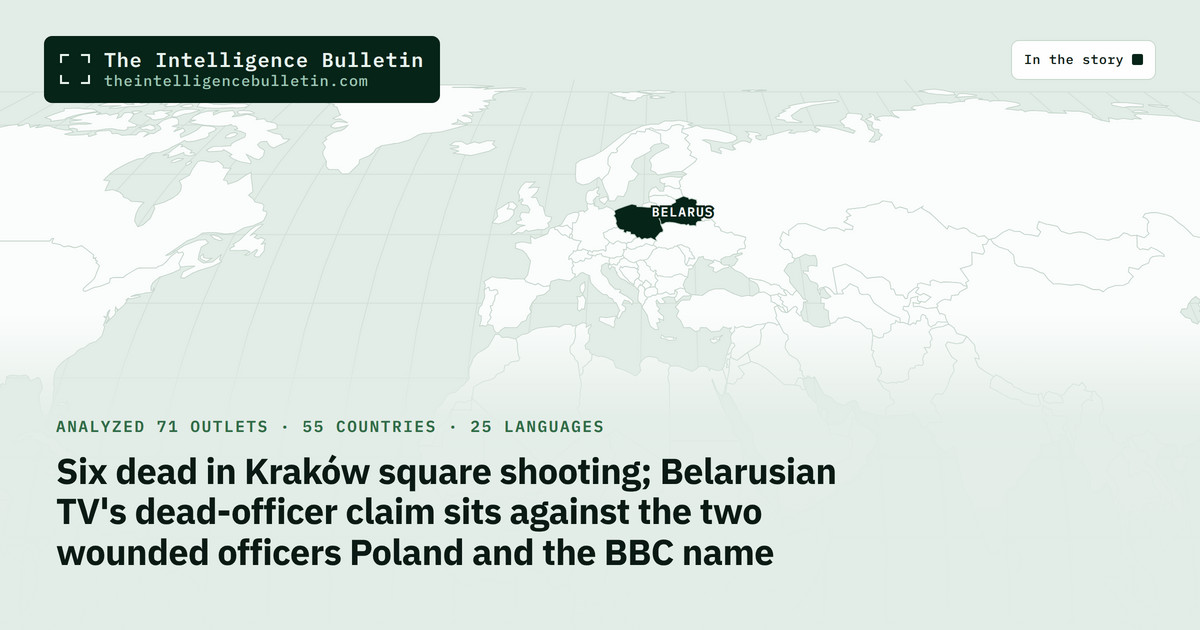
See the 55 countries
Albania, Armenia, Australia, Austria, Belarus, Belgium, Brazil, Bulgaria, Canada, China, Colombia, Croatia, Cyprus, Czech Republic, Finland, France, Germany, Greece, Hungary, India, Ireland, Israel, Kazakhstan, Kuwait, Latvia, Lebanon, Lithuania, Macedonia, Moldova, Montenegro, Morocco, Netherlands, New Zealand, Oman, Poland, Qatar, Romania, Russia, Saudi Arabia, Serbia, Singapore, Slovakia, Slovenia, Somalia, South Africa, Spain, Sweden, Switzerland, Turkey, Tuvalu, Ukraine, United Arab Emirates, United Kingdom, United States, Zimbabwe
A gunman killed six people in Kraków’s Main Market Square and injured at least fifteen, including two police officers, and three bodies, likely his family, were found at his home. Polish officials call it far-right terrorism; Belarusian state TV alone claims an officer died, a report Polish and British accounts exclude.
Across the press: Belarusian state TV reports a police officer among the six dead, while Rzeczpospolita and BBC News name two wounded officers alive in hospital.
Source base: 5 outlets quoted (Poland, United Kingdom, Ukraine, Morocco, Belarus), selected from 71 analyzed. 4 read in full, 1 by its headline only.
- DisputedA police officer was among the six dead, according to ONT, while Polish and British reporting says two named officers were wounded and are being treated.Source: ONT cites Radio Krakow for the dead-officer claim; Rzeczpospolita and BBC News cite Tusk and Polish police for the wounded-officer account.
- 4 of 5 · reported separatelySix people were killed in the shooting on Kraków’s Main Market Square.Polish police and Prime Minister Donald Tusk, cited by Rzeczpospolita, BBC News, Hespress and ONT.
- 3 of 5 · reported separatelyAt least 15 people were injured, including two police officers and five foreign nationals.Polish Interior Ministry figures cited by BBC News and Rzeczpospolita; ONT cites local authorities for 15 injured.
- 3 of 5 · reported separatelyThe attacker is a Polish man in his mid-20s, now in custody and seriously wounded.Polish police and Interior Minister Marcin Kierwiński, cited by Rzeczpospolita, BBC News and ONT.
- 3 of 5 · reported separatelyThree bodies — two women and a man, likely the attacker’s immediate family — were found at his home in Ostrowiec Świętokrzyski.Prime Minister Donald Tusk and Polish police, cited by Rzeczpospolita, BBC News and Hespress.
- 8–10 NovemberPoland’s national mourning days, with President Nawrocki’s regulation naming 8–9 November and Prime Minister Tusk naming 9–10; the final window will settle which reading stands.
- In the days following the attackPolish investigators’ work on whether the attacker had accomplices or supporters, after Tusk vowed to detain any ‘possible supporters’.
- OngoingThe recovery of the two wounded officers, named by Tusk as Jakub Kulik and Artur Morański, whose condition Polish and British reporting says is serious but stable after surgery.
- In the coming daysCopycat watch, after former national police spokesman Mariusz Sokołowski warned the attacker may have imitators.
Full analysis
What happened Why it matters How each country tells it Where accounts conflict Room for disagreement Our assessment Sources and evidence
What happened
A Polish man in his mid-20s drove into Kraków’s Main Market Square shortly before 15:00 local time on Saturday and opened fire on the crowds, killing six people and wounding at least fifteen in what Prime Minister Donald Tusk called the most drastic case of terrorism Poland has known. Footage showed the attacker’s vehicle speeding through the historic centre, people fleeing as gunfire rang out, shopfront glass shattering and a tram being struck. The attack lasted about three minutes, according to police.
The gunman kept firing as he drove on, covering roughly a kilometre and a half before police stopped him at the junction of Stradomska and Józefa Dietla streets. Belarusian state television, ONT, citing the Telegram channel SHOT, reports the continuing fire as he drove. Polish police headquarters said a dispatcher sent thirty crews to the scene, with the first patrol taking direct action against the armed attacker and the exchange of fire coming three minutes after the initial report. Dressed in full military tactical gear with a helmet and armed with an automatic weapon — Rzeczpospolita reports it may have been an AR-15 self-loading carbine — the attacker was wounded and detained. Interior Minister Marcin Kierwiński said investigators are testing the hypothesis that he took the weapon from his family home, where his father held a firearms licence. The attacker, a Polish man the BBC gives as 25 years old while Rzeczpospolita’s live blog used both 24 and 25, was in serious condition after two operations. More weapons and ammunition were found in his car, and Tusk said the vehicle posed no pyrotechnic threat; Małopolska police later evacuated nearby buildings while checking it, and the BBC reported that some buildings were evacuated as it was searched for explosives.
Among the six dead at the square, police chief Gen. Marek Boroń said, were a British citizen and two Polish women; the BBC reports three of those killed were Polish, one British and two unidentified. At least fifteen people were injured, according to interior ministry figures, including two police officers and five foreign nationals from Britain, Austria, Russia, Germany and Portugal. Portugal’s foreign ministry confirmed a Portuguese woman was among the wounded. Two city horses were also hit, one lightly and one with a gunshot wound to the leg; both survived.
Tusk named the two wounded officers as Senior Constable Jakub Kulik and Senior Constable Artur Morański, saying they saved many lives and calling them true heroes. The BBC, through authenticated footage, describes one officer confronting the suspect on the ground, visibly injured, then falling. The interior minister said one officer was fighting for his life and a second had a less serious injury; later accounts, including Radio ZET journalist Mariusz Gierszewski’s, said both underwent surgery and were stable. Tusk’s early social media post said three officers had been wounded before subsequent police and ministry statements settled on two. Belarusian state television, by contrast, citing Radio Krakow, reports that a police officer was among the six dead — a claim the Polish and British accounts flatly exclude, since they name the two living, wounded officers.
After identifying the gunman, police searched his home in Ostrowiec Świętokrzyski and found the bodies of two women and a man. Tusk said there was much to suggest they were the suspect’s immediate family, and TVN24’s reporter, per Rzeczpospolita, gave the unofficial identification of his mother, father and sister. Tusk had earlier told the crisis staff meeting in Kraków that a drone image suggested dead people were in the apartment, pending confirmation.
On motive, Kierwiński said the first analysis points to ultra-nationalist views but would be verified; the BBC quotes him saying everything suggests the attacker was fascinated by far-right ideologies. Tusk, speaking at Kraków’s city hall, said Poland had not had such drastic cases of terrorism and that the attack must be called terrorism. He also said he hoped for the quick detention of any possible helpers. The attacker was not a member of the Polish armed forces. His internet activity is now under review by the Central Bureau for Combating Cybercrime, according to Onet via Rzeczpospolita, to establish whether he belonged to radical online groups.
President Karol Nawrocki signed a regulation introducing two days of national mourning, and Rzeczpospolita reports the regulation names Sunday 8 November and Monday 9 November; in the same live blog, Tusk separately announced that Monday 9 and Tuesday 10 November would be days of national mourning, calling it a response to the president’s request. The BBC reports a period of mourning declared in Kraków until 11 November. Warsaw placed concrete road barriers on streets leading to Krakowskie Przedmieście on police recommendation, and Czech police announced additional armed patrols with long guns and ballistic protection in public places while saying the attack had no direct link to Czechia. PiS leader Jarosław Kaczyński called for planned protests in Poland to be cancelled out of respect for the victims. Condolences arrived from the Hungarian president and foreign minister, the Ukrainian prime minister, Italy’s prime minister, Germany’s chancellor and foreign minister, Slovakia’s prime minister, Moldova’s president, Ireland’s prime minister, Britain’s prime minister and others; Rzeczpospolita carries the fullest sweep of these statements. A scare on the roof of St. Mary’s Basilica in the square turned out to be a priest on the presbytery terrace, Małopolska police said, dementing a viral video that appeared to show someone running on the roof.
Why it matters
Poland has long styled itself, and been seen, as a safe island in Europe. Rzeczpospolita’s commentators Michał Szułdrzyński and Jerzy Haszczyński both write that the attack brutally ends the era in which Poland was considered a safe island, and that Main Market Square and Kraków become a symbol of that lost status. The scale — six dead in the country’s most visited square, plus three more at the suspect’s home — makes it, as Tusk said, without precedent in Poland’s post-communist history. The presence of a British national among the dead and five foreign nationals among the wounded spreads the political stakes across at least six governments. The far-right motive, already a first analysis rather than a finding, lands in the middle of Poland’s polarized politics at a moment of national protest called off at Kaczyński’s request.
The security ripple is immediate: armed Czech patrols, barriers in Warsaw, and a former national police spokesman warning that the attacker may have imitators. For the BBC, the story is motive first — the far-right label in the opening line, the British victim named early. For Hespress, writing in Arabic for a MENA audience, the headline carries the portable designation that the Kraków attack is a terrorist act, and the piece then pivots to commentary on migration, inflation and media manipulation. For Belarusian state television, the story is a tragedy without an ideology, and the narrative core is police heroism — an officer who continued to intervene despite his wounds. Each framing is a choice about what the event was for.
How each country tells it
- Rzeczpospolita · Poland · original reportingPoland’s own live coverage frames the massacre as a ‘zamach’ — an attack on the state as much as a crime — and leads on the state’s crisis response, national mourning, the wounded officers and the avalanche of foreign condolences.
- BBC News · United Kingdom · original reportingLeads with the ‘far-right’ label, the British victim and the three bodies found at the attacker’s home, foregrounding motive and the widening domestic toll over the Polish state’s response.
- Espreso TV · Ukraine · original reportingA Ukrainian-language breaking-news headline reads the attack as a plain catastrophe in a city Ukrainians treat as a safe rear, with no ideological label or state-response frame visible.
- Hespress · Morocco · original reportingThe sole Arabic-language voice reduces the event in its headline to an official designation — ‘the Kraków attack is a terrorist act’ — and leads with Tusk’s words, then appends a commentary paragraph about migration and media manipulation.
- ONT · Belarus · carries LoveKrakow; Radio Krakow; SHOT; PAP; Polsat NewsBelarusian state television reports the attack as a flat ‘tragedy’ with no far-right label, no named perpetrator ideology and no terrorism designation, while assembling details from Polish portals, Telegram channels and Polish police.
Where accounts conflict
The dead officer. ONT, citing Radio Krakow, states that among the six dead was a police officer. Rzeczpospolita and the BBC, citing Tusk and Polish police, name two wounded officers — Senior Constables Jakub Kulik and Senior Constable Artur Morański — as alive, in serious condition and after surgery in Kraków hospitals. No Polish or British account carries the dead-officer claim; ONT carries no account of the two named wounded officers, though it does quote a former police spokesman praising the officer who neutralized the attacker despite wounds. The conflict is material: whether the state’s own forces fell or survived changes what the attack was.
The accomplice. Polish and British reporting describes one attacker, detained and wounded, with Tusk vowing to detain any possible supporters — language that treats a wider circle as an investigative question, not an established fact. ONT carries both sides of its own contradiction: police spokesperson Katarzyna Cisło telling journalists that the service dealt with one perpetrator, and a police representative, Jakub Mirochna, telling the PAP agency that two people took part in the shooting, one wounded, with no information on the second. The Belarusian account does not resolve the two.
The mourning dates. Rzeczpospolita reports President Nawrocki’s regulation names Sunday 8 and Monday 9 November for national mourning, and the same live blog carries Tusk’s announcement that Monday 9 and Tuesday 10 November would be the mourning days. The BBC reports a period of mourning in Kraków until 11 November. These cannot all describe the same window; the Polish source itself holds two.
Room for disagreement
The strongest case that this story will not hold its current shape is that its most explosive label — far-right ideology — is explicitly provisional. Kierwiński himself said the first analysis points to ultra-nationalist views but will be verified; the gunman’s motives, ONT notes paraphrasing Polish police, remain unknown. Tusk’s own language about possible supporters and his stated hope for quick detention of helpers keeps open the possibility that what looks today like a lone actor will prove to have had direction or company; ONT’s single police-source claim of a second shooter gestures at the same unresolved question from the other side. And the Polish account’s own wobble — Tusk first saying three officers were wounded before the ministry and police settled on two, alongside two different national mourning windows — shows a state machine reporting in real time under unprecedented strain. On this view, the settled story could move as autopsies, the attacker’s online footprint and the Ostrowiec Świętokrzyski crime scene come into full view.
Our assessment
It is likely that this will stand as a lone-actor, far-right-inspired terrorist attack — the first of its kind and scale in post-communist Poland — and that the two wounded officers will remain the established account of what happened to Polish police. The core facts rest on the strongest warrant available: separate reporting chains — Rzeczpospolita and PAP on the Polish side, the BBC with its verification unit on the British side — converged independently on the same casualty figures, the same named officers, the same three bodies in Ostrowiec Świętokrzyski. The interior minister’s motive label is minister-level, on the record, and repeated across outlets in different languages; the near-simultaneous family killing pattern is consistent with a lone far-right actor acting on his own household before a public rampage. Everyone with an interest in the officer question — the Polish government, which names its wounded officers and has no reason to conceal a dead one, and the BBC, which authenticated footage of the confrontation — says the officers survived, while the dead-officer claim rests on a single chain: Belarusian state television repeating Radio Krakow. The weight sits on the side of the officers being alive.
What would change this: independent confirmation of a second shooter or a named accomplice, or a police statement moving the officer toll, would force the story to be rewritten around a coordinated attack rather than a lone one.
Sources and evidence
Press quoted
- Which account of police casualties is correct — that a policeman is among the six dead, as ONT reports citing Radio Krakow, or that the two named officers are wounded and alive, as Rzeczpospolita and BBC News report?
- What was the attacker’s actual motive, and did he act alone or with inspiration or direction from others?
- Were the three bodies found at his home victims of the same perpetrator, and what was their precise relationship to him?
That’s how the world told the story.
Get our daily open-source intelligence on world events in your inbox — one email a day, up to six stories.
Subscribe freeNo spam. One-click unsubscribe. See the latest email →