 AI-generated analysis published under the editorial responsibility of Rohit Sinnas. How it works →
See the 57 countries
Afghanistan, Armenia, Australia, Austria, Azerbaijan, Bangladesh, Bosnia and Herzegovina, Brazil, Canada, China, Croatia, Cuba, Cyprus, Denmark, Egypt, France, Germany, Greece, Hungary, India, Indonesia, Ireland, Israel, Italy, Japan, Lebanon, Liberia, Madagascar, Malawi, Malaysia, Mexico, Netherlands, New Zealand, Oman, Pakistan, Philippines, Poland, Qatar, Romania, Russia, Saudi Arabia, Singapore, Somalia, South Africa, South Korea, Spain, Switzerland, Syria, Taiwan, Thailand, Turkey, Uganda, Ukraine, United Arab Emirates, United Kingdom, United States, Vietnam
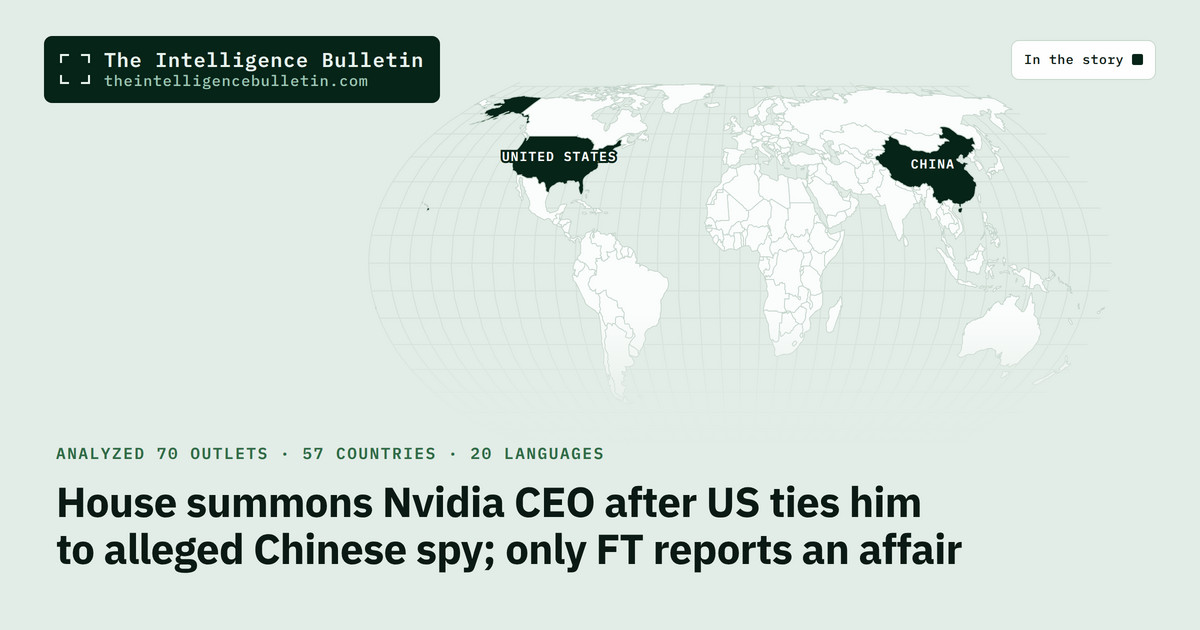
House chairs have summoned Nvidia’s Jensen Huang to a November 18 closed-door briefing over interactions with Alice Huang, whom US intelligence classifies as a Chinese asset. Only the FT chain reports a memo concluded an affair; the NYT chain calls it an investigation.
Across the press: The Financial Times chain reports an affair the New York Times chain reduces to an investigation of the relationship’s ‘background and purpose.’
Source base: 5 outlets read in full (United States, United Arab Emirates, Germany, Qatar, South Korea), selected from 70 analyzed.
- Denied on the recordChina dismissed the espionage accusations against it as ‘groundless smears and slanders’.Source: Chinese government statement, carried only by Tom’s Hardware among the selected sources.
- 2 of 5 · one shared reportA US government memo concluded Jensen Huang had a romantic relationship with Alice Huang, a Chinese citizen and Megaspeed executive.Financial Times, citing informed sources; relayed by Tom’s Hardware and by Al Jazeera via Investing.com.
- 5 of 5 · reported separatelyUS intelligence classifies Alice Huang as a Chinese government informant or asset, recruited by or working for the Ministry of State Security.The FT chain (Tom’s Hardware, Al Jazeera) and the NYT chain (Handelsblatt, Fnnews) both carry the classification; The National independently describes her as an ‘alleged Chinese intelligence asset’ believed to have passed information to China.
- 4 of 5 · reported separatelyHouse committee chairs asked Jensen Huang to appear for a closed-door briefing on November 18 about his interactions with Alice Huang and Nvidia’s security protocols against foreign espionage.The congressional letter, dated Wednesday and signed by the House Foreign Affairs, Intelligence and China select committee chairs; quoted independently by The National and Handelsblatt, referenced by Al Jazeera and Fnnews.
- 3 of 5 · reported separatelyNvidia pushed back on the allegations, saying its regional cloud customers receive ordinary business information, not trade secrets or national-security information.Nvidia representative, on the record to The National and relayed by Tom’s Hardware; Al Jazeera reports Nvidia declined to comment on the memo and personal-relationship claims but referred to prior statements about meeting thousands of client executives.
- November 18, 2026Jensen Huang’s requested closed-door briefing before three House committees; whether he appears and what the chairs state publicly afterward.
- January 4, 2027Blumenthal’s deadline for Big Tech record production; whether Nvidia is among the companies pressed in the post-midterm inquiry.
- The Trump-Xi Beijing summitWhether the memo, reported by Al Jazeera to have been distributed ahead of the meeting, resurfaces at or around the leaders’ talks.
- OngoingWhether US authorities move on the Megaspeed smuggling accusations after Handelsblatt noted no charges have followed.
Full analysis
What happened Why it matters How each country tells it Where accounts conflict Room for disagreement Our assessment Sources and evidence
What happened
On November 4, three Republican House committee chairs wrote to Nvidia chief executive Jensen Huang asking him to appear for a closed-door briefing about his interactions with Alice Huang, a Chinese citizen and executive at the Singapore data-center firm Megaspeed whom US intelligence classifies as an asset of China’s Ministry of State Security. The letter, signed by Foreign Affairs chair Brian Mast, Intelligence chair John Moolenaar and China select committee chair Eric Crawford, says recent reports "raise significant national security concerns regarding the People’s Republic of China’s access to sensitive US technology and information," and that "Congress determines the extent to which US national security has been placed at risk." The National and Handelsblatt both quote the letter; it is dated Wednesday and requests the briefing for November 18.
What drew the committees’ attention was a week of reporting about the relationship between the world’s most prominent chip chief and a woman US spy agencies had been watching. The New York Times reported a week earlier that US counterintelligence considered Jensen Huang the target of a potential Chinese influence operation and that authorities were investigating the "background and purpose" of Alice Huang’s relationship with him, a formulation the South Korean Financial News carries. Then, on November 7, the Financial Times reported that a secret US government memo, prepared earlier this year and distributed to a limited circle of senior officials before Donald Trump’s Beijing summit with Xi Jinping, concluded that Jensen Huang and Alice Huang had a romantic relationship. Tom’s Hardware and Al Jazeera relay the FT’s account; no source outside that chain carries the affair claim.
Alice Huang, also known as Huang Le, sits at the center of both chains’ reporting. Tom’s Hardware details the inconsistencies in her stated biography: a reported early career at Hunan TV and China Central Television that one executive says he has never heard of and the other has no record of; a post at HSBC’s private banking division; a vice presidency at CITIC Securities. Later she ran Megaspeed, a firm founded in 2023 and accused — through its subsidiary Speedmatrix, with offices in Johor, Malaysia — of smuggling $2 billion in AI chips into China. Handelsblatt notes US authorities examined Megaspeed for possible chip smuggling but brought no charges. Fnnews describes how Megaspeed’s Southeast Asian data centers, renting computing to Alibaba, became a channel for Chinese companies to use Nvidia chips barred from direct export, and reports that the investor network around Megaspeed was financially connected to Chinese military institutions.
Nvidia has pushed back. A representative told The National: "Our regional cloud customers receive ordinary business information – not sensitive Nvidia trade secrets – and zero information relevant to national security." The company said a robust security team travels with Huang "when needed," and that "if the US government believes that any person is a threat to American industry, it would let us know." Al Jazeera reports Nvidia declined to comment on the memo and the personal-relationship claims specifically, referring instead to prior statements that Huang meets thousands of client-company executives each year, and that an internal Nvidia review of Megaspeed found no evidence of wrongdoing. China’s government, carried only by Tom’s Hardware among these sources, called the espionage accusations "groundless smears and slanders."
Why it matters
The claim lands on the one person in the global chip industry who is simultaneously indispensable to American AI dominance and personally committed to selling into China. Jensen Huang spent the past year in Washington lobbying for relaxed export controls, and Fnnews recounts the record: his 2025 persuasion of President Trump to ease restrictions on lower-performance Nvidia chips, the subsequent deal letting China buy the company’s second-ranked processors with the US government taking 25 percent of the revenue, and a withdrawn plan to allow Blackwell sales. If the person making that case was himself the target of a Chinese intelligence operation, every argument he has made about the security of selling to China is now read through that lens.
The timing sharpens the stakes. Al Jazeera alone reports the memo was distributed to senior US officials before Trump’s Beijing summit, meaning the claim sat on the table as the two leaders met over the very technology in question. And the November 18 briefing arrives in a changed Congress: The National notes the letter went out a day after Republicans lost control of the House, and Democrats campaigned on holding Big Tech accountable, with Blumenthal issuing record demands with a January 4 deadline and incoming oversight chair Robert Garcia telling executives simply to "LAWYER UP." For Nvidia, the summons before the committees that write export law is a reputational and political event, not merely a security one.
How each country tells it
- Tom’s Hardware · United States · carries Financial TimesTreats the claim as a national-security and export-control matter, leading with the alleged ‘honeypot operation’ and tying Alice Huang to Megaspeed’s alleged $2 billion AI-chip smuggling.
- The National · United Arab Emirates · original reportingLeads with Nvidia’s pushback and the closed-door congressional summons, reading the story as a corporate-reputational and investment problem rather than a spy thriller.
- Handelsblatt · Germany · carries New York TimesTurns the headline into a question and emphasizes the claim’s evidentiary thinness, reporting that US authorities classified Alice Huang as a Chinese government informant but noting the congressional letter names no sources and no smuggling charges followed.
- Al Jazeera · Qatar · carries Financial TimesCarries the memo straight as an item about a link between an American tech chief and a suspected Chinese agent, and is the only source to report the memo was distributed to a limited circle of senior US officials before Trump’s Beijing summit with Xi.
- The Financial News (Fnnews) · South Korea · carries New York TimesStates the allegation flatly in the headline and uniquely details Huang’s lobbying record — his 2025 persuasion of Trump to relax AI-chip export bans, the 25% revenue-sharing deal, and the withdrawn Blackwell idea.
Where accounts conflict
The romantic relationship. The FT chain — Tom’s Hardware and Al Jazeera — reports a government memo concluded Jensen Huang and Alice Huang had an affair, and Tom’s Hardware leads with it as a "honeypot operation." The New York Times chain — carried by Handelsblatt and Fnnews — does not report an affair: Fnnews says US intelligence has been investigating the "background and purpose" of the relationship, and Handelsblatt reports the classification of Alice Huang as a Chinese government informant with no mention of romance. The National, which obtained the congressional letter independently, reports only Huang’s reported "interactions" with an alleged asset. The word the letter itself uses, quoted by both The National and Handelsblatt, is "interactions," not relationship.
Nvidia’s position. The National and Tom’s Hardware report Nvidia pushing back or denying the allegations, with the representative quoted at length by The National. Al Jazeera reports Nvidia declined to comment on the memo and the personal-relationship claims, referring instead to prior statements. The difference may reflect different questions put to the company — a broad denial versus a refusal to engage the specific memo — but a reader of one account hears a company fighting back and a reader of the other hears one declining to answer.
Room for disagreement
The strongest case that the affair will be confirmed runs through the evidence itself. The FT’s sources would have had access to a classified memo, and the congressional letter’s request for a briefing on Huang’s "interactions" is exactly what three chairs who possess a classified assessment but cannot cite it in an unclassified letter would write. Nvidia’s refusal, per Al Jazeera, to comment specifically on the memo rather than flatly denying the affair could indicate the company cannot safely dismiss the claim. A memo distributed at that level, ahead of a presidential summit, is a serious document — and if it exists as described, one leak or one answer at the November 18 briefing could put it on the record.
Our assessment
The romantic-relationship claim is unlikely to be confirmed or refuted publicly in the near term. It rests on a single reporting chain — the Financial Times, relayed by Tom’s Hardware and Al Jazeera — while the New York Times chain describes US intelligence as investigating the "background and purpose" of the relationship rather than having concluded it was romantic, and the congressional letter, quoted independently by The National and Handelsblatt, uses only the word "interactions." Al Jazeera itself notes the published information contains no independent evidence confirming the suspicions. Against that, the espionage classification of Alice Huang is corroborated across the FT and NYT chains and independently by The National, so the investigation the affair claim sits inside will almost certainly keep moving through the November 18 briefing and the scrutiny of Megaspeed.
What would change this: if the memo leaks in full or the briefing produces a public finding on the relationship, the call moves to confirmed; if both Huangs deny the affair on the record without contradiction from US officials, the call collapses.
Sources and evidence
Press quoted
- Does the US government memo exist as described and does it actually conclude the relationship was romantic, given that only the Financial Times chain reports it and the White House and CIA declined to comment?
- Will Jensen Huang appear at the November 18 closed-door briefing, and what evidence did the congressmen rely on, since Handelsblatt notes the letter does not name its sources and no charges followed the Megaspeed smuggling inquiry?
- Was Alice Huang actually recruited by China’s Ministry of State Security and involved in smuggling AI chips to China, when her reported biography is inconsistent and Nvidia’s internal review found no evidence of wrongdoing?
That’s how the world told the story.
Get our daily open-source intelligence on world events in your inbox — one email a day, up to six stories.
Subscribe freeNo spam. One-click unsubscribe. See the latest email →