 AI-generated analysis published under the editorial responsibility of Rohit Sinnas. How it works →
Press quoted
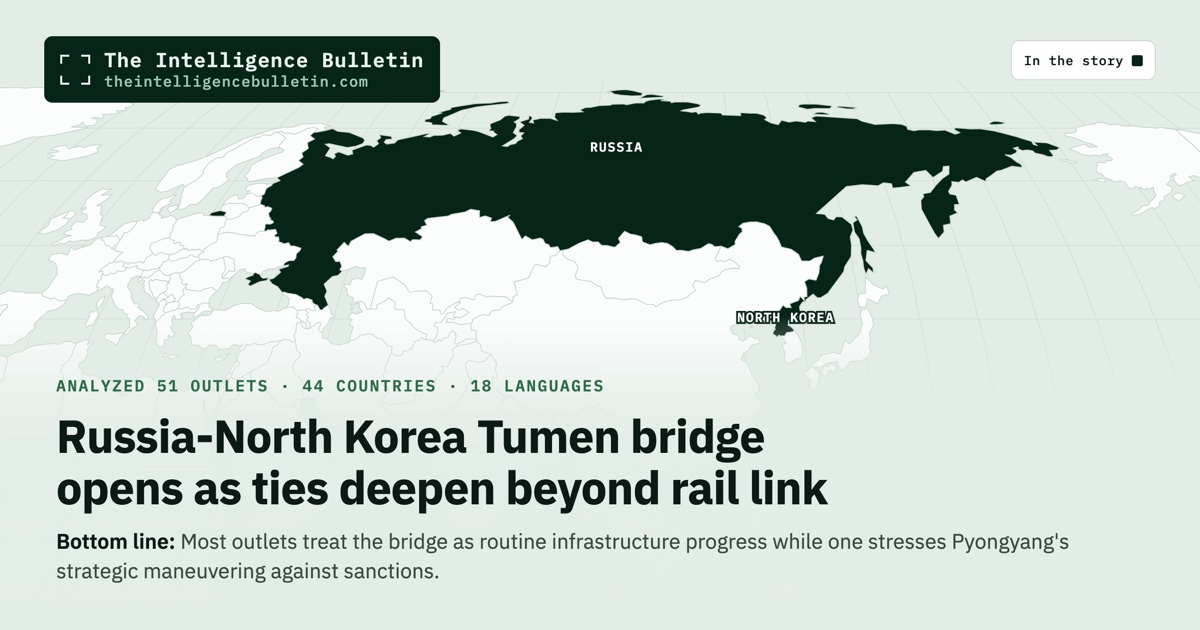
Most outlets treat the bridge as routine infrastructure progress while one stresses Pyongyang’s strategic maneuvering against sanctions.
The selected coverage converges on the bridge as a concrete symbol of Russia-North Korea partnership rather than dissecting its military utility. Turkish, Hong Kong, Philippine and Indonesian outlets frame the 1 km crossing primarily through Russian statements on trade, transport capacity and friendship, quoting Mishustin directly on its historic status and 300-vehicle daily limit. Taiwanese reporting stands apart by leading with Pyongyang’s state media reaction and citing South Korean experts on how the link, alongside a planned China span, lets Pyongyang play neighbors against each other while reducing sanctions pressure. No outlet in the set carries North Korean or Russian domestic framing; all rely on wire or official Russian releases. The shared emphasis on symbolism and multi-sector potential over troop movements or sanctions evasion reflects the sources’ distance from the principal actors and their preference for quoting verifiable infrastructure details over unverified security claims. This produces a consistent narrative of incremental economic integration that downplays the bridge’s potential role in sustaining Russia’s war effort.
Full analysis
Russia and North Korea opened their first dedicated road bridge across the Tumen River on September 8. The 1-kilometer two-lane structure connects the Russian border settlement of Khasan with the North Korean port city of Rason. Russian Prime Minister Mikhail Mishustin and North Korean Premier Pak Thae-song spoke by video link during the ceremony, addressing workers and officials on both sides as flag-adorned trucks crossed for the first time. The bridge carries a daily capacity of up to 300 vehicles and links directly into Russia’s federal road network, giving cargo an immediate route from the far east toward Vladivostok and onward to St. Petersburg. Until this crossing opened, vehicles had relied since 1959 on temporary planks laid across the adjacent rail bridge.
Construction began in April 2025 after the project was agreed during President Vladimir Putin’s visit to North Korea the previous year. The new span sits near the older Friendship Bridge, the rail link built after the Korean War. Russian officials named the road bridge after Yakov Novichenko, a Red Army soldier credited by Pyongyang with saving Kim Il-sung’s life in 1946 by intercepting a grenade. Mishustin described the opening as a historic event that would expand trade, economic, scientific, technological and cultural cooperation. He noted that relations had reached an unprecedented level and called the bridge itself a new symbol of friendship. North Korean state media, as reported through Seoul, presented the crossing as concrete evidence of tightening bonds between the two countries.
The event occurred against a backdrop of intensified military and economic coordination that began after Russia’s 2022 full-scale invasion of Ukraine. North Korea has supplied troops to help defend Russian territory in the Kursk region, and Russian forces have used North Korean missiles in Ukraine. Mishustin referred directly to those Korean personnel who had fought shoulder to shoulder with Russian soldiers. The bridge adds a permanent overland option to existing air and rail connections between Moscow and Pyongyang. Russian statements emphasized immediate cargo use, with full passenger service expected by the end of the year.
Four of the five outlets that covered the opening drew their accounts from wire services or official Russian releases. They foregrounded Mishustin’s remarks on capacity, connectivity and the symbolic value of the project. The Turkish state agency Anadolu Agency presented the development strictly as an infrastructure achievement. The South China Morning Post, BusinessWorld in the Philippines and Bisnis Indonesia in Indonesia all carried Reuters or similar copy that stressed the carefully choreographed display of partnership and the bridge’s role in expanding ties. Bisnis Indonesia added an emphasis on multi-sector development potential, quoting Mishustin on trade and culture while noting the strategic cooperation agreement signed in 2024.
The Taipei Times account differed in its lead and sourcing. It opened with North Korea’s own positive reaction as reported by state media and included analysis from Lim Eul-chul at Kyungnam University’s Institute for Far Eastern Studies. That piece noted that the Tumen bridge, together with a planned span to China, would give Pyongyang two major overland routes and allow it to encourage competition between its two neighbors. It also framed the infrastructure as reducing any need for Pyongyang to seek sanctions relief from Washington or make concessions on denuclearization. Ukrainian monitoring group Truth Hounds was cited warning that the bridge could serve as a direct artery for moving North Korean troops, construction brigades and military officials into Russia in one direction and Russian technology and resources in the other.
No outlet in the set carried reporting from inside North Korea or Russia beyond the official statements already released to international wires. All five pieces therefore operated at one remove from the principal governments involved. The shared focus on verifiable engineering details and Russian economic rhetoric produced a consistent portrait of incremental integration. The single account that incorporated South Korean expert commentary introduced the sanctions-evasion and great-power maneuvering dimensions that the wire-based pieces left aside.
What to Watch
The convergence on infrastructure and symbolism is not accidental. Outlets distant from both Moscow and Pyongyang naturally favor statements that can be attributed to named officials and physical measurements such as length and vehicle capacity. The one piece that moved beyond those parameters drew on regional expertise and North Korean state media reaction rather than Russian government releases. That difference matters because the bridge’s location and timing place it inside an active military supply relationship. The economic framing remains accurate as far as it goes, yet it leaves the reader without the context that the same concrete span also shortens the route for personnel and materiel relevant to the war in Ukraine. The Taiwanese reporting, grounded in local academic assessment and Pyongyang’s own statements, supplies the missing layer without contradicting any corroborated physical facts about the bridge itself. Readers who encounter only the infrastructure accounts will therefore understand the engineering milestone but underweight its place inside the broader sanctions and security picture that the single divergent source makes explicit.
That’s how the world told the story.
Get our daily open-source intelligence on world events in your inbox — one email a day, up to six stories.
Subscribe freeNo spam. One-click unsubscribe. See the latest email →