One Story. Many Angles.
Lithuanian reporting supplies domestic evacuation timelines and logistics details absent from the relayed accounts in Serbia and Azerbaijan.
Lithuanian outlets stand out by anchoring the coordination in concrete operational detail rather than abstract threat narratives. Lrytas and Delfi lit quote Vitkauskas on assessing one-way traffic flows, bridge reinforcement and Suwałki corridor logistics, while Delfi lit alone supplies the only independent domestic timeline: Vilnius authorities calculate that evacuating the capital could take eight to ten days, with a quarter of residents requiring organised transport. The Russian-language Delfi from Latvia largely translates the same Lithuanian statements, adding a neighbour’s emphasis on the three Baltic states without new facts. B92 and News.az, drawing from Euronews and Polskie Radio respectively, compress the story into a regional security development and note Polish participation without local timelines or exercise specifics. This pattern shows that the core factual chain originates in Lithuanian official statements and domestic coverage, while distant outlets relay it with less granularity and embed it in wider European security language. The selected sources therefore converge on the existence of ongoing bilateral assessment but diverge sharply in the level of procedural detail supplied, with only the Lithuanian press revealing what the plan would actually require on the ground.
Perspective Analysis
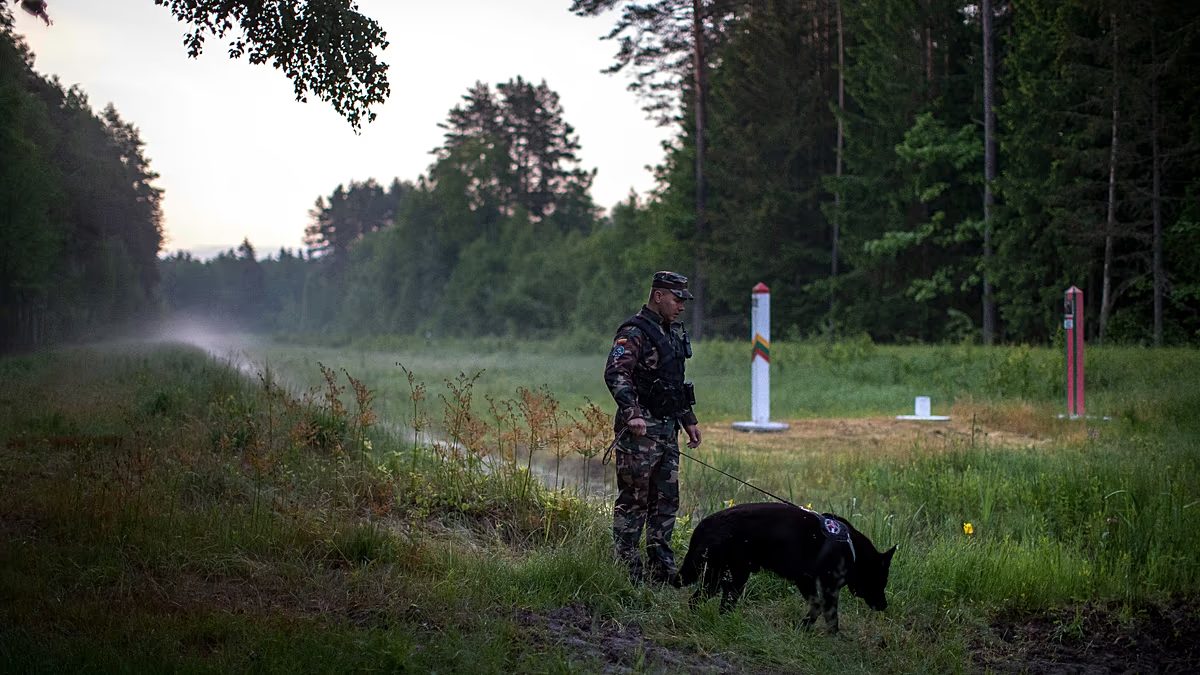
Lithuania and Poland have begun joint work on procedures for moving civilians across their shared border in a crisis, with the effort tied to Lithuania’s largest annual mobilisation drills that started on 25 September and run through 3 October. The head of Lithuania’s National Crisis Management Centre, Vilmantas Vitkauskas, told journalists that the two countries are examining logistics, transport flows, road capacity and infrastructure needs so that any large-scale evacuation of residents from Lithuania, Latvia and Estonia can be managed without bottlenecks at the border. A Polish delegation of around twenty officials from various institutions is taking part, reviewing gaps on both sides before a formal agreement is reached. The Suwałki corridor, the narrow land link between Poland and Lithuania, receives particular attention because of its dual military and logistical role.
The drills themselves test how state institutions would shift to a mobilisation footing if security deteriorated, energy and communications were disrupted, or allied forces arrived. Roughly three thousand officials, local-government representatives, business figures and volunteers are involved, alongside separate civil-defence exercises that simulate the evacuation of residents from municipalities bordering Belarus. Vilnius city authorities have already drawn up their own internal plan, with three main routes: one toward Panevėžys and Šiauliai, another toward Kaunas and Klaipėda, and a third toward the Suwałki corridor. The municipality expects to organise transport for about 120,000 residents who would need assistance, while the remainder would use private vehicles along designated routes with traffic-control points. Officials calculate that clearing the entire capital could require eight to ten days.
Vitkauskas has stressed that an internal evacuation plan already exists and that the new work focuses on the international dimension. In a scenario where border controls are introduced to support mobilisation and retain key personnel, large numbers of people could accumulate at crossing points. The task, he said, is to map procedures for one-way traffic in both directions, assess bridge reinforcement requirements and document shortcomings so that infrastructure investments can follow. Polish participation, he added, lifts the planning to a higher level because the neighbouring country’s input on its own side of the border is essential.
Reporting from Lithuanian outlets supplies the concrete operational detail. One account records Vitkauskas describing the assessment of transport links and the need to organise flows so that departures and arrivals do not collide. Another records Vilnius civil-defence officials explaining that average speeds during an evacuation might drop to around ten kilometres per hour and that the municipality would handle a quarter of the city’s population directly. These pieces also note that the exercises include practical tests of warning systems, collection points and movement through multiple regions.
Coverage elsewhere carries the same core statements from Vitkauskas but compresses them into a shorter regional-security item. Accounts published in Serbia and Azerbaijan cite the coordination and the Polish delegation, mention the Suwałki corridor’s importance and note the timing with the Lithuanian exercises, yet omit the specific timelines for Vilnius or the detailed logistics of one-way traffic and bridge work. The Russian-language edition published in Latvia translates the Lithuanian official remarks and adds that the plan would cover residents of all three Baltic states, without introducing new operational figures.
A reader limited to any single outlet therefore misses either the granular domestic picture or the wider pattern of how the story travels. The Lithuanian domestic press alone records the eight-to-ten-day estimate for Vilnius and the precise routes already mapped inside the country. Outlets farther away show that the same Vitkauskas quotations reach Southeast Europe and the Caucasus, but they present the development as a concise security development rather than a set of engineering and traffic-management tasks. The convergence across the five articles lies in the existence of ongoing bilateral assessment and the participation of roughly twenty Polish officials; the divergence lies in the depth of procedural description.
What to Watch
The Lithuanian accounts rest on direct on-record statements from Vitkauskas and from Vilnius municipal officials during the exercises themselves. Those statements are consistent where they overlap and supply the only independent count of evacuation duration. The relayed pieces add no contradictory figures; they simply carry less of the local record. Because the planning remains at the assessment stage, no final document exists to compare against the reporting. What the coverage demonstrates is that the practical work of turning a bilateral intention into usable procedures is being done first by the two countries most directly involved, and that only their domestic press has so far published the numbers that would allow an outsider to picture the scale of the task on the ground.
That’s how the world told the story.
Get tomorrow’s bulletin by email — one briefing, up to six stories.
Subscribe freeNo spam. One-click unsubscribe. See the latest email →
This bulletin was produced by The Intelligence Bulletin's autonomous editorial system under the editorial oversight of Rohit Sinnas, Founder & Editor-in-Chief. How it works →