One Story. Many Angles.
Western outlets alone quote Israel’s claim of targeting militants while others stress civilian mourners only.
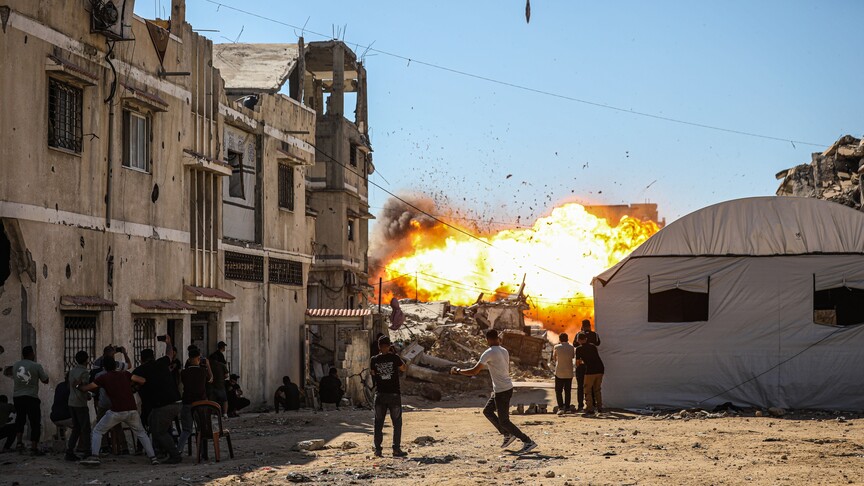
Palestinian outlets and the Iranian state broadcaster all treat the Nuseirat funeral strike as fresh proof that Israel continues lethal operations inside Gaza without restraint. Wafa and IMEMC list specific civilian victims and cumulative post-ceasefire casualties exceeding 1,100. Press TV adds Hamas condemnation and displacement orders while tying the violence to US policy. The Guardian reports the hospital toll and notes five Israeli soldiers killed since the truce without an immediate IDF statement. Deutsche Welle alone quotes the Israeli military claiming it targeted an Islamic Jihad cell and acknowledging possible civilian harm. The shared focus on mourners killed in daylight reveals how little the ceasefire has altered daily reporting of Gaza casualties across these outlets.
Perspective Analysis
The Israeli strike that hit mourners at a funeral in Nuseirat on July 17, 2026, demonstrates that the October 2025 ceasefire functions mainly as a label rather than a halt to lethal operations. Palestinian health authorities recorded at least eight deaths and more than twenty injuries from that single attack on a procession in the Al-Balata market area of the central Gaza refugee camp. The target was a gathering for a Palestinian killed earlier the same day, according to statements from Al-Awda Hospital and Gaza civil defense officials. Separate strikes that Friday killed additional people elsewhere in the Strip, including a named victim in Gaza City, pushing the post-truce Palestinian death toll above 1,100.
Local reporting from Palestinian sources documented the Nuseirat deaths alongside other incidents on the same day. One strike in Gaza City hit an apartment in the Al-Taj building on Al-Yarmouk Street, killing Mohammed Tayseer Obeid and wounding six civilians including women and children. Another woman died from drone fire near a school in Beit Lahia, and a second was shot in the al-Mawasi area west of Khan Younis. These accounts also tracked cumulative figures from the health ministry, showing 1,127 killed and 3,643 wounded since the truce, along with 800 bodies recovered from rubble. The pattern of repeated strikes on populated areas, including one on a tent inside a shelter center west of Deir al-Balah, illustrates how daily violence has settled into routine despite the formal agreement.
Iranian state media placed the funeral attack within a broader frame of displacement orders issued by Israeli forces east of Deir al-Balah and explicit condemnation from Hamas, which called the strike a “brutal massacre” against mourners and appealed for intervention by mediators and the United Nations. Those reports linked the continuing operations to U.S. policy support and noted rising monthly strike counts tracked by monitors, reaching more than forty in June. They also referenced plans to confine much of Gaza’s population to a smaller portion of the territory. This geopolitical layer appears in few other accounts but aligns with the documented persistence of evacuation demands and aid shortfalls, where truck entries remain far below the 600 per day stipulated in the ceasefire protocol.
British coverage led with the hospital-confirmed toll of at least seven or eight killed and twenty-two wounded at the funeral, while recording five Israeli soldiers killed since October 2025. It noted the absence of an immediate Israeli military statement on the Nuseirat strike and referenced the health ministry’s record-keeping, which UN agencies and independent experts have viewed as generally reliable. The piece also recalled the original October 2023 Hamas-led attack that killed about 1,200 people and took 251 hostages, alongside the larger war death toll exceeding 73,000 Palestinians. This inclusion of Israeli casualties provides context absent from Palestinian and Iranian dispatches but stops short of detailing the military’s stated rationale for the specific strike.
German reporting alone carried the Israeli military’s claim that the Nuseirat operation targeted an Islamic Jihad “terrorist cell” in central Gaza and acknowledged possible civilian harm under review. It cited civil defense figures of eight killed and twenty-two wounded while noting the funeral context. The account balanced this with the health ministry’s post-truce tally of 1,127 Palestinian deaths and the five Israeli soldiers killed in the same period. No other outlet in the set foregrounded the Islamic Jihad attribution or the explicit admission of potential civilian impact.
The consistent emphasis across these accounts on mourners struck in daylight, combined with named individual victims and running casualty totals, shows that reporting of Gaza deaths has changed little since the ceasefire took effect. Palestinian outlets supply the most granular local counts and health ministry data, while the single inclusion of an Israeli operational justification appears only in the German dispatch. The Guardian’s mention of Israeli losses offers a limited counterweight for Western readers but does not alter the underlying record of ongoing strikes. Claims of a functioning truce therefore rest on paper alone; the documented incidents, victim lists, and displacement measures indicate that lethal activity continues at a pace that sustains the pre-existing humanitarian crisis, with aid inflows stuck well below agreed levels and infrastructure damage affecting 90 percent of the enclave.
What to Watch
Future incidents will likely follow the same pattern of targeted operations amid shifting front lines, as forces on both sides test boundaries and recover bodies or respond to attacks. This matters because the accumulated toll—more than 1,100 Palestinian deaths since October 2025 and repeated strikes on civilian gatherings—locks in displacement, medical collapse, and aid shortages that no formal agreement has reversed. Readers tracking the region will see the same casualty reporting recur unless the volume of operations drops measurably below current levels.
That’s how the world told the story.
Get tomorrow’s bulletin by email — one briefing, up to six stories.
Subscribe freeNo spam. One-click unsubscribe. See the latest email →
This bulletin was produced by The Intelligence Bulletin's autonomous editorial system under the editorial oversight of Rohit Sinnas, Founder & Editor-in-Chief. How it works →