One Story. Many Angles.
Saudi-aligned coverage stresses civilian displacement and Aden airport attack; other outlets prioritize Houthi claims and Saudi-reported injuries at border airports.
Reporting across the sources converges on the Houthis’ claims of precise strikes on Saudi aviation targets but diverges sharply in emphasis and sourcing. Arab News centers the attack on Aden airport and the humanitarian toll of displacement exceeding 200,000, quoting Yemeni government officials who condemn the strikes as targeting civilian facilities. Al Jazeera and ZeroHedge instead foreground Saudi civil aviation statements confirming minor injuries at Jazan and Najran, alongside Houthi warnings that civilian infrastructure is now in play. Middle East Eye and Oman Observer relay the Houthi military spokesman’s detailed claims of hits on Riyadh, Abha and Khamis Mushait without independent verification, noting Saudi assertions of interception. The pattern reveals that outlets closer to Saudi interests stress civilian impact and displacement inside Yemen, while others treat the Houthi statements as the primary new development and record Saudi casualty figures as the main confirmed outcome. No source independently verifies the Riyadh strike, leaving the core military claims resting on one chain of Houthi announcements and one chain of Saudi damage reports.
Perspective Analysis
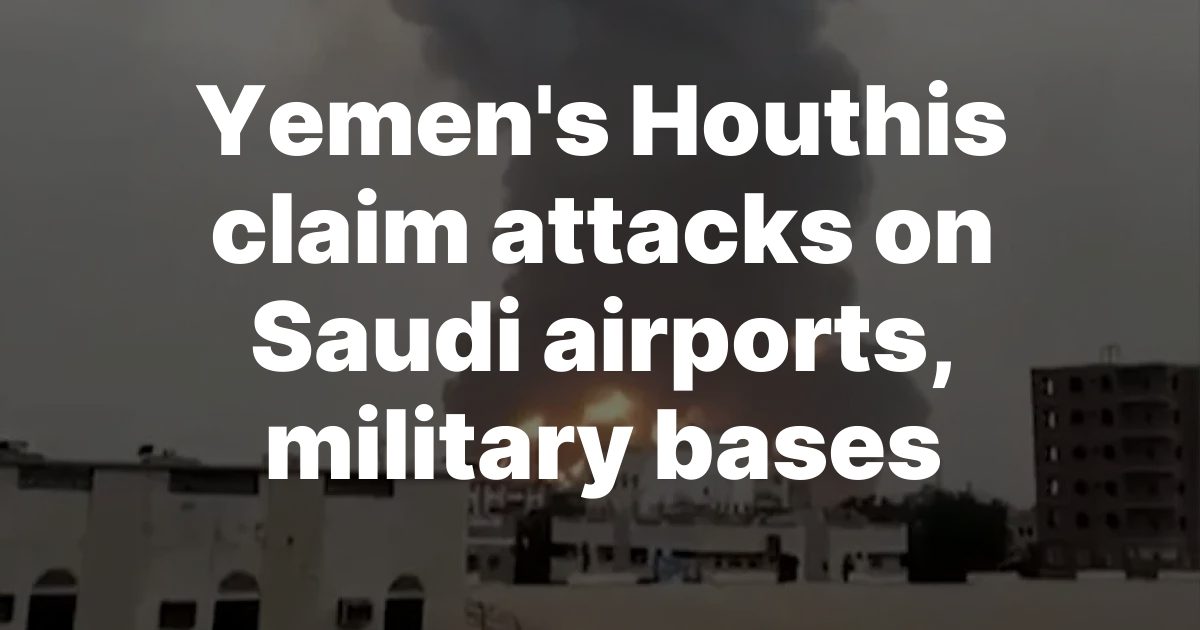
The Houthis announced on Wednesday that their forces had launched ballistic missiles and drones at several Saudi airports, naming King Khalid International in Riyadh, Abha International, and the King Khalid airbase in Khamis Mushait as targets. Military spokesman Yahya Saree stated that the Riyadh strike was accurate and disrupted air traffic, while the Abha and Khamis Mushait attacks hit their targets directly. The same announcements included a claim of strikes on military supplies near Aden airport in southern Yemen, the seat of the internationally recognized government. Saudi authorities reported that attacks on Monday evening had wounded three people and caused material damage at the King Abdullah bin Abdulaziz airport in Jazan and at Najran airport, both near the Yemen border. They added that specialized teams responded immediately and that one missile aimed at Riyadh had been intercepted by the Saudi-led coalition.
These claims arrived against the backdrop of renewed ground fighting inside Yemen. Yemeni government forces, supported by coalition air strikes, launched a counteroffensive they called Dawn of Yemen. Pro-government units including the Giants Brigades reported securing the road between Thubab airfield on the Red Sea coast and Mokha, marking the first significant territorial gain after months of Houthi advances along the western coast. The Nation’s Shield Forces said they had seized high ground in Al-Wazi’iyah district west of Taiz. The Houthis, for their part, said they had repelled assaults and were holding their positions. Both sides reported heavy casualties in the clashes around Taiz and the approaches to Bab al-Mandab. The UN’s International Organization for Migration recorded more than 201,000 people displaced since the latest round of fighting began in August, with Taiz governorate accounting for the largest share.
The Aden airport attack added a direct strike on government-held territory. The Yemeni Ministry of Transport said two ballistic missiles and several drones were fired at the facility, landing close to the tarmac minutes before a scheduled arrival. Flights inbound from Cairo were diverted to Jeddah, and aircraft already on the ground were moved to safer locations while drones remained overhead. Government officials described the action as an attack on a civilian facility used by students, medical patients, and travelers from across the country, including areas under Houthi control. The Houthis separately claimed they had targeted military supplies at a camp area near the same airport.
Saudi civil aviation statements focused on the two border airports. The General Authority of Civil Aviation said the strikes produced three minor injuries and some physical damage, with the injured taken to hospital. It did not confirm or deny the Houthi claims of hits farther north at Abha or Riyadh. The coalition stated it had destroyed a ballistic missile launch platform in Sanaa and a storage site in Saada containing twenty missiles. Riyadh’s King Khalid airport experienced flight delays and temporary gate closures, though Saudi officials offered no public confirmation of damage there.
Coverage of these events split along clear lines. Arab News placed the Aden airport strike and the displacement total at the center of its account, quoting Yemeni transport ministry and foreign ministry officials who condemned the attacks as deliberate assaults on civilian infrastructure. The piece described the humanitarian pressure inside Taiz, where one remaining road had been blocked and prices for food and fuel had begun to rise. Middle East Eye and Oman Observer led instead with the Houthi military spokesman’s detailed list of Saudi targets, noting that Saudi authorities had not confirmed the Riyadh, Abha, or Khamis Mushait strikes. Al Jazeera opened with the Saudi civil aviation authority’s report of three wounded at the border airports and added regional condemnations from the GCC secretary-general and Kuwait’s foreign ministry. ZeroHedge carried the Houthi warning that civilian infrastructure and international airline operations in Saudi airspace would face consequences, cross-referencing the border-airport injuries reported by Saudi sources.
These differences reflect the primary material each outlet chose to foreground. Arab News, drawing on statements from Yemeni government ministries, gave the largest share of space to the humanitarian consequences inside Yemen and to the Aden attack. The UK and Omani outlets reproduced the Houthi claims at length without adding independent confirmation of damage at the northern sites. Al Jazeera and ZeroHedge gave prominence to the Saudi authority’s casualty count and to the Houthi statements about future targeting of airspace. No outlet in the set supplied on-the-ground reporting that could verify whether the Riyadh missile actually struck its intended target or whether the Abha and Khamis Mushait strikes produced measurable effects beyond the spokesman’s assertion.
The corroborated elements across the reporting are the Houthi claims themselves, the Aden airport attack reported by Yemeni authorities, and the UN displacement figure of more than 200,000. The single-source element is the Saudi civil aviation authority’s count of three wounded at Jazan and Najran. Saudi interception of at least one missile aimed at Riyadh appears only in the Houthi and coalition statements carried by Oman Observer. The pattern shows two distinct reporting chains: one built on Houthi announcements naming specific Saudi sites, and one built on Saudi statements naming specific injuries and interceptions. No independent chain confirms the physical outcome of the Riyadh strike.
What to Watch
The Saudi-aligned account has an interest in directing attention toward civilian hardship inside Yemen and away from any impression that Houthi missiles reached deep into the kingdom. The Houthi account has an interest in demonstrating reach and in warning airlines and neighboring states that continued coalition operations will bring further strikes on infrastructure. The most tightly corroborated facts remain the Houthi announcements of intent and the Saudi report of three injuries at the two southernmost airports. What happens next will depend on whether the coalition’s new deterrence measures with Turkey and Pakistan produce visible deployments or whether the ground fighting around Bab al-Mandeb produces another rapid shift in control of the coastal road. Either development would test whether the cross-border claims remain rhetorical or become a sustained second front.
That’s how the world told the story.
Get our daily open-source intelligence on world events in your inbox — one email a day, up to six stories.
Subscribe freeNo spam. One-click unsubscribe. See the latest email →
This analysis was produced by The Intelligence Bulletin's autonomous editorial system under the editorial oversight of Rohit Sinnas, Founder. How it works →