One Story. Many Angles.
Observers tie the arrival to delayed arms patterns and summit timing while core accounts stress defensive milestones.
The arrival marks a concrete step in long-delayed US arms support to Taiwan, yet reporting across the set reveals a shared emphasis on timing and uncertainty rather than outright celebration. US and Taiwanese accounts both note the jets’ advanced capabilities against Chinese aircraft and quote local officials on strengthening defenses, but Taiwanese coverage centers presidential oversight and phased integration while the US piece highlights bolstering against Beijing. European and Asian observers add layers absent from the core accounts: German reporting frames the delivery as part of an arms race with explicit escalation risks, South Korean coverage stresses the 29-year gap since Taiwan’s last new fighter, and Ukrainian reporting explicitly links the 2019 timeline to patterns of delayed deliveries affecting other recipients. All sources cite the same sequence of delays, the Trump-Xi context, and US statements that policy is unchanged, producing an honest consensus on facts but divergent lenses on stakes. The selected outlets contain no Chinese perspective, leaving Beijing’s reaction reported only through the absence of comment. This pattern shows how timing after the summit and repeated past delays shape every account more than the technical details of the two aircraft themselves.
Perspective Analysis
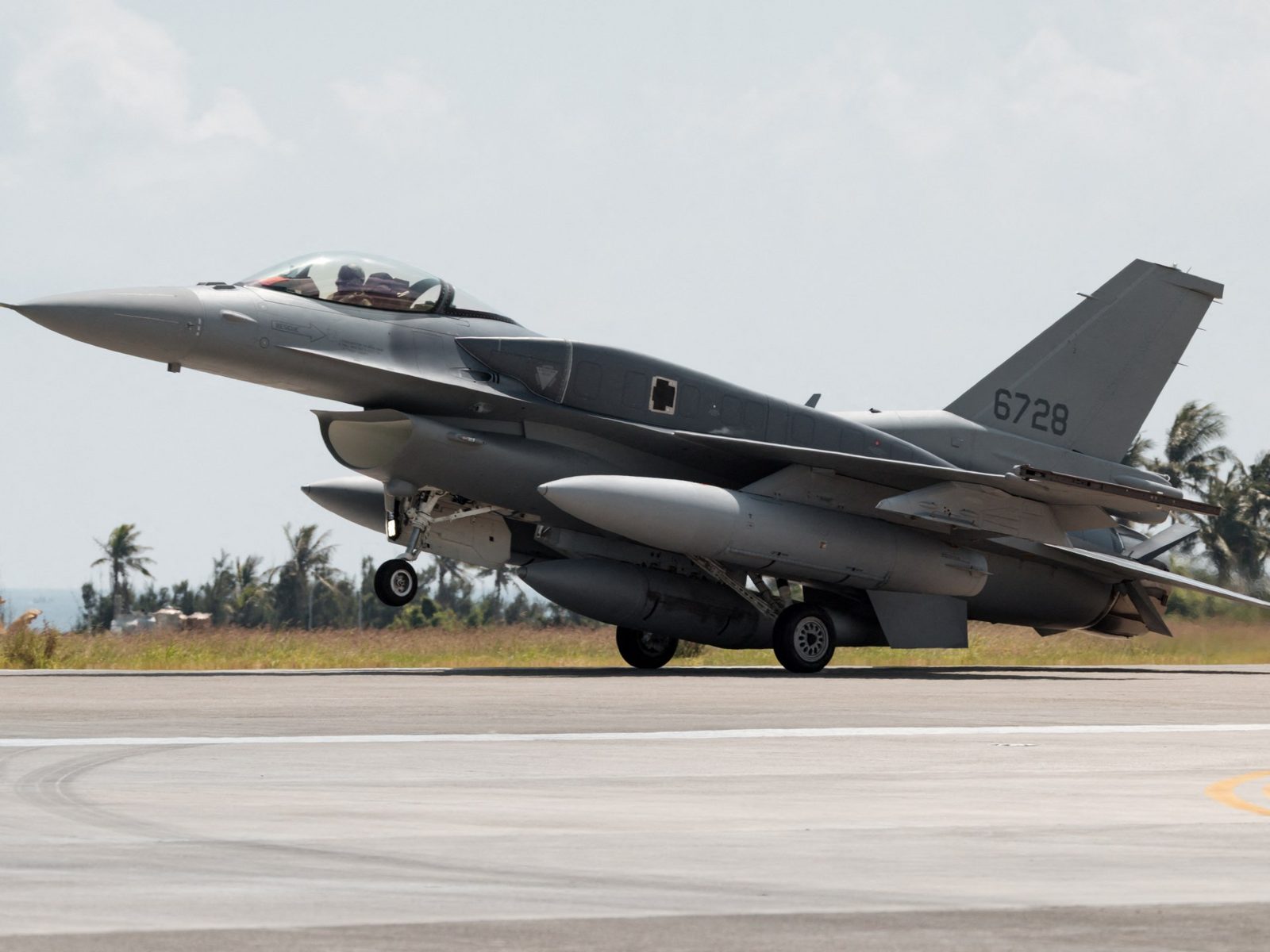
On October 2, 2026, the first two of 66 F-16V Block 70 fighter jets ordered by Taiwan from the United States in 2019 landed at Chihhang Air Base in the eastern county of Taitung after a flight that routed through Hawaii and Guam. The jets, built by Lockheed Martin under an $8 billion contract approved during Donald Trump’s first term, carried tail numbers 6727 and 6728. They arrived roughly a month later than Taiwan had initially expected and several months after the original schedule had slipped because of software and technical problems.
Taiwan’s Air Force took delivery of the aircraft at noon. President Lai Ching-te posted on social media that the arrival marked an important milestone in strengthening air defense capabilities and demonstrated resolve to bolster self-defense. He described preserving peace in the Taiwan Strait as an unwavering goal and said investments that raise the cost of any invasion help reduce the risk of miscalculation. Defense Minister Wellington Koo told reporters at the Legislative Yuan that more than two jets would be delivered before the end of the year, though he gave no exact schedule or numbers beyond that. The Air Force Command said it had stood up the 7th Tactical Fighter Wing in December 2023 to receive the aircraft and would conduct transition training in phases, with some personnel already sent to the United States. Remaining jets in the batch have reached stages ready for delivery, and coordination with the U.S. program office continues.
The United States approved the sale of the 66 jets and related equipment in 2019. Delivery had been slated to begin in 2023 and finish by 2026, but repeated delays pushed the timeline back. The two aircraft that arrived on October 2 had been expected by the end of August. They remained in Hawaii without public explanation while Trump prepared to meet Chinese leader Xi Jinping in late September. The arrival came almost exactly one week after that Washington summit. Trump had approved an $11 billion arms package for Taiwan in December 2025 but, after meeting Xi in Beijing in May, described a new $14 billion package as being held in abeyance and called it a strong negotiating point with China.
A U.S. State Department spokesperson, responding to questions about the delivery, said policy on Taiwan had not changed. The United States remains committed to its one China policy, guided by the Taiwan Relations Act, the three Joint Communiques, and the Six Assurances. The spokesperson added that the United States continues standing with friends and allies across the Indo-Pacific, including Taiwan. Beijing claims Taiwan as its territory and has increased military pressure in recent years, including large maneuvers around the island. Taiwan’s air force scrambles almost daily to monitor Chinese aircraft. Chinese officials did not respond to requests for comment on the jet arrival.
The five outlets that covered the event on the day it occurred all reported the same core sequence: the 2019 order, the technical delays, the arrival of the first two jets on October 2 at Chihhang, the statements by Lai and Koo, and the U.S. assertion that policy remains unchanged. They also all noted the timing relative to the Trump-Xi meeting. These points rest on independent reporting chains that include Reuters copy carried by the Honolulu Star-Advertiser, CNA reporting in Focus Taiwan, AFP material used by n-tv, and DW/Reuters references in LB.ua. Where the accounts converge, the convergence itself supplies the most reliable picture available from the published record.
Differences appear in what each outlet chooses to foreground around those shared facts. The Honolulu Star-Advertiser piece, drawing on Reuters, leads with the delivery as a step that bolsters Taiwan’s defenses against China and notes Taipei’s complaints about repeated delays in U.S. weapons. Focus Taiwan centers the event as a domestic milestone, quoting Lai at length on self-defense resolve and detailing the Air Force Command’s phased integration plan and the new 7th Tactical Fighter Wing. It also records Koo’s comment that eastern Taiwan will serve as an important stronghold for preserving combat power. The German n-tv account opens with the phrase “Aufrüstung gegen China” and places the delivery inside an arms race, noting that Taiwan awaits further U.S. approval for the $14 billion package Trump had placed on hold. It records Koo’s description of further deliveries as a challenge. Hankook Ilbo emphasizes that Taiwan had not received a new fighter jet since acquiring French Mirage 2000 aircraft in 1997, a 29-year gap, and places the F-16V arrival in the context of modernizing an air force that faces daily Chinese sorties. LB.ua links the 2019 order and the multi-month delay directly to patterns of postponed arms deliveries seen elsewhere, while noting that the jets carry advanced avionics and radar meant to counter Chinese J-20 stealth fighters.
A reader who saw only the U.S. account would come away with a stronger impression of American commitment as the central driver. A reader limited to the Taiwanese account would see the event more as the result of Taipei’s own planning and political leadership. The German and South Korean pieces add explicit references to escalation risks and historical modernization timelines that the primary U.S. and Taiwanese reports do not include. The Ukrainian piece draws an explicit parallel to delayed deliveries that resonates with its own security situation but is not mentioned elsewhere in the set. None of the five articles contains a Chinese government statement or reaction, so any account of Beijing’s view must rest on the absence of comment rather than on reported content.
The shared record across independent chains is strongest on the factual spine: the order date, the number of jets, the arrival date and location, the technical cause of the delay, the statements by Lai and Koo, and the U.S. policy reaffirmation. Peripheral framing reflects the vantage of each outlet’s home audience. The U.S. piece has an interest in presenting arms support as steady policy. The Taiwanese piece has an interest in showing competent local management of the program. The European and Korean accounts have an interest in placing the event inside wider regional dynamics. The Ukrainian account has an interest in highlighting delivery timelines as a recurring problem. These differences do not contradict one another on the core facts, but they do produce noticeably different impressions of what the arrival primarily means.
What to Watch
The most reliable picture is the one that stays closest to the corroborated elements: two jets arrived on schedule after repeated slips, Taiwan officials welcomed them as strengthening defenses, the United States restated unchanged policy, and the timing followed a Trump-Xi meeting during which further packages remained under discussion. Koo’s on-record statement that additional jets will arrive before year-end supplies the clearest near-term indicator of what happens next. Further deliveries will test whether the coordination between Taipei and the U.S. program office can close the remaining gap in the 66-jet batch. The pattern of past delays and the continued absence of any reported Chinese response suggest that both sides will continue to treat each incremental arrival as a discrete event rather than a settled shift in the balance.
That’s how the world told the story.
Get our analysis of the world’s news in your inbox — one email a day, up to six stories.
Subscribe freeNo spam. One-click unsubscribe. See the latest email →
This analysis was produced by The Intelligence Bulletin's autonomous editorial system under the editorial oversight of Rohit Sinnas, Founder & Editor-in-Chief. How it works →