 AI-generated analysis published under the editorial responsibility of Rohit Sinnas. How it works →
See the 35 countries
Albania, Armenia, Austria, Azerbaijan, Bosnia and Herzegovina, Bulgaria, China, Croatia, Czech Republic, Denmark, Egypt, Germany, Greece, Hungary, India, Israel, Jordan, Latvia, Lebanon, Macedonia, Moldova, Montenegro, Oman, Poland, Romania, Russia, Serbia, Spain, Switzerland, Turkey, Tuvalu, Ukraine, United Kingdom, United States, Venezuela
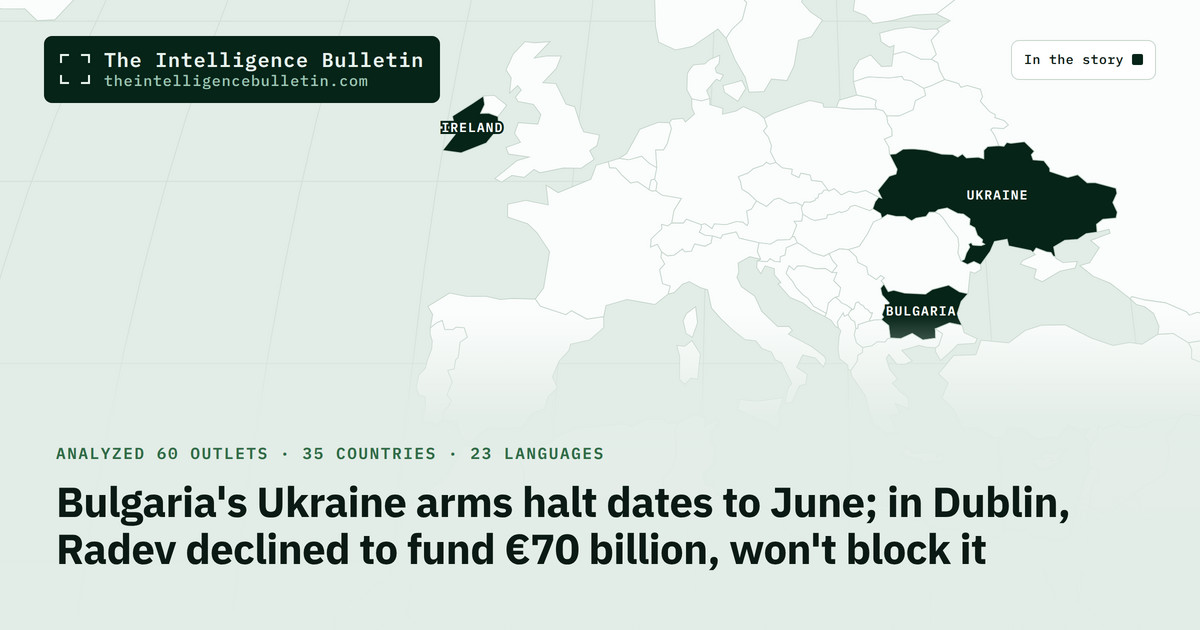
Radev said in Dublin that Bulgaria will not pay into the EU’s proposed €70 billion for Ukraine, citing its deficit, but will not block it. The army-depot weapons halt he restated dates to June, and commercial arms exports continue.
Across the press: Telegraf and Politika date Bulgaria’s depot halt to June; only Plovdiv24 and Politika report Radev’s written protest over dropped Abu Dhabi language.
Source base: 5 outlets read in full (Bulgaria, Ukraine, Russia, Poland, Serbia), selected from 60 analyzed.
- 4 of 5 · reported separatelyBulgaria no longer supplies weapons and ammunition from its army’s stockpiles to Ukraine, a halt Radev’s government announced in June 2026 and restated in Dublin on November 13.Radev’s Dublin remarks reported by Plovdiv24 and Politika; Telegraf dates the halt to June 23 and Argumenty Nedeli, relaying Reuters, to June.
- 5 of 5 · reported separatelyBulgaria will not contribute to the proposed additional €70 billion for Ukraine, citing its EU excessive-deficit procedure, but will not block other member states from paying.Radev, after meeting Ursula von der Leyen in Varna on November 10 and again in Dublin, reported across all five outlets.
- 3 of 5 · reported separatelyCommercial arms exports by Bulgaria’s defense industry are not banned, though Radev says they have declined since 2022–2023 because the war now needs drones more than shells.Radev in Dublin per Plovdiv24 and Politika; Telegraf’s own analysis.
- 2 of 5 · reported separatelyBulgaria backed the Dublin declaration on key principles of European security but entered a written reservation on its preamble, because language supporting the Abu Dhabi negotiations was removed from earlier drafts.Radev to reporters in Dublin, reported by Plovdiv24 and Politika.
- 2 of 5 · reported separatelyBulgaria received about €245.2 million in compensation for military aid given to Ukraine between 2022 and October 2026, €5.1 million of it through the European Peace Facility.Defense Minister Dimitar Stoyanov on November 7, reported by Telegraf (citing BTA) and Politika.
- 2027The €70 billion is meant to cover Kyiv’s expected financing shortfall that year, so any gap left by opt-outs would surface then.
- Still openWhat position will the team carry on Russia s demand for a new European security architecture, given Merz s we have that already, Kallas s insistence that it wait until after a peace deal, and EU officials reported openness at Abu Dhabi to parallel tracks? · Will the Kremlin accept a seven-member European team, when Putin asked for a single chief negotiator and, according to Politico, Moscow questioned on Friday whether he had agreed to any European seat?
- 14 Nov · Europe picks a five-nation team, not one negotiator, for Ukraine talks; Politico says Kremlin questions any European seat
- 12 Nov · Fifty leaders gather in Dublin to claim a Ukraine role; EU officials concede no negotiator will be named
- 13 Nov · Witkoff promises Europe a seat after Putin talks; Putin s price is one negotiator EU leaders decline to name
Full analysis
What happened Why it matters How each country tells it Room for disagreement Our assessment Sources and evidence
What happened
Bulgarian Prime Minister Rumen Radev told reporters at the informal meeting of EU leaders in Dublin on November 13 that his country no longer supplies weapons from its army’s stockpiles. "We no longer provide weapons and ammunition from the depots of the Bulgarian Army," he said. He added that Bulgaria has no money for the proposed €70 billion package for Ukraine, and that it had signed the summit’s declaration on European security only with a written reservation. The first of those lines produced headlines about a suspension. It was a restatement.
Telegraf dates the depot decision to June 23. That day Radev said that after 13 aid packages, Bulgaria had exhausted what its army could hand over without weakening national defense. In Dublin, Politika quotes him: "I said that clearly when our government took office." Argumenty Nedeli, relaying Reuters, attributes a June statement to Defense Minister Dimitar Stoyanov. It adds, on Reuters’ account alone, that partner countries were not notified when the aid stopped.
The policy reversed one that was only months old. Telegraf recalls that Radev, then president, opposed lethal aid in 2022, and that parliament overrode that stance on November 3, 2022. A government approved a 13th package in February 2026. On March 30, 2026, acting Prime Minister Andrey Gyurov and Volodymyr Zelensky signed a ten-year security agreement. It provided for continued military aid and joint production of drones and ammunition.
Radev’s government then moved step by step. In July, Wirtualna Polska reports, he declined Emmanuel Macron’s personal invitation to the Coalition of the Willing in Paris. "I do not think Bulgaria’s place is in this coalition," he said. Politika adds that a Bulgarian parliamentary decision bars the country’s soldiers from any mission the coalition is training to send to Ukraine. In September, by Wirtualna Polska’s account alone, Sofia threatened to oppose the EU’s 21st sanctions package on Russia. It demanded that three names be removed: Patriarch Kirill, former Lukoil chief Vagit Alekperov, and Iskander Makhmudov, a businessman linked to a supplier of spare parts for the Sofia metro. All three were removed, and Bulgaria then backed the package. Argumenty Nedeli reports that in October Sofia also declined to finance lethal weapons through the European Peace Facility.
The money refusal was formalized on November 10 in Varna, after Radev met Ursula von der Leyen. Politika says the €70 billion is meant to cover Kyiv’s expected financing gap in 2027. On October 20, Radev had pointed to the EU’s earlier €90 billion loan and asked how new demands looked amid Europe’s economic troubles. Politika reports that German Chancellor Friedrich Merz had asked Bulgaria, Hungary, Slovakia and Czechia to contribute. Citing Bulgarian National Radio, it adds that the Slovak and Czech premiers had already said no. "Mrs. von der Leyen keeps asking us to bring the deficit below 3 percent," Radev said in Varna, as quoted by Wirtualna Polska. Von der Leyen answered, per Politika, that the war would end "if Russia gives up its aggressive actions."
In Dublin, Radev repeated that Bulgaria blocks no one. "Whoever decides to help and invest money in whatever they want, let them do it," he said, according to Politika. He offered to discuss mechanisms that would keep any money away from weapons and direct it to humanitarian aid, electricity and medical care. If Bulgaria acted as a guarantor, he wanted funds steered to Ukraine’s Bulgarian community. Plovdiv24 quotes him calling it the largest historic community of any EU member state in Ukraine. He listed what Sofia still provides: electricity exports, repairs to Ukraine’s energy and rail infrastructure, and free assistance to thousands of Ukrainian families in Bulgaria.
Two details narrow the weapons story. First, commercial exports by Bulgaria’s arms makers are not banned. Radev said they were enormous in 2022 and 2023 and have declined since, because the war now needs drones more than the shells Bulgaria makes. Second, Defense Minister Stoyanov said on November 7, per Telegraf citing the state agency BTA, that Bulgaria received €245.2 million in compensation for aid given between 2022 and October 2026. Of that, €5.1 million came through the European Peace Facility and €240.12 million through agreements with allied countries.
The declaration dispute is the part Plovdiv24 leads with. Earlier drafts, Radev said, included text on the importance of the Abu Dhabi negotiations and the need to support them, and that text was later removed. Bulgaria backed the rest of the document, which Politika describes as a French initiative. Its objection to the preamble is recorded in the meeting’s minutes. Politika also quotes Radev saying Washington "has enough levers" to keep both sides talking.
Why it matters
For Kyiv, the material loss in Dublin was close to nil. The depots had been shut for five months, and Sofia had been largely repaid for what it gave. Telegraf still warns that losing a direct source of Soviet-caliber ammunition, which fits Ukraine’s existing guns without retraining, will be felt most in artillery supply. It adds that Ukraine’s partners can keep buying Bulgarian output on commercial terms.
The €70 billion refusal matters less for its size than for its justification. A deficit procedure is a reason other governments under EU fiscal pressure can borrow, and Politika’s report puts Bratislava and Prague in the same place as Sofia.
The reservation matters for timing. On the day Europe named a five-nation team to claim a seat in US-mediated talks, as TIB reported on November 14, a member state formally objected that the EU’s own text no longer endorsed the Abu Dhabi track Europe had been kept out of. None of the five outlets here is from Brussels, Berlin or Paris. The only EU-side response on the record is von der Leyen’s line in Varna, so how other capitals received the reservation is unreported in this set.
How each country tells it
- Plovdiv24 · Bulgaria · original reportingA straight readout of Radev’s Dublin remarks to reporters. It opens on his written reservation to the preamble of the European security declaration over dropped language backing the Abu Dhabi talks, and reaches the depot line and the deficit argument only later.
- Telegraf · Ukraine · opinionAn explainer on what Bulgaria has supplied since 2022 and what Kyiv loses now. It dates the depot halt to Radev’s June 23 announcement and notes that Bulgarian factories can still sell to Ukraine’s partners commercially.
- Argumenty Nedeli · Russia · carries ReutersUnder a headline calling Bulgaria ‘no comrade’ to Ukraine, the body is a sober retelling of a Reuters report. It covers the €70 billion refusal and the depot halt, and states plainly that Bulgaria ‘does not refuse support of Ukraine entirely.’
- Wirtualna Polska · Poland · original reportingIt frames Bulgaria as the latest EU state to break ranks. It ties the €70 billion refusal to Radev’s July rejection of the Coalition of the Willing and to Sofia’s September demand to strip names from the EU’s 21st Russia sanctions package.
- Politika · Serbia · original reportingA full Sofia-datelined account that combines the money refusal with Radev’s refusal to send soldiers to any Ukraine mission. It quotes him saying the depot halt was announced ‘when our government took office.’
Room for disagreement
The strongest case against treating this as a non-event is cumulative. Taken in order, the steps run as follows. June brought the depot halt, July the coalition refusal and September the sanctions carve-outs. October brought the European Peace Facility refusal, and November the €70 billion opt-out and the Abu Dhabi reservation. Each step was framed as not blocking anyone, and each moved Sofia further from the coalition’s line. The sanctions episode shows that the threat of a veto has already worked once.
Argumenty Nedeli pairs Sofia with a report, carried by no other outlet here, that Donald Tusk ended Polish funding for purchases of US weapons for Ukraine under NATO’s PURL program, citing deficits. If that holds, the budget argument is spreading to Ukraine’s most committed backers, not only its reluctant ones.
Our assessment
It is very likely that Bulgaria stays out of the €70 billion package without vetoing it, and that its weapons policy stays where it has been since June. The warrant is Radev’s own on-record statements in Varna and Dublin, reported consistently across all five outlets. The €245 million reimbursement figure, from the defense minister, supports this reading: the fiscal argument concerns new commitments, not costs Sofia has borne.
Each party has a reason to frame this its own way. Radev wants the reader to see fiscal prudence and peacemaking. Argumenty Nedeli’s headline calling Bulgaria "no comrade" to Ukraine wants a pattern of collapse. Wirtualna Polska’s "hard declaration" wants drift toward Moscow.
The real test is not Bulgarian money. It is whether Sofia’s reservations turn into conditions on decisions that need every member’s vote.
What would change this: Bulgaria threatening a veto over the €70 billion instrument or the next sanctions package, as it did in September, rather than simply sitting out.
Sources and evidence
Press quoted
- Did Poland actually stop funding PURL purchases of US weapons for Ukraine, as Argumenty Nedeli reports Donald Tusk announced, and is that tied to the same budget pressures Sofia cites?
- Does Bulgaria still consider itself bound by the 10-year security agreement signed on March 30, 2026, which Telegraf says provides for continued military aid and joint drone and ammunition production?
- Did the final text of the Dublin declaration restore the Abu Dhabi language Bulgaria demanded, or does its reservation stand in the record?
That’s how the world told the story.
Get our daily open-source intelligence on world events in your inbox — one email a day, up to six stories.
Subscribe freeNo spam. One-click unsubscribe. See the latest email →