May 27, 2026 – Global Headlines

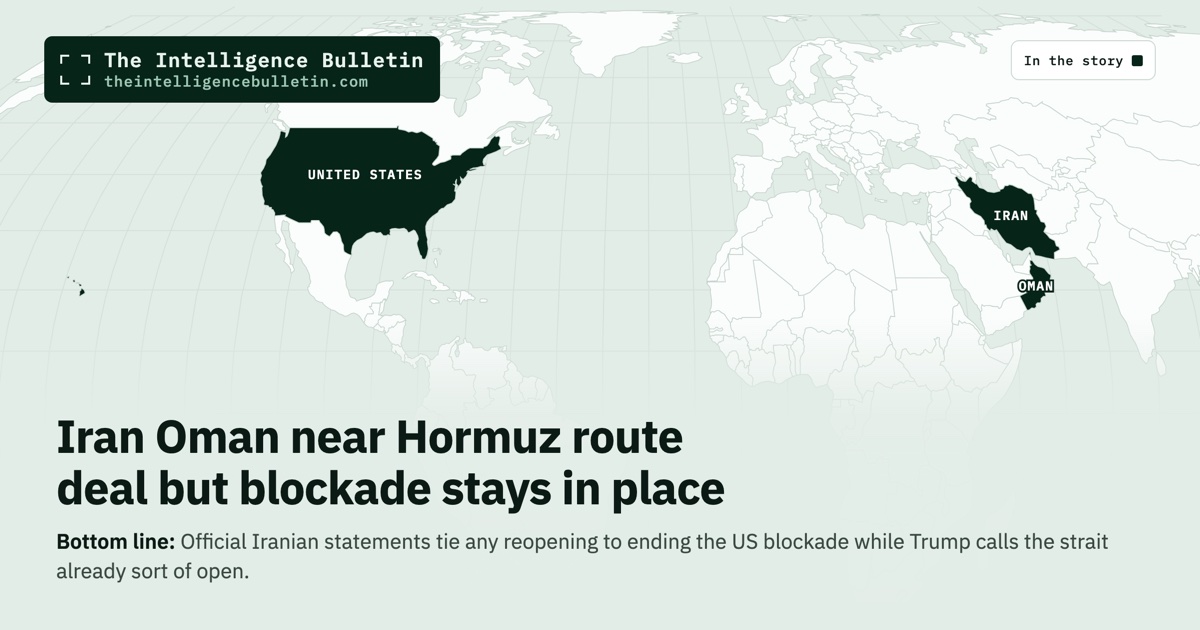
1Rubio Warns Strait of Hormuz Must Stay Open ‘One Way or the Other’

Story gist: On May 26 2026 U.S. Secretary of State Marco Rubio told reporters in Jaipur that the Strait of Hormuz must remain open and that any blockade would be unlawful and unsustainable. The statement followed U.S. strikes on Iran the previous day and came during ongoing bilateral talks. Rubio spoke as both the United States and Iran treat control of the narrow waterway as a core strategic red line.
One Story. Many Angles.
🇵🇰
Pakistan
dunyanews.tv
Rubio says Strait of Hormuz has to be open ‘one way or the other’
Read →
🇺🇸
United States
al-monitor.com
Rubio says Strait of Hormuz has to be open ‘one way or the other’
Read →
Perspective Analysis

The identical headline carried by Dunya News and Al-Monitor captures the bluntness of Rubio’s formulation more than any interpretive spin. Both outlets quote the phrase “one way or the other” verbatim, suggesting the line itself—not background context—drove placement on a day when seven outlets worldwide flagged the same cluster. That convergence is telling: even an outlet attuned to Global South energy-security worries and one steeped in Arab-Israeli diplomatic maneuvering chose to lead with the same raw warning rather than immediate speculation about Iranian retaliation or American follow-through. The location in Jaipur adds another layer. Rubio delivered the ultimatum on Indian soil, a venue that avoids the optics of a Gulf capital yet still sits within striking distance of the waterway whose closure would spike diesel and LNG prices across South Asia. Pakistan’s coverage registers this risk through the lens of developing-economy vulnerability, while Al-Monitor’s regional lens surfaces the same sentence as a possible signal that Washington is still leaving diplomatic lanes open. The shared text therefore functions less as competing frames than as evidence that the threshold language itself has crossed a new threshold of explicitness after the May 25 strikes. In that sense the story’s global pickup reflects not divergent national interests but a shared recognition that the Hormuz clause has been restated more starkly than at any point since the latest round of U.S.-Iran exchanges began.


2Mexico Postpones Judicial Elections to 2028

Story gist: Mexico’s Chamber of Deputies Committee on Constitutional Affairs approved a draft reform on May 26 2026 to shift the next judicial election from 2027 to 2028. The measure also advances electoral law changes and treats serious foreign interference as grounds for nullifying results. The decision was taken in Mexico City by the committee acting as source. It forms part of ongoing judicial reform with direct stakes for election timing and external influence rules.
One Story. Many Angles.
🇲🇽
Mexico
lasillarota.com
Deputies approve in committees postponing the judicial election to 2028 and reform against foreign interference
Diputados aprueban en comisiones aplazar la elección judicial a 2028 y reforma contra injerencia extranjera
Read →
🇲🇽
Mexico
entrelineas.com.mx
Commission approves constitutional reform to postpone 2027 judicial election to first Sunday of June 2028
Aprueban en Comisión reforma constitucional para aplazar elección judicial del 2027 al primer domingo de junio de 2028
Read →
Perspective Analysis

Two Mexican outlets converged on the same narrow procedural fact: a committee vote that simply moves the calendar. That convergence itself signals how tightly the story is still contained within domestic legislative channels rather than broader political contest. Lasillarota.com and Entrelineas.com.mx both led with the approval of the postponement plus the new foreign-interference clause, presenting the package as a single technical package rather than a political maneuver. The shared emphasis on the interference provision is telling; it frames the reform as defensive rather than dilatory, even though the primary effect is a one-year delay. Because both outlets operate inside Mexico’s domestic media ecosystem and drew from the same committee record, the identical framing reflects access to the same official text more than editorial alignment. No external voices or opposition reactions appear in either account, which keeps the story inside the narrow bounds of committee procedure. The absence of market or international reaction in the coverage further underscores that the move has not yet registered as a systemic event beyond Mexico City’s legislative corridors.


3Venezuela Names Rodríguez to Lead 90-Day Government Restructuring

Story gist: On May 26 2026 acting president Delcy Rodríguez announced at Miraflores Palace a national consultation and 90-day executive restructuring process. She appointed Héctor Rodríguez as presidential commissioner to simplify procedures and adapt the state to Venezuela’s new reality. The move follows the departure of Nicolás Maduro and involves the Consejo de Ministros. Regional outlets frame the step as either continuity or post-Maduro transition.
One Story. Many Angles.
🇻🇪
Venezuela
rnv.gob.ve
Mandataria (E) nombra a Héctor Rodríguez Comisionado Presidencial para la Reestructuración del Gobierno
Read →
🇨🇴
Colombia
semana.com
Siguen los cambios en Venezuela: Delcy Rodríguez anuncia comisión para reestructurar su gobierno, tras caída de Maduro
Read →
🇵🇾
Paraguay
lanacion.com.py
La Nación / Presidenta venezolana crea comisión para reestructurar su gobierno tras la caída de Maduro
Read →
Perspective Analysis

The Venezuelan state outlet presents the appointment of Héctor Rodríguez as a straightforward administrative upgrade, with Delcy Rodríguez invoking the Consejo de Ministros to signal orderly internal reform rather than rupture. Colombian coverage immediately situates the same announcement inside the aftermath of Maduro’s fall, treating the commission as evidence that Chavista structures are being recalibrated under pressure rather than voluntarily streamlined. Paraguayan reporting goes further, foregrounding the “caída de Maduro” in the headline itself and reading the 90-day timeline as external validation that the old order has already collapsed. All three accounts record the identical actors and timeline, yet the Venezuelan version withholds any reference to prior leadership change while the others embed the event inside that change. This split reveals how the same bureaucratic announcement functions as proof of stability inside Venezuela and as confirmation of displacement outside it, a divergence rooted in whether the outlet still treats the Chavista government as the legitimate center of power or as a remnant under reconstruction.


4Goyal Charts India-Canada Investment Roadmap with Corporate Chiefs

Story gist: On May 27 2026 Indian Commerce Minister Piyush Goyal met Canadian corporate leaders in Toronto. Discussions covered financial services, infrastructure, sustainable agriculture and critical minerals processing. The meeting sought to expand bilateral economic ties through targeted investment channels. Both Indian sources frame the encounter as a direct corporate-to-government effort to identify concrete partnership opportunities.
One Story. Many Angles.
🇮🇳
India
economictimes.indiatimes.com
Piyush Goyal maps out India’s bilateral roadmap with Canadian corporate chiefs
Read →
🇮🇳
India
calcuttanews.net
Piyush Goyal maps out bilateral roadmaps with Canadian corporate chiefs; Discusses agri, infra, finance, and critical minerals
Read →
Perspective Analysis

The two Indian outlets converge on the same core claim: Piyush Goyal used a single day in Toronto to translate long-standing diplomatic language into sector-specific investment targets. Economic Times leads with the minister “mapping” a bilateral roadmap, treating the Canadian executives as co-authors rather than guests. Calcutta News adds the explicit list of sectors—agri, infra, finance, critical minerals—yet still keeps the narrative anchored in Goyal’s itinerary rather than any Canadian policy shift. That shared emphasis reveals how Indian business media now routinely present high-level visits as deal-scouting exercises first and diplomatic theatre second. The absence of any reference to prior strains in India-Canada relations is itself consistent; both outlets treat the Toronto session as evidence that economic pragmatism can proceed without waiting for political alignment. The listed Canadian firms (McCain, Sun Life, Manulife, TD, Google) appear only as sectoral proxies, never as political actors, which keeps the story squarely inside India’s preferred frame of diversified supply-chain partnerships. In effect the coverage signals that New Delhi sees Canadian capital as one more node in its critical-minerals and agri-tech strategy, regardless of how Ottawa frames the same relationship.


5Xi Jinping Hosts Vucic to Advance China-Serbia Strategic Partnership

Story gist: On 2026-05-26, Chinese President Xi Jinping met Serbian President Aleksandar Vucic in Beijing. Xi urged elevating the comprehensive strategic partnership and expanding cooperation across multiple areas. The talks formed part of ongoing high-level diplomacy between the two nations. The event registered moderate significance with low market sensitivity.
One Story. Many Angles.
🇫🇷
France
lelezard.com
Shared future: China and Serbia elevate comprehensive strategic partnership to new heights
CGTN : Un avenir partagé : la Chine et la Serbie portent leur partenariat stratégique complet vers de nouveaux sommets
Read →
🇷🇸
Serbia
tanjug.rs
Ana Brnabić: Historic visit of President Vučić to China
Ana Brnabić: Istorijska poseta predsednika Vučića Kini
Read →
Perspective Analysis

Both outlets treat the Beijing meeting as a straightforward affirmation of deepening ties, with no visible friction or alternative angles. Lelezard.com, reprinting CGTN material, presents the encounter as the logical next step in a shared future, underscoring Xi’s language of mutual elevation and expanded cooperation. Tanjug.rs, quoting Serbian Prime Minister Ana Brnabić, instead foregrounds the visit’s historic character from Belgrade’s side, framing it as a reciprocal milestone that validates Serbia’s long-standing alignment with China. The convergence is telling: Chinese state messaging and Serbian state media converge on the same narrative of uncomplicated progress because each capital has clear incentives to project stability. For Beijing the encounter reinforces its pattern of high-level European outreach at a moment when other partnerships face headwinds; for Belgrade it signals continuity in a relationship that delivers infrastructure financing and diplomatic cover. Neither outlet introduces third-party reactions, regional context, or domestic Serbian politics that might complicate the picture. The result is a narrow but consistent signal that the two governments are deliberately synchronizing their public diplomacy on this date, treating the partnership as settled rather than contested.


May 26, 2026 – Global Headlines

1Cambodia King Pardons Kem Sokha After Treason Sentence

Story gist: On May 25 2026 Hun Sen signed a royal decree from King Norodom Sihamoni pardoning opposition leader Kem Sokha in Phnom Penh. Sokha had served part of a 27-year treason term linked to the Cambodia National Rescue Party. The pardon left a separate five-year travel ban intact. The decision follows sustained pressure from regional actors and domestic political calculations.
One Story. Many Angles.
🇵🇭
Philippines
bworldonline.com
Cambodian king pardons former opposition leader
Read →
🇺🇸
United States
econotimes.com
Cambodia King Pardons Opposition Leader Kem Sokha After Treason Conviction
Read →
🇺🇸
United States
lowellsun.com
Cambodian opposition leader Kem Sokha receives royal pardon for treason sentence
Read →
Perspective Analysis

The pardon arrives at a moment when Hun Sen appears to be managing succession for Hun Manet while testing how far international and regional tolerance extends. Philippine coverage through bworldonline.com places the event inside ASEAN routines, treating it as one more data point in the search for predictable diplomacy rather than a rights breakthrough. Economic outlets such as econotimes.com read the same decree as a possible signal that Phnom Penh wants to lower friction for investors wary of prolonged political risk. The Lowell Sun, by contrast, anchors the story in the language of democratic contestation, noting the unchanged travel ban and the earlier conviction’s political character. These differences are not contradictions; they reflect where each outlet’s audience actually experiences Cambodia—through supply chains, through alliance management, or through the residual vocabulary of post-1990s democratization. The shared factual core across all three is the narrow scope of the pardon itself, which suggests the gesture is calibrated to release pressure without restoring Kem Sokha or Mu Sochua to open political competition. That calibration, rather than any single headline, is what neighboring capitals and markets are now quietly pricing.


2India Hosts Quad Ministers Amid Indo-Pacific and West Asia Strains

Story gist: India hosted Quad foreign ministers from the United States, Australia and Japan in New Delhi on 25 May 2026. The meeting focused on West Asia tensions, Indo-Pacific maritime security, supply chains and critical technologies. It was announced by the Ministry of External Affairs as a coordinated response to evolving regional challenges. The gathering highlights India’s role in aligning Quad partners on shared strategic priorities.
One Story. Many Angles.
🇮🇳
India
economictimes.indiatimes.com
Quad agenda set in motion: India, Japan align on Indo-Pacific strategy ahead of key meet
Read →
🇮🇳
India
thehindu.com
Quad Foreign Ministers meet LIVE: Amid West Asia turmoil, Quad Foreign Ministers gather to reinforce Indo-Pacific stability
Read →
🇮🇳
India
freepressjournal.in
India To Host Quad Foreign Ministers’ Meeting Today Amid Evolving Indo-Pacific Challenges
Read →
Perspective Analysis

Indian coverage converged on a single narrative: New Delhi positioning itself as the convening power that can link Indo-Pacific security to West Asian instability without forcing a binary choice on partners. Economic Times framed the session through the Japan channel, stressing supply-chain resilience and technology cooperation as the practical deliverables that matter most to business readers. The Hindu placed the same meeting inside the immediate context of Gaza-related fallout, treating the Quad as a stabilising mechanism rather than an economic forum. Free Press Journal emphasised the hosting logistics themselves, presenting the event as evidence of India’s growing diplomatic bandwidth. The absence of any Indian outlet questioning the Quad’s utility or raising non-alignment concerns reveals how completely the grouping has been domesticated inside New Delhi’s strategic consensus. What varies is only the lens—commercial, security or protocol—through which each paper reports the same underlying calculation that India benefits from keeping the four capitals in regular dialogue.


3Pakistan and China Sign 15 Deals Worth $7 Billion in Beijing

Story gist: On May 25 2026 in Beijing, Pakistan Prime Minister Shehbaz Sharif and Chinese Premier Li Qiang witnessed the signing of 15 cooperation agreements and memorandums worth more than $7 billion. The pacts cover trade, investment, agriculture, energy, climate, industrial development and the next phase of CPEC. Pakistani ministers Attaullah Tarar and Ahsan Iqbal joined officials from the National School of Public Policy and Foreign Service Academy in talks with counterparts from China National Academy of Governance and China Media Group. The agreements mark the latest step in expanding bilateral economic cooperation between the two countries.
One Story. Many Angles.
🇸🇾
Syria
sana.sy
Pakistan, China sign 15 cooperation agreements across key sectors
Read →
🇵🇰
Pakistan
thefrontierpost.com
Pakistan, China sign 15 documents to expand bilateral ties
Read →
🇵🇰
Pakistan
samaa.tv
Pakistan, China sign 15 documents to expand bilateral ties
Read →
Perspective Analysis

The $7 billion figure attached to the Beijing signings reveals how both capitals treat CPEC not as a finished project but as an expandable platform for locking in future leverage. Syrian state media at sana.sy immediately placed the agreements inside an anti-Western resistance narrative, portraying them as evidence that Beijing and Islamabad are building parallel structures immune to Western pressure. Pakistani coverage split along familiar domestic lines: thefrontierpost.com stressed the strategic and security guarantees embedded in the next CPEC phase, consistent with Islamabad’s establishment view that economic packages must also deliver hard-power reassurance against India. samaa.tv, by contrast, highlighted investment inflows and job creation without invoking security language, reflecting a commercial outlet’s preference for presenting the deals as straightforward economic relief. What unites the three accounts is the absence of any mention of implementation risk or repayment terms; the shared silence suggests that, at least in official narratives, the political utility of announcing fresh billions still outweighs scrutiny of delivery. The timing, coming days after Xi and Putin extended their own treaty in the same capital, underscores how both Pakistan and China are sequencing high-visibility economic diplomacy to signal durability of their partnership even as global attention remains fixed elsewhere.


4Trump Links Iran Deal to Abraham Accords Expansion

Story gist: On May 25 2026 US President Donald Trump urged Arab and Muslim leaders to join the Abraham Accords and normalize ties with Israel after the Iran war. He signaled possible future expansion including Iran though that remains unlikely. The statement builds on his prior instruction to negotiators not to rush any Iran agreement. Arab states and Pakistan have voiced conditions or outright rejection.
One Story. Many Angles.
🇩🇪
Germany
epochtimes.de
Trump links Iran deal to expansion of the Abraham Accords
Trump verknüpft Iran-Deal mit einer Ausweitung der Abraham-Abkommen
Read →
🇮🇱
Israel
ynetnews.com
Trump pushes Abraham Accords expansion to create regional axis as Arab states insist
Read →
🇱🇧
Lebanon
yalibnan.com
Trump links Abraham Accords to any Iran deal. Pakistan reject the idea
Read →
Perspective Analysis

The most revealing thread is how quickly the story moved from Trump’s May 24 warning against rushing an Iran deal to his explicit tying of any agreement to fresh Arab-Israeli normalization. Epoch Times framed the move as strategic leverage that strengthens Western pressure on Tehran, treating the linkage as a natural extension of existing policy rather than a new demand. Ynet captured the Israeli priority of building an operational anti-Iran front, noting that several Arab capitals are already conditioning their participation on concrete security guarantees. Yalibnan instead foregrounded the Pakistani rejection and broader Arab wariness, underscoring that normalization remains politically costly for governments that still face domestic opposition to deeper ties with Israel. The three angles converge on one structural fact: Trump is conditioning progress on Iran to extract regional realignment that previous US administrations could not secure. The divergence appears only in emphasis, not in the underlying bargain being described.


5Lebanese President Demands Full Israeli Withdrawal from South

Story gist: On May 25 2026 Lebanese President Joseph Aoun stated that complete Israeli withdrawal from southern Lebanon is a non-negotiable national position to be pursued through negotiations under international law and UN resolutions. The demand was issued from Beirut on the anniversary of Israel’s 2000 pullout. It directly targets Israel as the counterpart while leaving Hezbollah’s role unaddressed in the statement itself.
One Story. Many Angles.
🇧🇷
Brazil
brasil247.com
Lebanon President demands total Israeli withdrawal
Presidente do Líbano exige retirada total de Israel
Read →
🇮🇳
India
thehindu.com
Lebanese President says Israeli withdrawal is ‘non-negotiable’
Read →
🇱🇹
Lithuania
15min.lt
Lebanon President Josephas Aounas: Israeli withdrawal is a non-negotiable requirement
Libano prezidentas Josephas Aounas: Izraelio pasitraukimas yra nediskutuotinas reikalavimas
Read →
Perspective Analysis

The most revealing aspect is how little daylight exists between the three outlets on the core fact of Aoun’s demand, even though their editorial homes point in different directions. Brasil247, operating from a Brazilian left that aligns with Lula’s skepticism of Israeli policy, simply records the statement as a straightforward assertion of Lebanese rights without adding qualifiers about Hezbollah or security trade-offs. The Hindu, reflecting India’s careful balance between defense cooperation with Israel and its traditional support for multilateral norms, likewise foregrounds the language of UN resolutions and sovereignty, treating the demand as a diplomatic rather than military matter. 15min.lt, situated inside a NATO member state, reports the same text but situates it within the broader context of ongoing border friction, implicitly reminding readers that any withdrawal would have to contend with Hezbollah’s presence. The convergence suggests the story is being treated as a diplomatic signal rather than a military escalation, which is consistent with the low market-sensitivity score attached to the event. What stands out is the absence of any outlet inflating the statement into a new crisis or downplaying it as rhetoric; all three convey that Aoun is restating a long-standing Lebanese position on the 25th anniversary of the prior withdrawal. This uniformity across Brasilia, New Delhi and Vilnius indicates the episode is viewed as routine boundary-setting rather than a rupture, even as each outlet’s audience brings its own priors about who bears responsibility for the south Lebanon stalemate.


May 25, 2026 – Global Headlines

1Trump Tells Negotiators Not to Rush Iran Deal

Story gist: On 2026-05-24, U.S. President Donald Trump posted on Truth Social that he had instructed negotiators not to rush an agreement with Iran. He stated talks were advancing constructively, time favored the United States, and the blockade on Iran would stay in place until any deal is certified and signed. The statement came amid ongoing nuclear talks involving Tehran and Washington. Key tension centers on whether Iran will accept U.S. terms without immediate relief from sanctions.
One Story. Many Angles.
🇺🇸
US
breitbart.com
Iran Agreed to Surrender Uranium, End Nuclear Ambitions: Reports
Read →
🇨🇳
China
Xinhua
White House says Iran deal could take days: report-Xinhua
Read →
🌐
UK/Iran
Shafaqna
Trump announces advanced negotiations with Iran
Read →
Perspective Analysis

Breitbart’s headline that Iran has agreed to surrender uranium reframes Trump’s cautionary note as outright capitulation, a move that aligns with its consistent portrayal of the president forcing concessions where prior administrations failed. Xinhua instead highlights the White House timeline remark that a deal could take days, underscoring Beijing’s interest in any shift that might ease energy markets or reduce the risk of wider Gulf instability without committing to endorsement. Shafaqna’s emphasis on advanced negotiations presents the same event as evidence that Tehran retains leverage, consistent with its focus on Iranian agency rather than American dictates. The divergence is not over facts but over which actor appears to hold the initiative: one outlet casts the blockade as proof of Iranian weakness, another treats the delay as routine diplomacy, and the third reads the pause as Iranian patience paying off. Structurally this reflects each outlet’s institutional position—domestic boosterism in the first case, state-managed neutrality in the second, and sectarian regional alignment in the third—rather than disagreement on whether talks are occurring.


2Western Premiers Meet in Kananaskis as Alberta Separatism Fears Rise

Story gist: On May 24 2026 premiers from Western Canada and northern territories convened in Kananaskis Alberta for their annual conference. They planned to address trade energy security defence and nation-building projects while confronting Alberta’s separatism concerns. The gathering follows a May 21 United Conservative Party motion urging Premier Danielle Smith to hold an October referendum on provincial status within Canada. Key participants include Alberta’s Danielle Smith and premiers from Manitoba Saskatchewan and the territories.
One Story. Many Angles.
🇨🇦
Canada
medicinehatnews.com
Western Canadian premiers set to meet in Alberta as province grapples with separatism
Read →
🇨🇦
Canada
winnipegfreepress.com
Western Canadian premiers set to meet in Alberta as province grapples with separatism
Read →
🇨🇦
Canada
stcatharinesstandard.ca
Western Canadian premiers set to meet in Alberta as province grapples with separatism
Read →
Perspective Analysis

The timing of the Kananaskis meeting reveals how quickly the United Conservative Party motion from May 21 has forced a regional reckoning that Ottawa has long treated as fringe. Alberta-based Medicine Hat News covers the event with the instinctive proximity of an outlet whose readers live inside the grievance rather than observing it from afar. Winnipeg Free Press positions the same facts through a Manitoba lens that keeps one eye on federal transfer formulas and resource revenue sharing without endorsing separation. St. Catharines Standard in Ontario frames the summit as a test of national cohesion with implicit emphasis on keeping Alberta inside Confederation rather than negotiating its exit. This geographic split in emphasis is not manufactured by the outlets but follows directly from where their circulation and political economy sit. The shared headline language across all three papers masks how each interprets the same list of agenda items energy security and nation-building projects as either a bargaining table or a loyalty test. The meeting therefore functions less as routine interprovincial diplomacy and more as an early stress test of whether Alberta’s internal separatist pressure can be contained within existing federal structures or whether it will force explicit renegotiation of Confederation’s terms.


3Muslim Ministers Condemn Somaliland Embassy in Jerusalem

Story gist: On May 24 2026 foreign ministers from Saudi Arabia Jordan Turkey and fifteen other Muslim states released a joint statement condemning Somaliland’s opening of an embassy in Jerusalem. They declared the step illegal under international law and UN resolutions and rejected any unilateral change to the city’s status. The statement also defended Somalia’s territorial integrity. The coordinated rebuke underscores persistent regional opposition to altering Jerusalem’s standing.
One Story. Many Angles.
🇸🇦
Saudi Arabia
arabnews.com
Foreign ministers of Saudi Arabia, other Muslim countries condemn opening of Somaliland embassy in Jerusalem
Read →
🇯🇴
Jordan
jordantimes.com
Jordan, 15 nations condemn opening of Somaliland embassy in occupied Jerusalem
Read →
🇮🇩
Indonesia
international.sindonews.com
Saudi Arabia and 14 Other Islamic Countries Condemn Opening of Somaliland Embassy in Jerusalem
Arab Saudi dan 14 Negara Islam Lainnya Kutuk Pembukaan Kedubes Somaliland di Yerusalem
Read →
Perspective Analysis

The joint condemnation issued on May 24 reveals a durable consensus among Muslim governments that Jerusalem’s status remains non-negotiable even when individual capitals pursue differing ties with Israel. Arab News presents Saudi Arabia as the lead voice in the statement while quietly balancing Riyadh’s Palestinian rhetoric with its recent diplomatic openings toward Israel. The Jordan Times instead stresses the occupied character of the city and the Hashemite role in protecting holy sites reflecting Amman’s narrower Levantine priorities. Sindonews reports the same list of signatories from an Indonesian vantage point that sits far from Arab-Israeli bargaining yet still registers the move as a clear violation. What unites the coverage is the absence of any defense of Somaliland’s action and the uniform invocation of UN resolutions. This convergence signals that Jerusalem functions as a baseline issue for Muslim states regardless of their distance from the Levant or their economic calculations with Israel. Somaliland’s attempt to secure recognition through an embassy therefore collided with a coalition that still treats the city’s final status as settled international ground.


4Rubio Tells Delhi Press Every Country Has Stupid People

Story gist: On 24 May 2026 at Hyderabad House in New Delhi, U.S. Secretary of State Marco Rubio and Indian External Affairs Minister S. Jaishankar held a joint press conference. Rubio responded to a question on racist online remarks against Indians by stating that stupid people exist in every country and that he would treat the issue seriously. The exchange occurred amid ongoing U.S.-India coordination within the Quadrilateral Security Dialogue. The tension centers on managing public diplomacy while preserving bilateral strategic ties.
One Story. Many Angles.
🇮🇳
India
hindustantimes.com
Every country has stupid people: US secy Rubio on racist remarks
Read →
🇮🇳
India
moneycontrol.com
Every country has stupid people: Marco Rubio on anti-India remarks from US
Read →
Perspective Analysis

Indian coverage of Rubio’s Delhi exchange converged on the same short phrase because both outlets operate inside a domestic information environment where any perceived slight to Indian-Americans registers immediately with readers. Hindustan Times and Moneycontrol each led with Rubio’s line that “every country has stupid people,” framing the answer as a standard diplomatic deflection rather than an evasion or a rebuke. That shared choice reveals how Indian English-language media now treat such remarks as routine alliance friction rather than diplomatic rupture. The absence of follow-up questions in the reported exchange, and the decision not to link the moment to prior online campaigns involving Sergio Gor or Indian-American lobbying, suggests the outlets viewed the episode as contained. Structurally this reflects the current phase of U.S.-India relations in which public spats are subordinated to Quad coordination and defense procurement timelines; both papers therefore recorded the answer without amplifying it. The consensus also underscores that, for these Delhi-based organizations, the primary audience is domestic and expects reassurance that the bilateral channel remains open rather than forensic analysis of American domestic politics.


5France Bans Entry to Israeli Minister Itamar Ben-Gvir

Story gist: France imposed an entry ban on Israeli National Security Minister Itamar Ben-Gvir. The decision targets the far-right figure in Benjamin Netanyahu’s government. It follows Ben-Gvir’s public positions on Palestinian issues and settlement policy. European and African outlets both reported the move as a direct response to Israeli actions.
One Story. Many Angles.
🇩🇪
Germany
spiegel.de
Israel/Itamar Ben-Gvir: France imposes entry ban on security minister
Isarel/Itamar Ben-Gvir: Frankreich verhängt Einreiseverbot gegen Sicherheitsminister
Read →
🇳🇬
Nigeria
thisdaylive.com
France Bans Israeli National Security Minister
Read →
Perspective Analysis

The French ban on Itamar Ben-Gvir stands out less for the act itself than for how little friction it generated across distant newsrooms. Spiegel frames the prohibition as a necessary European pushback against an Israeli minister whose rhetoric on Gaza and the West Bank has crossed explicit red lines drawn by EU foreign policy. Thisdaylive, by contrast, records the same event as another instance of Western capitals applying targeted restrictions on Israeli officials without broader context on Hamas or regional security threats. The convergence on the bare fact of the ban reveals a shared assumption that Paris can act unilaterally against a sitting Israeli minister and face no immediate diplomatic cost. What differs is the interpretive layer each outlet attaches: Spiegel ties the decision to long-standing German and French discomfort with Ben-Gvir’s explicit annexationist stance, while Thisdaylive situates it within a pattern of selective European sanctions that African governments have learned to watch for signals about their own relations with Brussels. Neither outlet questions the legal mechanism France used, suggesting the move is treated as routine administrative procedure rather than a novel escalation. The absence of counter-narratives from the two sources indicates that, at least in these reporting environments, the story functions primarily as confirmation of existing alignments rather than a prompt for new debate.


May 24, 2026 – Global Headlines

1India and Cyprus Elevate Ties to Strategic Partnership

Story gist: On May 23 2026 in New Delhi, India and Cyprus elevated bilateral relations to a strategic partnership during delegation talks. Leaders including Narendra Modi and Nikos Christodoulides signed a technical arrangement on maritime search and rescue while expanding cooperation in AI, fintech, defence and maritime connectivity. The upgrade follows India’s similar elevation with the Netherlands one week earlier.
One Story. Many Angles.
🇮🇳
India
khabarindia.in
India, Cyprus Strengthen Strategic Partnership
Read →
🇮🇳
India
openthemagazine.com
India–Cyprus Strategic Partnership: AI, Fintech, Defence and Maritime Ties Deepen with UPI, FTA and Innovation Push
Read →
Perspective Analysis

India’s quick succession of strategic partnerships with mid-sized European states reveals a deliberate pattern rather than isolated diplomacy. After upgrading ties with the Netherlands on semiconductors and defence, New Delhi has now locked in Cyprus on AI, fintech, UPI linkage and maritime search-and-rescue protocols. Both Indian outlets frame the Cyprus move as a clear bilateral win that extends India’s reach into the eastern Mediterranean without invoking larger power rivalries. Khabar India stresses nationalist credit for the Modi government, while Open Magazine supplies the policy detail on how UPI and innovation clauses fit existing Indian priorities. The absence of any counter-narrative across the coverage indicates the story functions domestically as evidence of expanding influence rather than contested foreign policy. This convergence suggests Indian editors see these agreements as low-risk, high-visibility steps that diversify partnerships beyond traditional Western or Gulf anchors.


2Shehbaz Sharif Opens Four-Day China Visit to Review CPEC

Story gist: On May 23 2026 Pakistani Prime Minister Shehbaz Sharif departed for Hangzhou on a four-day official visit to China. The trip includes meetings with senior Chinese leaders and business events focused on bilateral cooperation. Key entities involved are CPEC and Alibaba alongside officials including Li Qiang and Ishaq Dar. Pakistani coverage presents the visit as routine diplomacy while Indian outlets link it to regional security implications.
One Story. Many Angles.
🇵🇰
Pakistan
en.dailypakistan.com.pk
PM Shehbaz leaves for China on four-day official visit
Read →
🇮🇳
India
orissapost.com
Pak PM Shehbaz Sharif leaves for China for four-day visit
Read →
🇮🇳
India
thehindu.com
Pakistan Prime Minister Shehbaz Sharif leaves for China for four-day visit
Read →
Perspective Analysis

Pakistani and Indian outlets converge on the bare itinerary of Shehbaz Sharif’s departure yet split sharply on what the four days in Hangzhou actually mean for the wider region. Daily Pakistan frames the mission as standard high-level maintenance of CPEC infrastructure and trade pipelines, listing expected talks with Li Qiang and Xi Jinping without reference to third parties. Orissa Post and The Hindu, by contrast, embed the same schedule inside the India-China-Pakistan triangle, noting that any fresh CPEC commitments in disputed territory directly affect Indian strategic calculations. This divergence is structural rather than rhetorical: Pakistan’s outlet operates inside an alliance whose economic lifeline runs through Beijing, so the visit registers as continuity; Indian papers operate inside a competitive security environment where every CPEC milestone is read as incremental territorial and logistical pressure. The absence of market-sensitive language across all three sources further underscores that the story is treated as diplomatic process rather than immediate commercial event. What the coverage therefore reveals is not disagreement over facts but competing maps of consequence—one anchored in bilateral economic delivery, the other in trilateral balance-of-power effects that have defined South Asian geopolitics since CPEC’s launch.


3Israeli Strike Hits Gaza Police Post, Killing Five

Story gist: On 23 May 2026 an Israeli drone struck a police post in the al-Tuam area of northern Gaza City. Reports from Gaza Health Ministry sources recorded five deaths, described variously as police officers or civilians, with a sixth fatality noted in some accounts. The incident occurred during a claimed truce period. Actor roles show Israeli Defense Forces targeting the site against Palestinian security personnel.
One Story. Many Angles.
🇧🇦
Bosnia and Herzegovina
hayat.ba
Despite truce: Gaza under fire again, five policemen killed
Uprkos primirju: Gaza ponovo pod vatrom, pet policajaca poginulo
Read →
🇩🇴
Dominican Republic
elnacional.com.do
Palestinian death toll rises to 6 after Israeli attack on police post in northern Gaza
Suben a 6 los palestinos muertos tras ataque de Israel a puesto policial en norte de Gaza
Read →
🇬🇷
Greece
athens-times.com
Gaza Airstrike Kills 5 Police, Teenager
Read →
Perspective Analysis

The Bosnian outlet Hayat.ba opens by foregrounding the truce breach, framing the strike as evidence that Israeli operations continue uninterrupted even when ceasefires are declared, a lens shaped by regional Muslim-majority sensitivities to Palestinian casualties. El Nacional in the Dominican Republic tracks the rising death toll to six and zeroes in on the police-post target, reflecting a Global South habit of cataloguing Israeli actions as escalatory without pausing to weigh security justifications. Athens Times, by contrast, records the same strike as killing five police plus a teenager, stripping away truce references and presenting the event as one data point among routine security incidents. This convergence on the core facts—an Israeli drone hit a northern Gaza police facility on 23 May—reveals how little daylight exists between outlets once the event itself is isolated from surrounding narratives. The structural divergence appears only in the added context each outlet elects to withhold or supply: the Balkan and Latin American sources import the truce claim to heighten the sense of violation, while the Greek account imports the teenage casualty to keep the focus narrowly operational. Prior TIB coverage of unrelated NATO and trade stories underscores that Gaza incidents surface globally only when casualty counts or truce claims create a detectable cross-outlet cluster, as occurred here.


4Czech President Urges NATO to Show Force Against Russia

Story gist: On 2026-05-23 Czech President Petr Pavel told the Guardian that NATO must respond decisively and possibly asymmetrically to Russian provocations, arguing Moscow understands force and that tolerance invites escalation. The comments from Prague follow the U.S. pledge of 5,000 additional troops to Poland during the NATO foreign ministers meeting in Sweden. They arrive against sustained Russia-NATO friction in Central Europe.
One Story. Many Angles.
🇷🇸
Serbia
blic.rs
Czech President Pavel: NATO must “show teeth” to Russia
Češki predsednik Pavel: NATO mora da “pokaže zube” Rusiji
Read →
🇵🇱
Poland
rp.pl
Czech President on response to Russia’s actions. “Let NATO show its teeth”
Prezydent Czech o reakcji na działania Rosji. „Niech NATO pokaże zęby”
Read →
Perspective Analysis

The timing matters more than the phrasing. Pavel’s call landed the same day Washington announced fresh troops for Poland, turning a Czech interview into an implicit endorsement of the new deterrence posture rather than an isolated remark. Polish coverage treats the statement as validation from a fellow frontline state, folding it into a narrative that Russia only respects strength and that recent U.S. moves finally supply it. Serbian reporting, by contrast, registers the same words as a warning sign, stressing the risk that asymmetric responses could widen the conflict and underscoring Belgrade’s preference for staying outside the escalation cycle. The divergence tracks geography and alliance status more than ideology: Warsaw sits directly on the exposed flank and has absorbed the security consequences of every Russian probe since 2014, while Belgrade’s non-NATO position and energy ties to Moscow make any hardening of the Alliance look like added pressure rather than added safety. Both outlets quote Pavel’s “show teeth” line almost verbatim, yet one presents it as overdue realism and the other as a reminder that words can still accelerate events. What the coverage reveals is less disagreement over facts than differing calculations of who bears the immediate cost if deterrence fails.


5Zelensky Rejects Merz EU Associate Status Proposal as Unfair

Story gist: On 2026-05-23 Ukrainian President Volodymyr Zelenskyy wrote to European Council President António Costa, Commission President Ursula von der Leyen and Cypriot President Nikos Christodoulides rejecting a German proposal for associate EU membership without voting rights. He called the plan unfair and noted Viktor Orbán’s departure as an opening to restart full accession talks. The letter directly addresses EU leaders on Ukraine’s integration path.
One Story. Many Angles.
🇩🇪
Germany
berliner-zeitung.de
Dispute over EU membership: Zelenskyy rejects Merz proposal as ‘unfair’
Streit um EU-Mitgliedschaft: Selenskyj weist Merz-Vorschlag als „unfair” zurück
Read →
🇩🇪
Germany
tagesschau.de
Zelenskyy calls Merz idea for Ukrainian EU special status ‘unjust’
Selenskyj nennt Merz-Idee zu ukrainischem EU-Sonderstatus “ungerecht”
Read →
Perspective Analysis

German outlets converge on Zelenskyy’s letter as the central event yet diverge sharply in what they treat as the real problem. Berliner Zeitung leads with the word “Streit” and presents the Merz idea itself as the trigger for open friction, reflecting its established skepticism toward both EU enlargement orthodoxy and the current Kyiv government’s demands. Tagesschau instead records Zelenskyy’s objection in measured institutional language, treating the exchange as another routine data point in accession negotiations rather than evidence of a flawed German initiative. The difference is structural: one outlet sees German domestic politics and EU overreach as the story’s core, the other sees the preservation of Brussels procedures. Both headlines name Merz explicitly, confirming that the proposal’s German origin, not its precise content, drives coverage. This shared focus on a single CDU figure inside an otherwise EU-wide debate reveals how quickly the accession question has become a German partisan issue rather than a collective European one. The absence of any counter-proposal or response from the addressed EU presidents in either account further underscores that the reporting remains anchored in Berlin’s internal calculations.


May 23, 2026 – Global Headlines

1Trump Pledges 5,000 More US Troops to Poland at NATO Meeting

Story gist: On May 22 2026 President Donald Trump and Secretary of State Marco Rubio announced the deployment of 5,000 additional U.S. troops to Poland during a NATO foreign ministers meeting in Helsingborg, Sweden. NATO Secretary General Mark Rutte welcomed the decision, which reverses an earlier Pentagon plan. Rubio simultaneously urged allies to address U.S. concerns in the Middle East. The move highlights shifting American expectations inside the alliance.
One Story. Many Angles.
🇺🇸
US
bignewsnetwork.com
Trump pledges NATO with 5,000 extra troops for Poland; Rubio asks allies to address US concerns in Middle East
Read →
🇪🇸
Spain
eldiariomontanes.es
US demands more involvement from NATO allies amid Trump’s ‘disappointment’
EE UU exige a los aliados de la OTAN más implicación ante la «decepción» de Trump
Read →
🇷🇸
Serbia
nin.rs
Rubio hits NATO member: ‘If you don’t give bases to America, why are you in the alliance’
Rubio udario na članicu NATO: „Ako ne date baze Americi, zašto ste u savezu”
Read →
Perspective Analysis

The troop increase itself drew little dispute across outlets, yet the surrounding demands from Rubio quickly became the sharper story. Bignewsnetwork.com presented the pledge as straightforward alliance reinforcement while folding in Rubio’s call for European help in the Middle East, treating the two elements as complementary management of the partnership. Spanish coverage in eldiariomontanes.es instead foregrounded Trump’s reported disappointment and the pressure on allies to shoulder more, reflecting Madrid’s position as a European NATO member repeatedly asked to raise spending and accept new U.S. facilities. Serbian outlet nin.rs took the critique one step further, quoting Rubio’s blunt warning about bases and questioning the logic of membership under such terms, consistent with Belgrade’s distance from the alliance and its interest in exposing U.S. leverage tactics. The convergence on the demands rather than the troops reveals that the real signal for most editors was not the 5,000 soldiers but the reminder that Washington now conditions its commitments on visible reciprocity, a message that lands differently depending on whether an outlet sits inside or outside the U.S. security umbrella.


2Mexico and EU Sign Modernized Trade Agreement in Mexico City

Story gist: On 2026-05-23, Mexico and the European Union signed a modernized Global Agreement at Palacio Nacional in Mexico City. The deal expands cooperation on infrastructure, energy transition, health, education, research and digital economy issues while lowering tariffs. European officials including Ursula von der Leyen attended alongside President Claudia Sheinbaum. The agreement lists the United States as a target actor amid shifting global trade alignments.
One Story. Many Angles.
🇲🇽
Mexico
diarioportal.com
Mexico and the European Union strengthen trade relations amid hostile geopolitical landscape
Fortalecen México y la Unión Europea relación comercial ante hostil panorama geopolítico
Read →
🇲🇽
Mexico
razon.com.mx
EU promises massive investment in Mexico after signing modernized agreement
UE promete millonaria inversión en México tras firma de acuerdo modernizado
Read →
🇮🇩
Indonesia
en.tempo.co
EU, Mexico Sign Expanded Trade Deal
Read →
Perspective Analysis

The most striking element is how two Mexican outlets immediately positioned the signing as a hedge against external pressure rather than a routine commercial upgrade. diarioportal.com framed the pact explicitly as a defensive response to a hostile geopolitical panorama, treating the agreement as strategic insulation for Mexico at a moment when U.S. trade policy remains volatile. razon.com.mx, by contrast, zeroed in on promised European investment inflows, presenting the event as a capital win that could offset domestic economic headwinds. The Indonesian outlet Tempo.co stripped away both the defensive and the investment angles, reporting only the formal expansion of the trade framework and its multilateral implications. This divergence reveals a clear pattern: Mexican coverage reads the deal through the lens of immediate U.S. leverage, while the non-Western source registers it as another data point in shifting South-North commercial architecture. The presence of von der Leyen and António Costa at the Palacio Nacional ceremony underscores that Brussels sees Mexico as a stable interlocutor precisely when relations with Washington are uncertain. The fact that all three outlets converged on the same date and location without disputing the core terms suggests the underlying event carried enough institutional weight to override normal editorial filters, yet each outlet still filtered it through its own structural preoccupations.


3Tulsi Gabbard Resigns as Director of National Intelligence

Story gist: On May 22 2026 Tulsi Gabbard announced her resignation as U.S. Director of National Intelligence to President Donald Trump at the White House. The resignation takes effect June 30 and was described in her letter as a personal decision. JD Vance publicly called her a patriot while Iranian officials issued statements praising her tenure. Coverage across outlets immediately highlighted competing interpretations of the departure’s meaning for the Trump administration.
One Story. Many Angles.
🇮🇳
India
aninews.in
Iran praises Tulsi Gabbard’s work after her resignation
Read →
🇲🇽
Mexico
lasillarota.com
Another departure in Trump’s cabinet; Tulsi Gabbard resigns as Intelligence Director
Otra baja en gabinete de Trump; Tulsi Gabbard renuncia como directora de Inteligencia
Read →
🇮🇳
India
newkerala.com
Tulsi Gabbard Resigns as DNI; Vance Calls Her Patriot
Read →
Perspective Analysis

Indian coverage split along distinct lines the moment the resignation landed. Aninews led with Iran’s public endorsement of Gabbard’s record, treating the departure as an opening for Tehran to signal that at least one senior American official had been worth engaging. Newkerala instead foregrounded JD Vance’s tribute and the health-related details Gabbard herself supplied, presenting the exit as an orderly, even honorable, close to public service. The contrast inside one country shows how Indian editors can choose either to amplify an adversary’s voice or to echo the White House line without ever contradicting the basic facts. Mexican reporting took the opposite route. Lasillarota framed the move as simply the latest departure from Trump’s cabinet, embedding it in a running narrative of personnel churn that already colors Latin American views of Washington stability. That choice reflects a structural habit: regional outlets track U.S. executive turbulence because it directly affects migration, trade and security cooperation that Mexico must manage daily. No outlet disputed the date, the letter, or the June 30 effective date; the divergence appears only in which actor is allowed to supply the closing judgment. The result is three short dispatches that together map the same resignation onto three different power relationships: adversary validation, domestic partisan endorsement, and neighborly concern over administrative continuity.


4US Orders Green Card Applicants to File from Home Countries

Story gist: On May 22 2026 US Citizenship and Immigration Services issued a policy memo ending routine adjustment of status for most foreign nationals on temporary visas. Applicants must now return to their home countries to complete green card processing except in narrowly defined extraordinary circumstances. The change affects skilled workers from India and migrants from Latin America already inside the United States. It reverses decades of administrative practice that allowed in-country filing while applicants awaited decisions.
One Story. Many Angles.
🇮🇳
India
livemint.com
Trump administration tightens US immigration rules, mandates green card applicants to apply from home countries
Read →
🇨🇴
Colombia
hoydiariodelmagdalena.com.co
US requires immigrants in green card process to await decision in their countries of origin
EE.UU. exige a los inmigrantes que están en proceso de ‘Green Card’ que esperen la decisión en sus países de origen
Read →
🇺🇸
United States
kvia.com
Trump administration issues directive requiring green card applicants to apply outside the US
Read →
Perspective Analysis

The policy memo lands at a moment when Washington is testing how far administrative tools can reshape migration flows without new legislation. Indian coverage through Livemint focuses on the immediate hit to H-1B holders and their families who had counted on seamless status adjustments while working in technology and consulting sectors; the outlet notes that return trips could stretch into years given backlogs at US consulates in India. Colombian reporting from Hoy Diario del Magdalena instead stresses the physical separation imposed on applicants already settled in US communities, framing the requirement as an abrupt reversal that forces Latin American migrants to abandon jobs and schooling while cases are adjudicated abroad. KVIA, the US station, treats the memo as a straightforward enforcement clarification, recording the State Department and USCIS language on limited exceptions without exploring downstream effects on employers or sending-country economies. What stands out across the three accounts is the shared acceptance that the rule change itself is real and enforceable rather than aspirational rhetoric; the divergence appears only in which population bears the visible cost. This convergence suggests the policy has crossed from campaign promise into operational guidance faster than prior immigration restrictions, with each outlet simply tracking the consequences most relevant to its primary audience.


5Rubio Reports Slight Progress in US-Iran Nuclear Talks

Story gist: On May 22 2026 U.S. Secretary of State Marco Rubio said slight progress occurred in indirect nuclear talks with Iran. President Donald Trump stated the negotiations had reached their limit and could produce either a deal or renewed attacks. Messages and draft texts continue to circulate between Washington and Tehran while NATO members diverge over escalation risks in the Middle East.
One Story. Many Angles.
🇮🇳
India
openthemagazine.com
Marco Rubio Reports ‘Slight Progress’ in US-Iran Nuclear Talks as NATO Rift Widens Over Middle East War
Read →
🇺🇸
United States
wsfcam.iheart.com
Rubio Reports Progress in Iran Talks Amid Ceasefire
Read →
🇺🇸
United States
katu.com
Rubio says ‘some progress’ made in Iran talks as Trump keeps options open
Read →
Perspective Analysis

The Indian outlet Open The Magazine frames the same Rubio statement as evidence that NATO is fracturing under the weight of a possible wider Middle East war, treating U.S. diplomatic language as secondary to alliance strain. American coverage on iHeart and KATU instead presents the remarks as incremental movement that preserves presidential options, with little reference to alliance cohesion. This split is not accidental. Indian reporting, shaped by New Delhi’s distance from both Washington and Tehran, sees the episode as another data point in multipolar realignment where European reluctance to back further strikes matters as much as any draft text. U.S. domestic outlets, operating inside the immediate political cycle, register the same words as evidence that the administration can still claim momentum without committing to deadlines or force. The result is two different stories from one briefing: one about eroding Western unity, the other about tactical flexibility that keeps war powers in the White House. Neither outlet disputes the existence of ongoing messages; they simply assign different weight to the diplomatic channel versus the risk that the channel collapses.


May 22, 2026 – Global Headlines

1UCP Motion Pushes Smith Toward Alberta Separation Referendum

Story gist: On May 21 2026 United Conservative members on an Alberta legislature committee in Edmonton introduced a motion directing Premier Danielle Smith and her cabinet to hold a provincewide referendum on Alberta’s status in Canada this October. The move originates from separatist elements inside the governing party and carries an implicit threat to oust Smith if she resists. It exposes friction between provincial autonomy demands and federal unity pressures inside the United Conservative government.
One Story. Many Angles.
🇨🇦
Canada
nationalpost.com
Danielle Smith to put pro-Canada referendum question to Albertans
Read →
🇨🇦
Canada
thestar.com
Danielle Smith announces Alberta vote on whether to start work on separation referendum
Read →
🇨🇦
Canada
calgaryherald.com
Alberta Premier Smith announces referendum to stay in Canada — or to have another referendum
Read →
Perspective Analysis

The most revealing detail across coverage is how quickly Canadian outlets recast an internal UCP revolt as a controlled decision by Premier Danielle Smith herself. National Post frames the coming vote as a pro-Canada question designed to head off outright separation, reflecting its national-conservative preference for managed federalism over open rupture. Toronto Star instead emphasizes the destabilizing risk, portraying Smith’s announcement as an unnecessary concession that hands separatists legitimacy and weakens Ottawa. Calgary Herald sits closer to the provincial grievance line, presenting the referendum as a binary choice between staying or preparing another vote, which quietly validates long-standing Alberta complaints about federal overreach. These differences are not accidental; they track each paper’s structural position. A national conservative daily defends the federation by softening the motion’s edge. A progressive national outlet sees any referendum language as inherently threatening to national cohesion. The regional Alberta paper reflects local elite calculations that treating separation talk as routine politics keeps the UCP intact. What the coverage collectively shows is that no major Canadian outlet treats the motion as a genuine bottom-up separatist surge; all locate the agency inside the governing party’s internal discipline problem. That convergence suggests the story is less about Alberta leaving Canada than about whether Danielle Smith can still control her own caucus.


2GOP Cancels House Vote on Iran War Powers Resolution

Story gist: On May 21 2026 House Republican leaders canceled a planned vote on a resolution to limit President Donald Trump’s authority for military action against Iran without congressional approval. The measure had been advanced by Democrats including Hakeem Jeffries and Gregory Meeks to enforce constitutional checks. It was withdrawn in Washington DC after appearing close to passage with some Republican support. The decision prevents immediate constraints on unilateral executive action toward Iran.
One Story. Many Angles.
🇺🇸
US
nypost.com
GOP calls off vote on Iran war resolution that was on the verge of passing
Read →
🇺🇰
UK
theguardian.com
House Republicans cancel vote on war powers resolution to end US war in Iran
Read →
🇨🇦
Canada
cp24.com
Iran news: Republicans call off vote on Iran war resolution
Read →
Perspective Analysis

House Republican leaders pulled a war-powers resolution that was reportedly on the verge of passing, an unusual move that reveals how quickly partisan lines reassert themselves once executive latitude is at stake. The New York Post frames the cancellation as prudent management of a hastily drafted measure that could tie the president’s hands at a sensitive moment with Iran, aligning with its defense of Republican institutional priorities. The Guardian instead presents the withdrawal as deliberate evasion of accountability, underscoring Democratic arguments that Congress must reclaim its role before any escalation occurs. CP24, writing from Ottawa, places the episode in a wider diplomatic frame, noting that allies worry about unpredictable U.S. military moves and the absence of clear legislative guardrails. This convergence on the basic sequence of events yet divergence in emphasis shows how domestic outlets treat the episode as a test of party loyalty while the Canadian outlet registers the downstream effects on regional stability. The pattern echoes earlier Trump-era clashes over Syria and Yemen authorizations, where procedural maneuvers repeatedly delayed formal congressional votes until momentum dissipated.


3Trump Announces Additional 5,000 US Troops for Poland

Story gist: On May 21, 2026, US President Donald Trump announced the deployment of 5,000 additional American troops to Poland. The move was tied to his relationship with Polish President Karol Nawrocki as part of routine force rotations. No casualties or immediate incidents accompanied the decision. The announcement underscores ongoing US military presence on NATO’s eastern flank.
One Story. Many Angles.
🇹🇷
Turkey
aa.com.tr
US to send 5,000 additional troops to Poland: Trump
Read →
🇦🇿
Azerbaijan
news.az
5,000 more American troops heading to Poland, Trump says
Read →
🇺🇸
United States
article.wn.com
Trump, facing GOP blowback, sends 5,000 troops to Poland
Read →
Perspective Analysis

Turkish and Azerbaijani coverage treats the troop increase as a predictable extension of American commitments in a region both countries watch closely for shifts in Russian and NATO positioning. Anadolu Agency frames the announcement through Ankara’s lens of managing alliance obligations while preserving independent maneuvering room in the Black Sea, where extra US forces could alter balances without directly involving Turkish troops. News.az places the same numbers inside a post-Soviet calculation, noting how the deployment sits alongside Russian reactions and Azerbaijan’s own balancing act between Moscow, Ankara and Washington. In contrast, the US domestic report from article.wn.com inserts an internal political qualifier, highlighting Republican criticism of the decision and portraying it as inconsistent with earlier Trump-era restraint on overseas commitments. This domestic emphasis reveals a fault line: European and post-Soviet outlets register the move primarily as an external security signal, while the American source reads it through the filter of Washington factional politics. The limited variation across the three outlets actually points to a shared recognition that the deployment itself carries low immediate risk yet fits into longer-running calculations about NATO cohesion and Russian tolerance. Turkey and Azerbaijan both avoid speculating on Polish domestic reactions, keeping the focus on how the extra brigade-level presence might affect their own corridor calculations rather than Warsaw’s electoral math.


4Alcolumbre Blocks Reading of Banco Master CPI Requests

Story gist: On May 21 2026 Senate President Davi Alcolumbre rejected reading requests to create a CPMI into Banco Master during a joint session in Brasília. The decision prevented immediate advancement of the inquiry commission despite pressure from Flávio Bolsonaro Nikolas Ferreira and opposition lawmakers. The move followed a dispute involving Banco Master and came after PT and opposition members submitted the petitions. Alcolumbre later apologized to parliamentarians for the procedural refusal.
One Story. Many Angles.
🇧🇷
Brazil
camara.leg.br
Alcolumbre denies requests to read bills for creation of CPI on Banco Master
Alcolumbre nega pedidos de leitura de requerimentos para criação de CPI do Banco Master
Read →
🇧🇷
Brazil
estadao.com.br
Alcolumbre rules out reading requests to create Master CPI now asked by PT members and opposition
Alcolumbre descarta ler requerimentos para criar CPI do Master agora pedida por petistas e oposição
Read →
🇧🇷
Brazil
noticias.r7.com
Alcolumbre avoids installing Banco Master CPMI and apologizes to parliamentarians
Alcolumbre evita instalar CPMI do Banco Master e pede desculpas a parlamentares
Read →
Perspective Analysis

The most revealing detail across coverage is how uniformly Brazilian outlets treat Alcolumbre’s refusal as a procedural fact rather than a partisan rupture yet each still layers its own institutional or audience cue onto that fact. camara.leg.br records the Senate president simply denying the reading of the requests which matches the official record of a joint session where no commission was installed that day. estadao.com.br adds the explicit detail that the petitions came from petistas and the opposition framing the block as the latest move in a running contest over congressional investigative power. noticias.r7.com shifts the emphasis to Alcolumbre’s personal apology to frustrated lawmakers turning the same refusal into a moment of parliamentary drama that resonates with a broader audience. This convergence on the core event alongside small but consistent framing differences shows how even a narrow procedural decision in Brasília is read through each outlet’s established lens without any source inventing a larger scandal. The low market sensitivity noted in the underlying data further explains why the story registers mainly as institutional housekeeping inside Brazil rather than an immediate economic or international trigger.


5Israel Releases and Deports Gaza Flotilla Activists

Story gist: On May 21 2026 Israeli authorities freed activists from the Global Sumud flotilla held at Ktziot prison and prepared their deportation. The group was detained after the navy seized their vessels in international waters while they attempted to reach Gaza. The action follows reports of harsh detention conditions and underscores persistent disputes over maritime access to the territory.
One Story. Many Angles.
🇹🇷
Turkey
yenisafak.com
Activists held by Israel recount experiences: ‘Real heroes are the resisters’
İsrail’in alıkoyduğu aktivistler yaşadıklarını anlattı: ‘Gerçek kahramanlar direnişçilerdir’
Read →
🇮🇹
Italy
leggo.it
Flotilla, the account of the Italian activist after release: ‘On that Israeli ship a concentration camp was set up’
Flotilla, il racconto dell’attivista italiano dopo il rilascio: «Su quella nave israeliana è stato allestito un campo di concentramento»
Read →
🇸🇬
Singapore
channelnewsasia.com
Israel deports all foreign activists from Gaza flotilla
Read →
Perspective Analysis

The swift release and planned deportation of the flotilla activists from Ktziot prison reveals a calculated Israeli effort to neutralize an immediate diplomatic irritant rather than prolong a confrontation that could draw wider attention to naval interdiction tactics. Turkish coverage from Yeni Şafak frames the episode as further proof of resistance heroism, aligning with Ankara’s long-standing rivalry with Israel and its domestic emphasis on Palestinian solidarity to bolster regional influence. Italian reporting in Leggo instead amplifies an activist’s comparison of shipboard conditions to a concentration camp, reflecting a European activist tradition that prioritizes personal testimony to sustain pressure on Israeli policy. By contrast, Channel NewsAsia limits itself to the bare sequence of interception, detention and deportation, consistent with Singapore’s preference for concise factual accounts that avoid entanglement in Middle East narratives. This split underscores how outlets rooted in states with active stakes in the Israeli-Palestinian arena—Turkey through political positioning, Italy through civil-society networks—inject emotive detail, while a non-aligned Asian voice treats the event as a routine consular matter. The absence of broader market or systemic fallout in the GDELT data further explains why the story registers mainly as a human-interest episode outside the region rather than a strategic turning point.