 AI-generated analysis published under the editorial responsibility of Rohit Sinnas. How it works →
Press quoted
National outlets embed the same anonymous report in their own security priorities while official statements stay silent on the pact.
All five outlets trace the pact to the same anonymous Saudi-linked sources carried by AFP and Reuters, yet each frames its significance differently. Geo TV situates the visit inside Pakistan’s mediation role and existing bilateral defence ties with Riyadh, quoting the Foreign Office on regional stability. Okaz relays the Reuters dispatch with minimal elaboration, presenting the trilateral summit as routine strategic coordination in Jeddah. Hürriyet Daily News highlights Erdogan’s one-day working visit and prior meetings with MBS, underscoring Ankara’s diplomatic engagement. Middle East Eye and Ynetnews both foreground the pact’s timing against the US-Iran conflict and disrupted shipping lanes; Ynetnews alone names Iran tensions explicitly in the headline. Official statements from Ankara and Islamabad omit any reference to the agreement, leaving the reporting chain dependent on unattributed Saudi sources. The convergence on the signing itself is therefore narrow, while the surrounding security context varies sharply by national vantage.
Full analysis
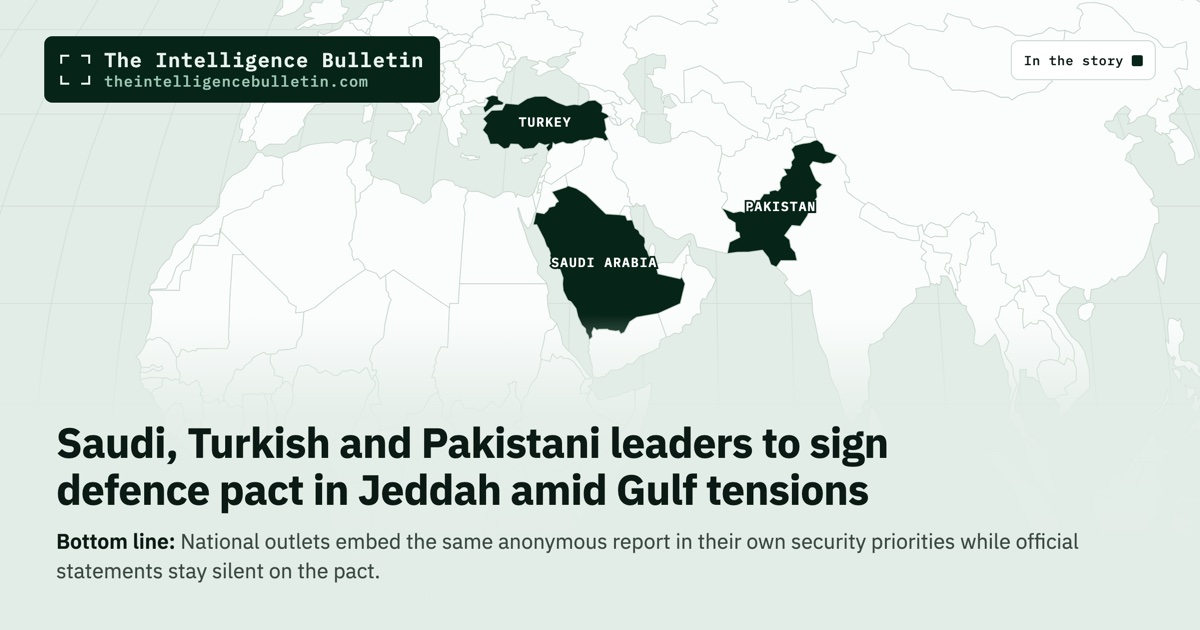
Saudi Arabia will host a one-day summit in Jeddah on Friday at which Turkish President Recep Tayyip Erdogan and Pakistani Prime Minister Shehbaz Sharif are expected to join Crown Prince Mohammed bin Salman in signing a joint defence pact. Two sources close to the Saudi military and government told AFP the agreement had been under discussion for some time but recent regional developments accelerated the timetable. Reuters carried a parallel account from two regional sources stating the three countries would sign a mutual defence agreement in the Red Sea city that day. Both dispatches noted the leaders would meet to discuss bilateral and trilateral relations alongside regional and international issues.
The visit schedule supplies the immediate context. Sharif arrived in Saudi Arabia on August 6 accompanied by Chief of Army Staff and Chief of Defence Forces Field Marshal Asim Munir; the Pakistani delegation will remain until August 8. Erdogan’s office confirmed he would travel for a single working day at the invitation of the Saudi authorities. Makkah’s deputy governor and the Saudi minister of environment received the Pakistani party in Jeddah. The Turkish Communications Directorate said Erdogan would meet both the crown prince and the Pakistani prime minister. Official statements issued by Ankara and Islamabad made no reference to the defence pact itself.
Pakistan and Saudi Arabia already operate under a mutual defence agreement signed in September 2025 that treats aggression against either country as an attack on both. Geo TV reported that Pakistan dispatched fighter jets and other forces to Saudi Arabia in April under that earlier pact. The same outlet noted Sharif and Munir performed Umrah during the current visit and that Foreign Office spokesperson Tahir Andrabi described the trip as focused on strengthening bilateral ties and exchanging views on regional developments. Andrabi added that Pakistan continued diplomatic efforts to reduce tensions in the Middle East.
The three outlets that relayed the AFP and Reuters reports differed in how they situated the new agreement. Okaz presented the signing as part of routine strategic coordination during the Jeddah summit, quoting the Reuters sources on the timing and location without further security framing. Hürriyet Daily News emphasised Erdogan’s working visit and prior contacts with the crown prince, citing the same AFP sources on the accelerated pace. Middle East Eye and Ynetnews both placed the pact against the backdrop of the US-Iran conflict and disrupted shipping through the Strait of Hormuz; Ynetnews alone used the phrase “amid Iran tensions” in its headline.
Geo TV supplied the most detailed Pakistani framing. It reported that Sharif’s visit would include talks with the crown prince on bilateral relations and regional developments, with the Foreign Office stressing the importance of promoting regional peace and a shared strategy for stability. The outlet also recalled Pakistan’s earlier role as a mediator seeking to end the US-Iran war that had drawn in several Gulf countries. No Turkish or Saudi outlet in the set carried comparable on-record comments from their own governments about mediation.
The reporting chains converge narrowly on the fact of the signing. Every account traces the core claim to the same unattributed Saudi-linked sources carried by AFP or Reuters. No outlet published an official document or on-record confirmation from any of the three governments that the pact would be signed. The surrounding security context varies by national vantage: Pakistani coverage foregrounds Islamabad’s existing defence ties and diplomatic efforts, Saudi coverage keeps the tone procedural, Turkish coverage highlights Ankara’s diplomatic schedule, and the two non-regional outlets explicitly link the timing to the Iran conflict.
That pattern leaves the agreement’s precise provisions and obligations outside public view. The sources quoted by AFP and Reuters offered no details on whether the new pact would extend mutual-defence commitments beyond the 2025 Saudi-Pakistan agreement, establish joint command structures, or address specific contingencies. The absence of official statements from Ankara and Islamabad on the pact itself reinforces that the public record rests on the two anonymous Saudi sources.
What to Watch
The narrowest reading supported by the material is therefore that the three governments intend to formalise additional defence cooperation in Jeddah on Friday, that the decision was reached after months of talks accelerated by current Gulf conditions, and that the precise content remains known only to the participants. The reporting shows consistent sourcing for the existence of the meeting and the reported agreement, yet the differing national emphases illustrate how each capital chooses to present its participation to its own audience.
That’s how the world told the story.
Get our daily open-source intelligence on world events in your inbox — one email a day, up to six stories.
Subscribe freeNo spam. One-click unsubscribe. See the latest email →