Bulgaria’s EMCO hit again as sabotage claims revive decade-old probe

Map of the countries in the story: Bulgaria’s EMCO hit again as sabotage claims revive decade-old probe
A fire and series of explosions hit an EMCO ammunition storage site near Gorni Varpishta in central Bulgaria overnight on 11-12 September 2026. No one was injured. The company, run by Emilian Gebrev and a supplier of weapons to Ukraine, called the incident sabotage and cited more than a decade of similar events at Bulgarian defence firms. Bulgarian authorities opened an investigation, said they were not ruling out outside interference and linked the probe to prior incidents, while a Russian outlet reported the blast without mentioning sabotage.

One Story. Many Angles.

🇧🇬
Bulgaria
Bgnes
Original reporting
Bulgaria’s EMCO: 15 years of explosions, fires and the poisoning of Emilian Gebrev — what is known and what remains unanswered
Read →
🇷🇺
Russia
Vg News
RUSSIAN
Original reporting
In Bulgaria, an ammunition depot of the EMCO arms factory exploded
“В Болгарии взорвался склад боеприпасов оружейного завода EMCO”
Read →
🇬🇧
United Kingdom
BBC
Original reporting
Bulgaria investigates fire at weapons site that owner calls sabotage
Read →
🇦🇹
Austria
Vol.at
GERMAN
Original reporting
Explosion and fire in Bulgarian weapons depot: Russian sabotage?
“Explosion und Brand in bulgarischem Waffenlager: Russische Sabotage?”
Read →
🇭🇰
Hong Kong
South China Morning Post
Carries Reuters reporting
Bulgaria probes explosion at weapon storage site
Read →
5 sources · each independently reported
Analyzed 52 outlets across 27 countries and 17 languages
In Brief

Bulgarian coverage stresses repeated domestic failures while Russian coverage omits sabotage entirely and Austrian coverage names Russia in the headline.

Bulgarian reporting frames the latest blast as the newest chapter in a fifteen-year domestic pattern of unexplained fires and explosions at EMCO and related defence sites, some of which prosecutors have tied to Russian nationals and military intelligence without securing convictions. Russian coverage states only the basic facts of the fire and explosions at the Gorni Varpishta warehouse, omitting any reference to sabotage, Ukraine supply links or the owner’s accusations. Austrian reporting places the incident inside a wider European pattern of suspected Russian sabotage against facilities supporting Ukraine and headlines the question of Russian responsibility. BBC and SCMP reporting centre the official investigation, the company’s sabotage claim and the minister’s refusal to exclude outside interference, while noting the owner’s history of alleged targeting. The contrast reveals that outlets aligned with NATO or EU perspectives treat the sabotage theory as the live question under investigation, whereas the Russian source treats the event as an isolated industrial incident and the Bulgarian source treats it as evidence of long-standing unresolved security failures at home.

Perspective Analysis

A fire broke out at an EMCO ammunition storage facility near the village of Gorni Varpishta in central Bulgaria on the night of 11-12 September 2026. Flames spread from one warehouse to others, triggering a series of explosions. The site held ammunition and gunpowder. Workers had already left for the day, and two guards evacuated safely. No one was injured. Regional governor Kristina Sidorova described the fire moving from hall to hall, with the final explosion occurring shortly before midnight. Authorities activated the BG-Alert system and cordoned off the area.

This marked the second such incident at EMCO facilities in just over a month. On 10 August a similar fire and series of explosions struck another company warehouse near Belitsa in Tryavna municipality. That blaze also caused no casualties, though it damaged stored ammunition. Both sites sit in the Gabrovo region. EMCO, a private Bulgarian defence firm, produces and stores weapons that have been supplied to Ukraine. The company is run by Emilian Gebrev, who has faced prior attacks.

EMCO issued a statement calling the latest fire sabotage. The firm pointed to more than ten comparable incidents at Bulgarian defence companies since 2011. It noted that the Gorni Varpishta facility had not been used for months and had passed a full compliance inspection only twenty days earlier. Human error, the company said, was ruled out. Bulgarian interior minister Ivan Demerdzhiev told reporters that investigators were examining possible outside interference while also reviewing storage conditions. He announced that every munitions warehouse in the country would now face security checks and that past cases at EMCO and other firms would be re-examined for patterns.

Bulgarian prosecutors have long connected several earlier explosions and fires to suspected Russian involvement. The 2011 blast at an EMCO warehouse near Lovni Dol destroyed export ammunition. Similar incidents occurred at VMZ Sopot facilities in 2015 and at an Arsenal site near Maglizh in 2020. In 2015 Gebrev, his son Hristo and production director Valentin Tahchiev were poisoned with an organophosphorus compound while in Bulgaria. Prosecutors charged three Russian nationals in absentia for the attempted murder and later expanded charges to six Russians accused of terrorism linked to the explosions. European arrest warrants were issued, yet no final court convictions have resulted. Evidence remains circumstantial, and courts have noted its limits. Separate fires at EMCO’s Karnobat site in 2022 and 2023 were also investigated as possible arson, though those probes were suspended without indictments.

Russian reporting on the September incident confined itself to the location, the timing and the sequence of fire and blasts. It quoted the regional governor on the spread of the flames but made no reference to sabotage claims, Ukraine supply links, Gebrev’s history or any pattern of prior attacks. Austrian coverage placed the event inside a broader European pattern of suspected sabotage against facilities supporting Ukraine and asked directly whether Russia stood behind the blast. British reporting recorded the company’s sabotage accusation and the minister’s refusal to exclude outside interference, while noting the owner’s earlier alleged targeting. Hong Kong reporting, drawing on agency copy, summarised the minister’s statements and the company claim without assigning responsibility.

The accounts diverge most sharply on context and causation. A reader limited to Russian sources would see only an isolated industrial accident at one Bulgarian factory. A reader limited to Bulgarian sources would encounter a fifteen-year domestic record of unresolved incidents at EMCO and related plants, with prosecutors repeatedly naming Russian nationals yet failing to secure convictions. A reader of Austrian coverage would encounter an explicit question of Russian responsibility framed against other recent European incidents. Western and Asian reporting occupies the middle ground, presenting the official investigation and the competing explanations without endorsing either.

The corroborated record shows repeated fires and explosions at EMCO sites, an owner who attributes them to sabotage, and an interior minister who treats outside interference as one live possibility while ordering wider security reviews. Prosecutor records establish charges against Russian nationals in earlier cases, but the absence of convictions leaves those links unproven. The company’s supply relationship with Ukraine supplies a plausible motive for external actors, yet the same record also shows multiple domestic investigations that have not produced perpetrators. Bulgarian coverage draws on the longest local prosecutorial timeline and therefore captures the pattern of unanswered questions most fully. Russian coverage omits that timeline and the supply context. Austrian coverage advances a Russia-specific hypothesis beyond what the minister or the company has stated on record.

What to Watch

The next developments will turn on whether the fresh investigation yields new physical evidence or witness statements that move beyond the circumstantial chains already examined. If prior cases are any guide, the outcome may again rest on whether Bulgarian courts accept the same limited identification methods that earlier appeals have questioned. For European defence planners the stakes lie in whether facilities producing or storing materiel for Ukraine can be protected at scale, regardless of who ultimately bears responsibility for any single blast.
Share this story

Iran pushes Hormuz pact signing in Oman Monday while Bahrain demands restored ties first

Map of the countries in the story: Iran pushes Hormuz pact signing in Oman Monday while Bahrain demands restored ties first
Iranian President Masoud Pezeshkian and Foreign Ministry spokesman Esmaeil Baghaei stated that foreign ministers from Arab Gulf states will meet in Muscat on Monday to sign an agreement on joint shipping routes through the Strait of Hormuz with Oman and notify the International Maritime Organization. The announcement follows three months of Iran-Oman negotiations on safe navigation corridors. Bahrain’s Foreign Ministry rejected participation in any such meeting until diplomatic relations with Iran are restored, citing prior attacks on its infrastructure and insisting on accountability and legal processes.

One Story. Many Angles.

🇮🇷
Iran
Press TV
Original reporting
Tehran calls Oman meeting a key step toward regional stability and security
Read →
🇪🇬
Egypt
Erem News
ARABIC
Carries Bahrain Foreign Ministry via BNA reporting
Bahrain: We will not meet with Iran on the Strait of Hormuz before the return of relations
“البحرين: لن نجتمع مع إيران حول مضيق هرمز قبل عودة العلاقات”
Read →
🇸🇦
Saudi Arabia
Al Riyadh
ARABIC
Original reporting
Bahrain announces non-participation in a meeting with Iran regarding ‘Hormuz’
“جريدة الرياض | البحرين تعلن عدم مشاركتها في اجتماع يضم إيران بشأن «هرمز»”
Read →
🇬🇧
United Kingdom
Middle East Monitor
Carries Anadolu reporting
Iran says Arab foreign ministers to sign Hormuz navigation deal in Oman Monday
Read →
🇹🇷
Turkey
Anadolu Agency
Carries Iranian Foreign Ministry via IRIB reporting
Iran says Oman to host regional meeting on Hormuz shipping on Monday
Read →
5 sources · each independently reported
Analyzed 70 outlets across 58 countries and 21 languages
In Brief

Iranian reporting presents the meeting as a done regional step; Gulf sources make Bahrain’s refusal the central precondition.

The reporting reveals a clear diplomatic fault line: Iranian sources present the Oman meeting as an established regional step toward Hormuz security involving multiple Arab states, while Gulf Arab reporting centers Bahrain’s precondition of restored ties and references attacks as barriers. Press TV frames the talks as a proactive Iranian initiative emerging from recent six-month developments, with Baghaei stressing respect for sovereignty and a phased corridor framework. Erem News and the Al Riyadh headline instead foreground Bahrain’s explicit refusal, relayed via its Foreign Ministry and BNA, tying participation to ending attacks and international responsibility. Middle East Monitor amplifies Pezeshkian’s claim of Arab ministers signing the deal, drawing on his India Today interview, whereas Anadolu Agency sticks to the Iranian Foreign Ministry’s narrower description of an Oman-hosted discussion of bilateral talks without confirming broader attendance. No selected outlet from Oman appears, leaving the host’s confirmation absent. The accounts diverge on whether a multi-state signing is imminent or whether Bahrain’s stance blocks it outright; independent chains show Iranian originating claims versus Gulf rejection statements, with relays in non-Arab outlets. This pattern shows how Iranian outlets emphasize momentum while Gulf-aligned ones highlight preconditions rooted in security grievances.

Perspective Analysis

Iranian President Masoud Pezeshkian told Indian broadcaster India Today that foreign ministers from Arab countries would gather in Muscat on Monday to sign an agreement establishing a joint shipping route between Oman and Iran through the Strait of Hormuz and to notify the International Maritime Organization of the arrangement. He added that the countries whose territories had been used to launch attacks against Iran by the United States would also attend. Iranian Foreign Ministry spokesman Esmaeil Baghaei separately described the same Monday meeting as one that would address the outcome of recent Iran-Oman talks on safe commercial routes and would serve as a key step toward stability and security in the Persian Gulf region.

Baghaei, speaking to Al Mayadeen, placed the planned session inside a longer process. He said the decision to convene Iran with Persian Gulf states had developed over the previous six months rather than arising suddenly. Iran and Oman had already spent nearly three months negotiating arrangements for safe navigation through the strategic waterway. On 25 August the two countries had announced discussions on a phased framework that would begin with a temporary joint maritime corridor and include a joint mine-clearance project. Baghaei stressed that Iran had not targeted regional countries during recent military operations but had struck only United States bases located in those countries, and that Tehran respected the national sovereignty and territorial integrity of its neighbors.

Turkish state news agency Anadolu Agency carried the Iranian Foreign Ministry statement that Oman would host a regional ministerial meeting on Monday involving Iran, Iraq and Gulf states to discuss the results of the Iran-Oman negotiations on commercial shipping routes. The same dispatch noted Iran’s continued commitment to navigation security in the strait while recording heightened tensions with Washington over the waterway, including a June memorandum that had envisioned a deal to reopen it as part of a wider peace process.

Bahrain’s Foreign Ministry issued a direct refusal. In a statement carried by the Bahrain News Agency and reported by Erem News, the ministry declared that the kingdom would not attend any meeting with Iran to discuss the Strait of Hormuz until diplomatic relations between the two countries are restored. It said it had already informed Oman through official channels of this position. The statement listed prior attacks on Bahraini infrastructure and civilian targets, including an incident involving an ammonia storage tank that came close to causing a major disaster, and the recent targeting of Saudi Arabia’s east-west oil pipeline. Bahrain argued that security and stability cannot be built by overlooking attacks or by pursuing appeasement. It listed four necessary foundations for peace: an end to attacks, international accountability and compensation for damage, respect for state sovereignty and prohibition of using any country’s territory as a base for attacks on neighbors, and settlement of outstanding issues through legal means. The ministry further insisted that any arrangement for Hormuz navigation must rest on the 1982 United Nations Convention on the Law of the Sea, receive approval from the International Maritime Organization, guarantee free transit for all vessels without discrimination or fees, and involve all members of the Gulf Cooperation Council because the security of the passage directly affects their energy supplies.

The Al Riyadh headline summarized the same Bahraini position, underscoring non-participation in any meeting that would include Iran on the subject of Hormuz. No selected source contained a statement from Oman confirming or denying the Monday session. Middle East Monitor reported the Iranian claims of an imminent multi-state signing while noting the absence of immediate confirmation from Oman. It also recorded an earlier statement by Secretary of Iran’s Supreme National Security Council Mohsen Rezaei that an agreement with Oman on a new corridor would be signed within days and that the entrance and exit of the proposed corridor would remain under Iranian control.

The accounts diverge on the scope and readiness of the meeting. Iranian originating reports from Press TV and statements relayed by Anadolu Agency and Middle East Monitor present the Monday gathering as a settled regional step that will produce a signed navigation agreement involving multiple Arab foreign ministers. Bahrain’s on-record position, carried by Erem News and signaled in the Al Riyadh headline, treats any such participation as impossible until diplomatic relations are restored and the listed security conditions are met. The two positions cannot both be accurate on the question of attendance: either the broader Arab ministerial presence occurs or Bahrain’s precondition blocks it. The single-source claim of an imminent signing with Arab ministers originates in Pezeshkian’s India Today interview and receives no corroboration from independent chains in the set. The corroborated Bahraini refusal rests on direct ministry statements carried through Bahraini state media and relayed by at least two outlets.

A reader limited to Iranian reporting would encounter an account of advancing bilateral and regional diplomacy that frames the meeting as a natural next step after months of technical talks and recent military restraint. The same reader would not see Bahrain’s explicit precondition or the detailed list of attacks and legal requirements that Bahrain places at the center of its stance. A reader limited to Gulf-aligned reporting would encounter a firm rejection rooted in security grievances and would not see the Iranian description of a phased corridor framework or the claim that eight littoral states are expected to participate. Turkish and British outlets that relayed Iranian statements without adding Gulf rebuttals would leave the Bahraini position invisible, while Erem News and Al Riyadh foreground the refusal without including the Iranian timeline of three-month negotiations or the specific phased proposals.

What to Watch

The corroborated rejection from Bahrain stands on direct attribution to its Foreign Ministry and on the public record of infrastructure attacks the ministry cites. The broader claim of an imminent multi-state signing rests on a single interview and receives no independent confirmation within the source set. Bahrain’s insistence that any Hormuz arrangement must follow established international maritime law and involve the full Gulf Cooperation Council supplies a concrete standard against which future Iranian-Omani proposals can be measured. Oman’s silence in the selected coverage leaves the host government’s view of the proposed Monday session unrecorded here, which narrows the picture of regional reception. The next concrete test will be whether the Monday meeting occurs with the attendance Iranian officials described or whether Bahrain’s precondition prevents it, and whether any resulting navigation corridor meets the legal and multilateral criteria Bahrain has placed on record.


Share this story

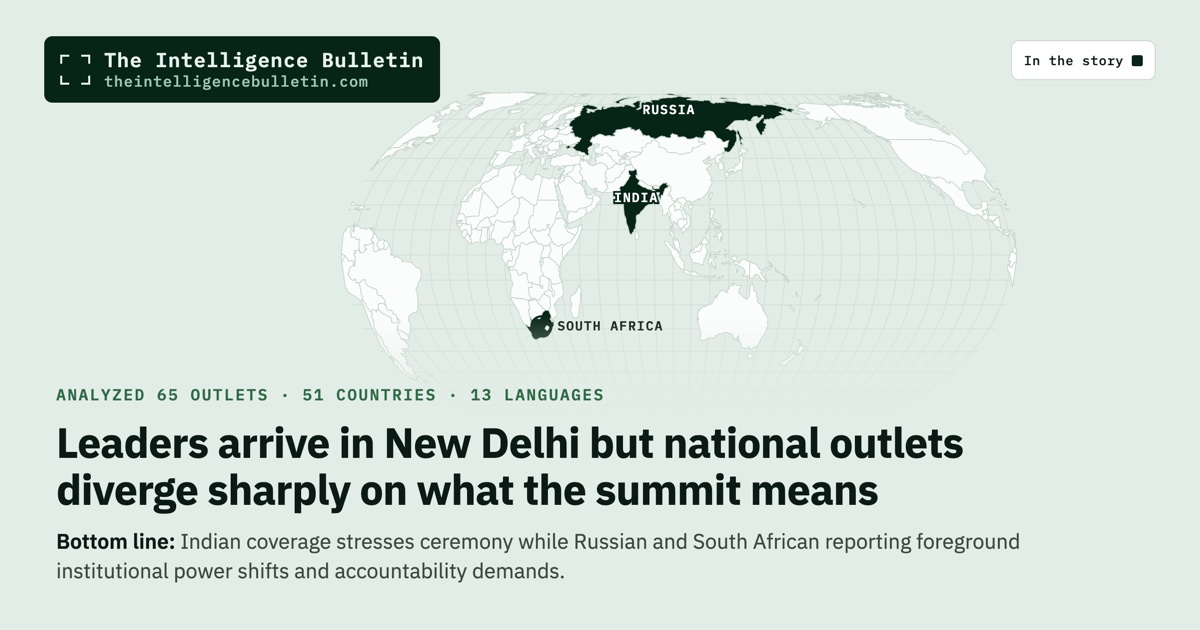
Leaders arrive in New Delhi but national outlets diverge sharply on what the summit means

Map of the countries in the story: Leaders arrive in New Delhi but national outlets diverge sharply on what the summit means
Indian Prime Minister Narendra Modi welcomed Russian President Vladimir Putin at Bharat Mandapam in New Delhi on September 12, 2026, as the 18th BRICS Summit began under India’s chairship. Chinese President Xi Jinping arrived for his first visit to India since 2019, with bilateral talks scheduled. South African President Cyril Ramaphosa and other leaders also attended. Reporting across outlets highlights arriving leaders, planned joint statements, and discussions on multilateral reforms amid ongoing wars.

One Story. Many Angles.

🇮🇳
India
ANI News
Original reporting
BRICS Summit: PM Modi welcomes Russian President Vladimir Putin at Bharat Mandapam
Read →
🇷🇺
Russia
RIA Novosti
RUSSIAN
Original reporting
Global changes: what Putin, Modi and Xi warned about at the BRICS summit
“Глобальные перемены: о чем предупредили Путин, Моди и Си на саммите БРИКС”
Read →
🇿🇦
South Africa
The Citizen
Original reporting
Ramaphosa demands UN reform, accountability at Brics Summit in India
Read →
🇶🇦
Qatar
Al Jazeera
Original reporting
China’s Xi lands in India for BRICS summit overshadowed by wars
Read →
🇩🇪
Germany
Deutsche Welle
Original reporting
BRICS Summit 2026: China’s Xi to meet Modi today
Read →
5 sources · each independently reported
Analyzed 65 outlets across 51 countries and 13 languages
In Brief

Indian coverage stresses ceremony while Russian and South African reporting foreground institutional power shifts and accountability demands.

Coverage of the BRICS opening reveals a shared factual core of arrivals and institutional talks that quickly fractures along national priorities. Indian reporting centers the ceremonial welcome and bilateral diplomacy with Putin, including gift exchanges and progress reviews in defense and energy. Russian accounts foreground warnings from Putin, Modi and Xi about the end of unipolar order, institutional reforms and resistance from established powers. South African pieces stress Ramaphosa’s explicit demands for UN Security Council expansion, accountability for violations in Palestine, Sudan and Iran, and multilateralism under international law. Al Jazeera situates the event against wars in the Middle East and Ukraine plus energy strains, while noting the India-China thaw signaled by Xi’s visit. Deutsche Welle tracks the Xi-Modi meeting as the key bilateral development. The pattern shows each outlet amplifying the element most salient to its audience or government stance rather than converging on a single narrative of bloc unity or anti-Western alignment.

Perspective Analysis

Prime Minister Narendra Modi greeted Russian President Vladimir Putin at Bharat Mandapam in New Delhi on September 12, 2026, marking the formal opening of the 18th BRICS Summit under India’s chairship. The two leaders met for the second time in two weeks, exchanged gifts including a Tamil text on wisdom, and continued discussions during a shared car ride to an industrial exhibition. Modi had already held separate sessions the previous day with Putin, Iranian President Masoud Pezeshkian, United Nations Secretary-General António Guterres, and Ethiopian Prime Minister Abiy Ahmed Ali. Chinese President Xi Jinping arrived the same morning for his first visit to India since 2019, with a bilateral meeting set for later that day.

The summit brought together leaders from the 11-member bloc, which now includes Brazil, China, Egypt, Ethiopia, India, Indonesia, Iran, Russia, Saudi Arabia, South Africa and the United Arab Emirates. India set the theme of building resilience, innovation, cooperation and sustainability. A joint statement from the grouping was expected after overnight negotiations that produced consensus on several points despite earlier differences. Modi urged members to convert internal unity into concrete global outcomes and proposed ten new initiatives plus a continuity mechanism for decisions. Putin described the bloc as representing one-third of the planet’s land, nearly half its population and 40 percent of world GDP, and argued that the unipolar system was giving way to a redistribution of power toward the Global South and East.

South African President Cyril Ramaphosa addressed a session on inclusive global governance and stressed the need for United Nations Security Council reform to give Africa permanent representation. He called for accountability on violations of international law, citing the situation in Palestine, Sudan and the conflict involving Iran, and said multilateralism must rest on sovereign equality and the UN Charter. Chinese and Russian statements echoed the reform theme. Xi called on BRICS states to lead improvements in global governance and to play a larger role in peace and innovation. Putin urged coordinated work inside the International Monetary Fund, World Bank and World Trade Organization while also developing BRICS financial tools such as the New Development Bank.

Coverage of the same arrivals and talks diverged immediately on emphasis. Indian reporting centered the ceremonial aspects of Modi’s welcome for Putin and the schedule of bilateral meetings that included defense, energy and space cooperation. Russian accounts placed the day’s main weight on explicit warnings from Putin, Modi and Xi about resistance from powers accustomed to a hierarchical order and on the need to end that hierarchy. South African reporting isolated Ramaphosa’s demands for accountability mechanisms and for an end to selective application of international rules. Al Jazeera placed the entire gathering against the backdrop of wars in the Middle East and Ukraine and the resulting energy and trade pressures, while noting the significance of Xi’s presence for India-China relations. Deutsche Welle tracked the scheduled Xi-Modi encounter as the central bilateral development and the clearest sign yet of a gradual thaw after the 2020 border clash.

These differences are not simple omissions. The Indian account records the exchange of a sacred Tamil book and progress on people-to-people ties but does not foreground calls to restrain established powers. The Russian text records Putin stating that tariff wars, sanctions and interference are tools used by those unwilling to accept a changed balance, a framing absent from the Indian report. The South African piece alone records Ramaphosa naming specific conflicts and insisting that the same principles apply to all states. Al Jazeera alone opens with the wars that have disrupted shipping and energy markets, while Deutsche Welle alone highlights the 5:45 p.m. local time slot reserved for the Xi-Modi session and the expert view that early progress on the border is required before broader economic ties can deepen.

The shared factual spine across the reports is narrow but consistent. Modi did welcome Putin at the venue. Xi did arrive for his first visit since 2019. Leaders from multiple countries did raise United Nations Security Council reform and broader governance changes. Only one account records the specific list of conflicts Ramaphosa invoked when demanding accountability.

The Indian and German reporting on the practical mechanics of the summit—arrivals, bilateral scheduling, and the India-China track—aligns with the corroborated record of who met whom and when. The Russian emphasis on systemic warnings reflects Moscow’s interest in portraying the gathering as evidence of irreversible multipolar momentum. The South African emphasis on accountability reflects Pretoria’s long-standing position on institutional reform and selective enforcement. Al Jazeera’s focus on active conflicts reflects its regional vantage on the Middle East and the direct effects on energy routes and shipping. None of the accounts constructs a single narrative of seamless bloc unity or uniform anti-Western alignment; each amplifies the dimension most relevant to its own government’s stance or audience.

What to Watch

The most reliable picture is therefore the one that keeps the corroborated mechanics of the opening day in view while treating the interpretive overlays as national readings rather than collective conclusions. The summit marks a concrete step in the expanded grouping’s institutional routine, yet the reporting shows that routine still produces markedly different accounts of what the step signifies. The next test will be whether the expected joint statement and the scheduled bilateral follow-through translate into measurable coordination on the very institutions the leaders named, or whether the differing national framings continue to shape what each capital claims the summit achieved.


Share this story

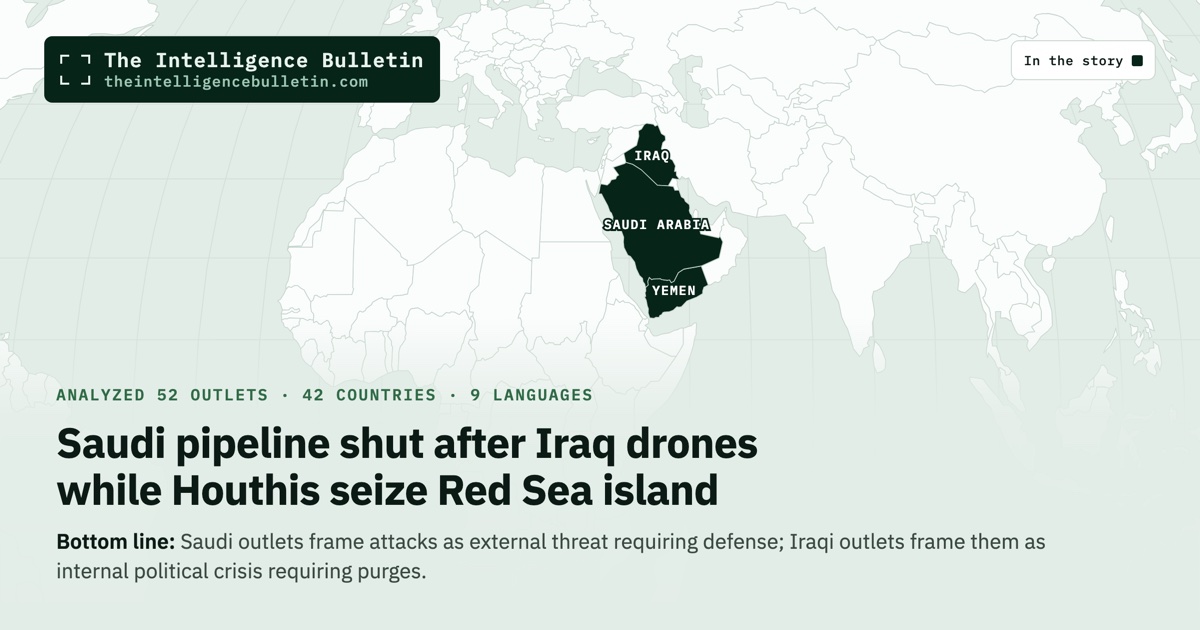
Saudi pipeline shut after Iraq drones while Houthis seize Red Sea island

Map of the countries in the story: Saudi pipeline shut after Iraq drones while Houthis seize Red Sea island
Saudi Arabia temporarily shut its East-West oil pipeline after drone attacks on September 10 that injured people in Riyadh and Madinah regions, attributing the strikes to Iran-aligned militias operating from Iraq. Iraq condemned the attacks, launched an investigation, dismissed a military commander from Maysan, and closed a border crossing with Iran; Saudi Arabia refrained from military response to allow Baghdad to act. Separately, Iran-backed Houthis captured Perim Island in the Bab el-Mandeb Strait, tightening control over a key Red Sea shipping route that Saudi crude now relies on after Hormuz disruptions.

One Story. Many Angles.

🇸🇦
Saudi Arabia
Arab News
Original reporting
Arab News | Saudi Arabia temporarily shuts East-West Pipeline after attacks
Read →
🇮🇶
Iraq
Iraqi News
Original reporting
Iran-aligned militias again put Iraq-Saudi ties at risk
Read →
🇸🇦
Saudi Arabia
Al Watan
ARABIC
Original reporting
Iraq dismisses the commander of Maysan operations after drone attacks targeting Saudi Arabia
“العراق يقيل قائد عمليات ميسان بعد هجمات مسيّرة استهدفت السعودية”
Read →
🇮🇳
India
The Times of India
Carries Reuters and ship-tracking analysts reporting
Saudi Arabia shuts key oil pipeline as Houthis seize strategic Red Sea island
Read →
🇭🇰
Hong Kong
South China Morning Post
Carries Reuters reporting
Yemen’s Houthis reach strategic island in Bab el-Mandeb Strait
Read →
5 sources · each independently reported
Analyzed 52 outlets across 42 countries and 9 languages
In Brief

Saudi outlets frame attacks as external threat requiring defense; Iraqi outlets frame them as internal political crisis requiring purges.

Saudi reporting centers on the pipeline shutdown as a precautionary defensive step against external aggression from Iraqi territory, with minimal emphasis on Baghdad’s internal response. Iraqi coverage instead highlights the political fallout inside Iraq, including the prime minister’s swift dismissal of a commander and border closure, framing the episode as a threat to improving Riyadh-Baghdad ties from Iran-aligned groups. The two Saudi outlets align closely on the attacks’ origin and injuries but differ in emphasis: one stresses official energy ministry statements on the shutdown, the other reports Iraq’s personnel changes as evidence of Riyadh’s pressure succeeding. Indian and Hong Kong reporting broaden the lens to energy markets and maritime security, noting the pipeline’s role bypassing Hormuz and the island seizure’s potential to choke Red Sea exports, details absent from actor-centric accounts. All independent chains corroborate the pipeline attacks, Iraqi origin claims, injuries, and Houthi island advance; the pattern reveals a split between regional actors treating it as bilateral security politics and outside observers treating it as an energy and shipping escalation. No outlet contradicts the core sequence, yet the omission of global price risks in Gulf papers and of Saudi restraint in some Indian framing shows how national stakes shape what receives prominence.

Perspective Analysis

Saudi Arabia shut its East-West oil pipeline on September 11 after drones struck sections in the Riyadh and Madinah regions the morning before. The Saudi Energy Ministry said several people were injured in the attacks and received medical treatment. Emergency teams assessed the line and the shutdown was ordered as a precaution, with further updates promised as needed. The ministry linked the strikes to earlier Houthi actions against southern Saudi targets that had already caused fires at oil facilities.

The same day brought another development at the opposite end of the Arabian Peninsula. Iran-backed Houthis reached Perim Island in the Bab el-Mandeb Strait, according to four Yemeni government sources. Earlier reports indicated government forces had withdrawn from the island and that Houthis had also taken the mainland coastal town of Dhubab facing it. The strait sits at the southern entrance to the Red Sea, a route Saudi crude has relied on more heavily since tanker traffic through the Strait of Hormuz was disrupted by the wider conflict.

Saudi statements identified the drones as coming from Iraqi territory, specifically tied to operations in Maysan province. Riyadh said it had chosen not to respond militarily at this stage after a request from Iraq’s prime minister, who asked for time to handle those responsible. Saudi Arabia reserved the right to act later if needed to protect its territory and infrastructure. The attacks wounded civilians in addition to damaging pipeline facilities, and the Saudi Foreign Ministry condemned them in strong terms.

Iraqi authorities moved quickly on their side. Prime Minister Ali al-Zaidi directed security forces to investigate and pursue legal action against anyone involved. Baghdad condemned the use of its territory and closed the Shalamcheh border crossing with Iran as a precaution. Security sources said a wider operation was underway to detain suspects. The government announced the immediate dismissal of the commander of Maysan operations after an investigation found the drones had launched from a site inside that province. Iraq emphasized it would not allow its land or airspace to serve as a launch point against neighbors and said it would not tolerate actions that harmed its relations with Gulf states.

The East-West pipeline runs roughly 1,200 kilometers from Saudi oil fields in the east to the Red Sea export terminal at Yanbu. In recent months it has carried between 4 million and 5 million barrels per day, an amount equal to roughly 4 to 5 percent of global supply. The line gained added importance once Hormuz traffic was curtailed, offering an alternative export path that avoids the narrower northern strait. Satellite imagery showed fires and smoke at pumping stations along the route after the strikes.

Saudi coverage placed the pipeline shutdown at the center and described the attacks as external aggression requiring defensive measures. Arab News led with the Energy Ministry statement on the precautionary halt and injuries. Al Watan reported the same attacks but added the Iraqi commander dismissal and investigation, presenting Baghdad’s personnel changes as a direct result of Saudi pressure and as evidence that Riyadh’s restraint had produced results inside Iraq.

Iraqi reporting instead stressed the domestic political and security consequences. Iraqi News framed the episode as a fresh strain on improving Baghdad-Riyadh ties caused by Iran-aligned militias operating beyond central control. It detailed the prime minister’s orders, the border closure, and the investigation while noting that no Iraqi group had yet been formally named as responsible.

Outside the region, reporting connected the pipeline incident directly to the island seizure and its implications for shipping. The Times of India described both developments as tightening pressure on energy routes that had already shifted because of Hormuz problems, noting the pipeline’s daily volume and the risk of longer tanker voyages if the Bab el-Mandeb corridor became unusable. South China Morning Post, carrying a Reuters dispatch, focused on the Houthis’ move onto Perim as an effort to control a vital global trade lane amid the Iran-US confrontation, with less detail on the pipeline or Iraqi response.

The two Saudi outlets converged on the attacks’ origin, the injuries, and the precautionary shutdown, yet differed in how much space they gave Iraqi internal actions. Arab News stayed with Riyadh’s official energy and security statements. Al Watan incorporated the commander dismissal and Iraqi statements, showing Saudi diplomatic leverage at work. Iraqi coverage treated the strikes as a problem Baghdad had to solve internally to preserve relations, while the Indian and Hong Kong pieces treated the combined events as a single escalation affecting export volumes and tanker routing.

All independent reporting chains carried the same core sequence: the September 10 drone strikes on the pipeline, their attribution to launches from Maysan in Iraq, the injuries, the shutdown, Iraq’s dismissal of the commander and border closure, and the Houthi advance onto Perim. No account disputed those elements. The difference lay in what each set of outlets chose to foreground once those facts were stated.

A reader limited to Saudi papers would see a defensive infrastructure decision against external attack and, in one case, evidence that Riyadh’s patience had produced Iraqi concessions. A reader limited to Iraqi coverage would see a domestic crisis managed by Baghdad to protect its Gulf relationships. A reader limited to the Indian or Hong Kong accounts would see the pipeline and island moves together as a fresh threat to the 4-to-5-million-barrel daily flow now routed through the Red Sea. The regional accounts correctly identified the immediate actors and the restraint shown by Saudi Arabia; the external accounts correctly identified the scale of the energy corridor now at risk.

What to Watch

The broader stakes sit with the shipping lanes. The pipeline’s documented daily volume and its role as a Hormuz bypass give concrete weight to concerns about further disruption. The Houthi position on Perim adds a second chokepoint to one that already matters for Saudi exports. Regional capitals have immediate security and political incentives to present the episode in bilateral terms. Observers farther from the direct confrontation have less reason to narrow the frame and more reason to track the cumulative effect on global supply routes. The next moves will likely be measured in tanker schedules and any additional closures or seizures rather than in public statements alone.


Share this story

North Korea Missile Launches Follow Trilateral Drills as Seoul Holds Emergency Meeting

Map of the countries in the story: North Korea Missile Launches Follow Trilateral Drills as Seoul Holds Emergency Meeting
North Korea launched several short-range ballistic missiles from near Wonsan toward the East Sea early on September 12, 2026. South Korea’s Joint Chiefs of Staff detected the launches at 5:20 a.m., with the missiles flying about 250 kilometers before splashing down. Seoul’s National Security Office held an emergency meeting with defense officials, condemned the action as a violation of UN Security Council resolutions, and shared information with the United States and Japan. The launches followed the conclusion of five-day US-South Korea-Japan maritime drills focused on regional threats.

One Story. Many Angles.

🇰🇷
South Korea
The Korea Herald
Original reporting
S. Korea holds emergency security meeting after North Korea fires ballistic missiles
Read →
🇰🇵
North Korea
NK News
Original reporting
North Korea fires multiple ballistic missiles towards East Sea: ROK military
Read →
🇭🇰
Hong Kong
South China Morning Post
Carries Reuters reporting
North Korea launches missile salvo after US-South Korea-Japan drills
Read →
🇶🇦
Qatar
Al Jazeera
Carries South Korean Joint Chiefs of Staff and US Pacific Command reporting
North Korea fires ballistic missiles off eastern coast, Seoul says
Read →
🇬🇧
United Kingdom
Daily Star
Carries South Korean Joint Chiefs of Staff reporting
North Korea fires ballistic missiles into sea as nation sends warning to Donald Trump
Read →
5 sources · each independently reported
Analyzed 63 outlets across 55 countries and 26 languages
In Brief

Outlets converge on the launches as a reply to recent US-South Korea-Japan exercises rather than an unprompted act.

The reporting across five outlets shows near-total convergence on the core facts of the launches and South Korea’s immediate response, with the timing after trilateral drills emerging as the dominant explanatory frame rather than any standalone provocation. South Korean sources emphasize the domestic security machinery—the emergency National Security Office meeting and Joint Chiefs of Staff statements—while regional and international accounts add the explicit connection to the just-ended Freedom Edge exercise involving the United States, South Korea, and Japan. This pattern reveals how the same official South Korean data is repurposed: one set of stories centers procedural readiness and condemnation, another positions the launches as a predictable counter to the drills that Pyongyang had already criticized in advance. The Daily Star alone injects a direct Trump warning angle, yet even there the underlying claims trace back to the same Joint Chiefs of Staff release rather than independent North Korean statements. No outlet supplies a Pyongyang-sourced account; all rest on South Korean and US assessments that the missiles posed no immediate threat to allied territory. The consistent detail that South Korea and the United States began joint analysis of the projectiles immediately underscores how the event is treated less as a surprise rupture than as the latest data point in an ongoing cycle of drills and responses.

Perspective Analysis

North Korea fired several short-range ballistic missiles from an area near Wonsan on its eastern coast before dawn on September 12. South Korea’s Joint Chiefs of Staff detected the launches at 5:20 a.m. local time. The projectiles flew roughly 250 kilometers before landing in the East Sea. South Korean and American authorities began a joint technical analysis of the missiles immediately, while information on the launches was also shared with Japan.

Seoul’s presidential National Security Office convened an emergency meeting the same morning that brought together the defense ministry, the Joint Chiefs of Staff, and other agencies. Officials reviewed the security implications, assessed South Korea’s response options, and reaffirmed the government’s position that the launches violated United Nations Security Council resolutions. The presidential office called on Pyongyang to stop such actions at once. The United States Pacific Command stated that the event did not pose an immediate threat to American territory or to its allies and reiterated Washington’s commitment to the defense of South Korea and the region.

The launches came one day after the conclusion of a five-day maritime exercise called Freedom Edge conducted by the United States, South Korea, and Japan in international waters southeast of Jeju Island. The drills focused on responses to North Korean nuclear and missile threats as well as other regional security challenges. North Korea had already denounced the exercise in advance, with its defense minister warning of “strong and reflective countermeasures.” A similar salvo of ten missiles had been fired toward the East Sea from near Pyongyang on August 20, twenty-three days earlier.

Every published account of the September 12 launches rests on the same South Korean military statements. No outlet carried an independent North Korean confirmation or a statement from Pyongyang itself. The Korea Herald reported the emergency meeting and the government’s condemnation in detail, drawing directly from the presidential office. NK News stayed closest to the Joint Chiefs of Staff release, noting the 250-kilometer range and the ongoing South Korean–American analysis. The South China Morning Post placed the timing after the trilateral drills in its lead sentence. Al Jazeera emphasized the geography of the East Sea, the information sharing among South Korea, the United States, and Japan, and the fact that the United States assessed no immediate threat. The Daily Star alone added an interpretive link to Donald Trump, describing the launches as a warning to the American president in the wake of recent decisions to scale back certain exercises.

A reader limited to South Korean domestic reporting would see an efficient, coordinated official response centered on the National Security Office meeting and a clear condemnation of the launches as illegal. That reader would learn the technical details of detection and range but would encounter the connection to the Freedom Edge drills only as a secondary local-media speculation rather than a central explanatory frame. A reader limited to the South China Morning Post or Al Jazeera would instead encounter the launches as a predictable reply to the just-ended trilateral exercise, with the South Korean meeting presented as one element within that larger sequence. The Daily Star’s addition of a direct Trump warning sits outside the other accounts; its underlying facts still trace to the same Joint Chiefs of Staff statement, not to any new evidence of North Korean intent.

The convergence across the five outlets is therefore tighter than their headlines suggest. All five carry the same corroborated details: the time and location of the launches, the 250-kilometer flight distance, the emergency meeting, the condemnation as a UN resolution violation, and the timing immediately after the Freedom Edge drills. The differences lie in emphasis rather than in disputed facts. South Korean outlets foreground the machinery of response; regional and international outlets foreground the exercise context that North Korea itself had already flagged as provocative. No independent reporting chain contradicts any of these elements, and no outlet supplies a competing account from Pyongyang.

The framing that places the launches as a direct reply to the trilateral drills aligns most closely with the evidence available in the published record. Multiple outlets note both the timing and North Korea’s prior public criticism of the exercise. The South Korean government’s own statements treat the launches as a violation rather than as a justified countermeasure, yet the sequence of events—drills ending one day before the launches—appears in every account that supplies context. The interest in presenting the launches as routine provocation rather than retaliation belongs primarily to Seoul, which must demonstrate resolve to its own public and to its allies while avoiding any suggestion that its own exercises provoked the response. The interest in highlighting the drill connection belongs to outlets that cover the wider regional security picture, where the pattern of exercises followed by launches is already familiar.

The United States assessment that the launches posed no immediate threat to allied territory reinforces the picture of a contained event rather than an escalation. That judgment, reported by Al Jazeera and the Daily Star, rests on the same South Korean and American tracking data used for the range and trajectory details. Absent a North Korean statement explaining the purpose of the launches, the most reliable inference remains the one supported by timing and prior statements: the action fits the established pattern of responding to joint military activity with missile demonstrations over the sea.

What to Watch

The next moves are likely to follow the same cycle. South Korea and its allies will continue to monitor activity and share information while pressing for an end to the launches. North Korea has shown no sign of altering its practice of conducting such tests near periods of heightened allied cooperation. The absence of any direct Pyongyang-sourced account in the current coverage leaves the precise intent behind these particular missiles open, but the public record already supplies the sequence that produced them.


Share this story

Russian drones resume Kyiv strikes on fuel stations and telecom after lull, killing two

Map of the countries in the story: Russian drones resume Kyiv strikes on fuel stations and telecom after lull, killing two
Russian jet-powered drones struck gas stations and a Kyivstar telecom building in Kyiv on September 11, killing two and injuring at least eight or nine. Strikes also hit other Ukrainian cities including a Pavlohrad shopping area with higher casualties. Ukrainian drones struck Russian logistics targets in Saratov and elsewhere, with Russian reports of deaths in Tula. The attacks followed a reported brief lull and prior-day strikes on similar targets.

One Story. Many Angles.

🇺🇦
Ukraine
Kyiv Post
Original reporting
Russia Hits Kyiv’s Telecom Building Amid Widening Gas Station Strikes
Read →
🇹🇷
Turkey
Anadolu Agency
Original reporting
Overnight airstrikes injure 8 in Ukraine’s capital Kyiv, logistics center in Russia’s Saratov hit
Read →
🇶🇦
Qatar
Al Jazeera
Original reporting
Russian strikes kill two in Kyiv as Moscow targets capital’s fuel stations
Read →
🇬🇧
United Kingdom
The Independent
Carries Reuters reporting
Ukraine-Russia war latest: Children among five killed and 67 injured as Putin strikes shopping centre
Read →
🇩🇪
Germany
Süddeutsche Zeitung
GERMAN
dpa, Reuters wire copy
Ukraine News: Dead and injured in Russian attacks on Dnipro and Kiev
“Ukraine News: Tote und Verletzte bei russischen Angriffen auf Dnipro und Kiew”
Read →
5 sources · each independently reported
Analyzed 64 outlets across 56 countries and 16 languages
In Brief

Ukrainian and Qatari outlets stress capital infrastructure and civilian toll while the Turkish agency alone pairs strikes with Ukrainian retaliation inside Russia.

Reporting across the five outlets shows consistent confirmation of Russian drone strikes on Kyiv fuel stations for a second day, with two deaths and multiple injuries, plus a telecom building hit, but diverges sharply on framing and scope. Kyiv Post centers Ukrainian civilian and commercial infrastructure damage in the capital. Al Jazeera highlights the pattern of fuel-station targeting as a civilian-energy campaign. Anadolu alone pairs the Kyiv strikes with a simultaneous Ukrainian hit on a Russian Saratov logistics center, presenting mutual escalation. The Independent embeds the event in a live blog noting shopping-centre deaths in Pavlohrad and wider regional tolls. Süddeutsche Zeitung spreads the account across multiple Ukrainian cities including Dnipro while also detailing Ukrainian drone strikes inside Russia that killed two in Tula. The pattern reveals that outlets closer to the conflict stress local Ukrainian impact while others balance or broaden to reciprocal actions; no selected source includes direct Russian-government framing of the strikes. This convergence on the Kyiv gas-station campaign and divergence on reciprocity indicates the event is treated as resumption of targeted pressure rather than isolated escalation, with casualty figures aligning closely where independent chains overlap.

Perspective Analysis

Russian jet-powered Shahed drones struck two Ukrnafta gas stations in Kyiv’s Obolonskyi and Dniprovskyi districts early on September 11, killing two people and injuring at least eight others. One victim died at the scene and the second in hospital. A rescuer was wounded when Russian forces returned to one of the sites hours later. The same wave hit a building belonging to Kyivstar, Ukraine’s largest telecommunications company. President Volodymyr Zelensky stated that the overnight and daytime attacks also reached eight other Ukrainian regions and described Russia’s growing use of faster jet-powered drones as increasingly terrorist in character. The strikes followed a similar attack on a Kyiv gas station the previous day.

Ukrainian authorities reported that the capital’s fuel stations had become a deliberate focus. Mayor Vitali Klitschko said the sites were hit within minutes of each other after air-raid sirens sounded. Ukrainian warnings had already circulated that drivers should avoid refuelling during alerts. Zelensky linked the pattern to Russian efforts to pressure civilian life and called on the United States to impose new sanctions immediately. He separately offered a truce covering strikes on energy infrastructure, stating that Ukraine would respond in kind if Russia attacked its grid over the winter.

The same day brought heavier casualties elsewhere in Ukraine. In Pavlohrad, Russian drones struck a shopping area when streets were crowded, killing five people—including three teenage boys aged 13, 14 and 15—and injuring 67. Shops and vehicles were damaged. Regional governor Oleksandr Hanzha reported the toll and the regional prosecutor’s office opened a war-crimes investigation. Additional strikes hit an oilseed facility in Dnipro operated by the US firm Bunge, killing two, and damaged a nine-storey apartment building in the Kyiv region, injuring eight.

Ukrainian forces conducted their own long-range drone operations overnight. Anadolu Agency reported that a logistics centre belonging to the Russian online retailer Ozon in Saratov was set ablaze. Russian regional authorities recorded no injuries there but said the facility suspended operations. In Tula, south of Moscow, two people were killed and three injured when Ukrainian drones reached the area; local governor Dmitry Milyayev said 26 drones were shot down over the region. Missile debris from Ukrainian strikes also damaged an industrial site and a residential building in Volgograd, injuring two. Russian air defences claimed to have intercepted more than 770 Ukrainian drones across multiple regions that night.

The Kyiv gas-station attacks occurred on the second consecutive day of such strikes and after reports that Russia had identified roughly twenty fuel sites in the capital as targets. Zelensky appealed to Ukraine’s partners for expanded measures against the newer, faster drones and thanked those already supplying air-defence missiles. Ukrainian Foreign Minister Andrii Sybiha declared September 11 a day of mourning.

Coverage of these events converged on the core facts of the Kyiv strikes and their immediate human cost. Four of the five outlets—Kyiv Post, Al Jazeera, Anadolu Agency and Süddeutsche Zeitung—reported the same two deaths and at least eight injuries from the gas-station hits, all citing statements from Klitschko or Zelensky. The Independent placed the same Kyiv incidents inside a broader daily tally that also recorded the five deaths and 67 injuries in Pavlohrad. No outlet contradicted these casualty figures.

The accounts diverged in emphasis and scope. Kyiv Post foregrounded the telecom-building strike and the widening campaign against gas stations as direct damage to civilian and commercial infrastructure inside the capital. Al Jazeera stressed the repeated targeting of fuel stations as a new pattern aimed at civilian energy supplies. Anadolu Agency alone placed the Kyiv strikes alongside the Ukrainian drone attack on the Saratov logistics centre, presenting the night’s events as simultaneous action by both sides. The Independent embedded the Kyiv and Pavlohrad incidents in a live blog that also covered Ukrainian drone strikes inside Russia and other regional developments. Süddeutsche Zeitung reported Russian attacks on gas stations and other sites in Kyiv and Dnipro while separately noting the Ukrainian strikes that killed two in Tula and damaged the Saratov facility.

No selected outlet carried statements from Russian officials describing the purpose or targets of the Kyiv strikes. Russian claims appeared only through Ukrainian or third-party accounts of Ukrainian counter-strikes and Russian air-defence tallies. The single-source detail of the Kyivstar building hit appeared only in Kyiv Post’s local reporting. The Saratov logistics strike was carried solely by Anadolu Agency.

The convergence on the Kyiv gas-station campaign and the matching casualty counts across independent reporting chains supplies the strongest warrant for those elements of the story. The pattern of repeated fuel-station targeting receives support from multiple Ukrainian official statements reproduced in outlets operating from different vantage points. The decision by Anadolu Agency to include the Ukrainian strike on Russian territory supplies a reciprocal frame absent from the other four accounts, even though that frame rests on a single reporting chain. Outlets physically closer to the fighting gave greater space to granular damage inside Ukraine; outlets farther away or operating with broader mandates incorporated Ukrainian actions inside Russia or aggregated casualties across several cities.

What to Watch

The resumption of direct strikes on the capital after the reported lull therefore registers in the coverage as a continuation of targeted pressure on civilian infrastructure rather than an isolated escalation. The consistent casualty figures and the shared sourcing from Kyiv officials indicate that this pressure is being tracked through the same primary statements across outlets. What remains visible only when the accounts are read together is the narrow band of mutual action that one outlet recorded and the others did not.


Share this story