One Story. Many Angles.
US pieces stress diplomatic momentum while European and Global South accounts embed the same announcement in broader war risks or specific US interests.
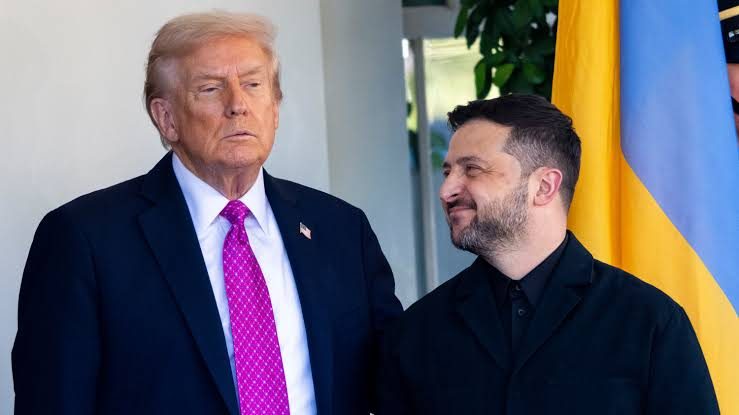
The reporting converges tightly on Zelenskyy’s Telegram announcement of a phone call with Trump that produced agreement for a New York meeting on the margins of the UN General Assembly, yet the accounts part company on what the call signals. US-framed pieces present the exchange as evidence that diplomatic momentum is building and direct negotiations could resume under American mediation, citing the Witkoff-Kushner trip and ideas for energy and food security steps. Polish coverage adds timing details tied to the UN calendar and notes prior July contact, framing the declaration itself as the notable development for European security. Swiss live updates embed the item inside wider Ukraine-war tracking that includes European intelligence warnings about possible Russian moves against NATO, treating the bilateral agreement as one data point among many. Indian reporting draws on Axios sourcing to foreground the US de-escalation push, specifically Trump’s reported emphasis on halting Ukrainian strikes on Russian refineries and diesel prices. Azerbaijani dispatches stay narrowly on Zelenskyy’s stated agreement, offering a concise post-Soviet regional echo without additional framing. The pattern shows that outlets closer to the negotiating parties amplify momentum language while others keep the event inside the ongoing conflict’s larger risks, and no independent chain contradicts the core fact of the call and meeting commitment.
Perspective Analysis
Zelenskyy announced on his Telegram channel that he had spoken by phone with Trump and that the two leaders had agreed to meet in New York. He described the conversation as important, said they had discussed many issues, and stated that the meeting “could change a lot” while adding that diplomatic momentum existed. The Ukrainian president thanked Trump for the recent visit to Kyiv by US envoys Steve Witkoff and Jared Kushner, noting that the pair had seen the situation in Ukraine firsthand and that the two sides had reviewed key issues. He said ideas were under discussion for de-escalation steps and for addressing fundamental security questions involving energy, food and the protection of human life. He did not give a precise date.
The meeting is expected to take place on the sidelines of the 81st session of the United Nations General Assembly, which opens in New York on 21 September 2026, with the main general debate scheduled for 22 September. Trump is due to speak during that debate. Zelenskyy’s announcement followed an earlier in-person meeting between the two leaders on 28 July in Washington. Witkoff and Kushner had traveled to Kyiv earlier in September in their roles as mediators; it was their first visit to Ukraine in that capacity after several earlier trips to Russia.
Plans are under discussion to revive direct negotiations between Kyiv and Moscow under US mediation. Russia has indicated that talks could resume in October. Earlier rounds reached an impasse last winter and were suspended during the period of the Iran war. The current effort focuses on short-term de-escalation measures alongside broader security questions. One account reported that during the phone call Trump repeatedly urged Zelenskyy to halt Ukrainian strikes on Russian oil refineries, linking those attacks to disruptions in fuel supplies and higher diesel prices; the word “diesel” came up many times, according to a source familiar with the conversation.
Ukrainian officials have indicated that Ukraine could consider halting strikes on Russian energy facilities if Russia provides firm guarantees against attacks on Ukrainian critical infrastructure. Zelenskyy has also called for additional US air-defense missiles to counter Russian ballistic missile attacks. Russia and Ukraine continue to accuse each other of lacking genuine interest in ending the fighting, with Ukraine seeking to regain territory occupied by Russian forces.
The five accounts examined converge on the core sequence of the phone call and the agreement to meet in New York. They differ in the surrounding detail they supply and in the weight they place on particular elements. The Spokesman-Review piece, which carries German Press Agency copy, presents the exchange as part of peace efforts that are picking up, with direct talks potentially resuming under American mediation. Wprost supplies the July 28 date of the previous Washington meeting and notes the precise UNGA calendar, including the timing of Trump’s scheduled speech, while framing the declaration itself as a significant signal for European security. Le Temps places the announcement inside a live blog on the Ukraine war that also reports European intelligence assessments warning that Russia may be preparing more decisive action against NATO, possibly including limited incursions or influence campaigns within months. IndiaPost draws on additional reporting to foreground US pressure on Ukrainian strikes against Russian refineries and the diesel-price dimension. APA carries only the narrow statement of agreement without further elaboration.
A reader limited to any single outlet would therefore miss either the calendar precision and prior contact noted in the Polish account, the wider conflict risks tracked in the Swiss live coverage, the specific US interest in energy infrastructure reported through the Indian piece, or the narrower factual relay offered by the Azerbaijani dispatch. The single-source detail on refinery strikes and diesel prices appears only in the IndiaPost account citing Axios; no other chain examined here carries that element. The corroborated record across the remaining four outlets establishes only the phone call, the agreement to meet, the envoy visit to Kyiv, and the general reference to de-escalation ideas on energy, food and lives.
What to Watch
The corroborated elements—the phone call and the New York meeting commitment—rest on Zelenskyy’s own public statement repeated across independent reporting chains. The single-source claim on refinery strikes carries its own attribution and cannot be treated as settled. The Swiss coverage supplies context on European intelligence assessments of Russian intentions that the other accounts examined do not include. Outlets closer to the US negotiating effort emphasize language of momentum and resumption; those farther from it keep the announcement inside the larger pattern of ongoing attacks and competing security calculations. The meeting itself will show whether the reported diplomatic momentum produces concrete steps on energy infrastructure or security guarantees, or whether it remains one data point among continuing hostilities.
That’s how the world told the story.
Get tomorrow’s bulletin by email — one briefing, up to six stories.
Subscribe freeNo spam. One-click unsubscribe. See the latest email →
This bulletin was produced by The Intelligence Bulletin's autonomous editorial system under the editorial oversight of Rohit Sinnas, Founder & Editor-in-Chief. How it works →