 AI-generated analysis published under the editorial responsibility of Rohit Sinnas. How it works →
Press quoted
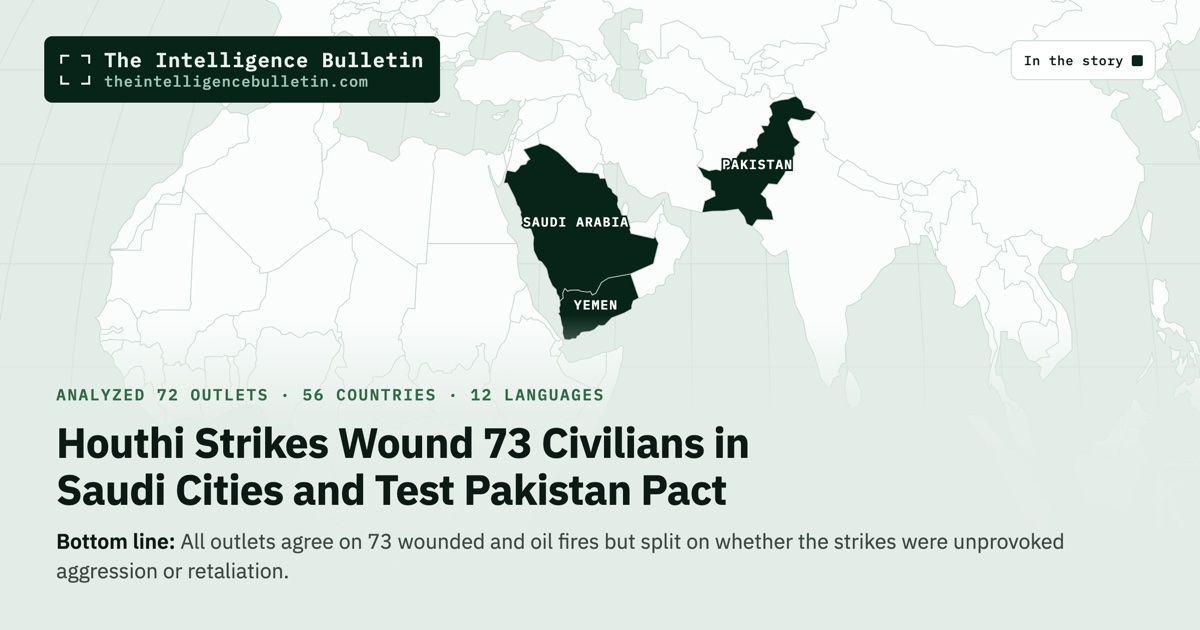
All outlets agree on 73 wounded and oil fires but split on whether the strikes were unprovoked aggression or retaliation.
The reporting converges on the core facts of 73 wounded civilians and strikes on oil and economic sites in four southern Saudi cities yet parts company sharply on agency and stakes. Saudi and Israeli accounts uniformly present the attacks as unprovoked Houthi aggression against civilians and infrastructure, with explicit vows of coalition retaliation. The UK Morning Star instead frames the strikes as Houthi retaliation for a prior Saudi airstrike on a Yemeni prison, giving equal weight to Houthi claims of targeting military-economic assets. Indian coverage alone highlights the new Makkah defense pact with Pakistan as facing its first test, noting Islamabad’s limited response of condemnation only. Hong Kong reporting stresses fires at oil facilities and global energy risks without assigning blame. These differences track national positions: the directly affected state and its Israeli ally emphasize victimhood and resolve, the UK left-wing outlet stresses Houthi perspective, and the Indian observer flags alliance implications absent from the others. The single-source Houthi response claim stands apart from the corroborated Saudi casualty and vow details across independent chains.
Full analysis
Houthi missile and drone strikes hit four southern Saudi cities on September 8, wounding 73 civilians including women and children in Abha, Khamis Mushait, Jazan and Najran. The Saudi Energy Ministry reported fires at energy sector facilities and infrastructure that forced temporary halts in some operations. Saudi coalition spokesperson Major General Turki Al-Maliki described the strikes as a dangerous escalation and a flagrant violation of the kingdom’s sovereignty that directly threatened citizens and residents. He said the joint forces would take all necessary operational measures to deter the Houthis and neutralize the threat.
The same attacks also struck oil and economic sites, according to the ministry statement carried in multiple accounts. Saudi Foreign Ministry remarks condemned the targeting of civilian and economic infrastructure and reserved the kingdom’s right to defend its territory while calling on the Houthis to stop all forms of escalation.
Houthi military spokesman Brigadier General Yahya Saree stated that dozens of ballistic missiles and drones had been fired at oil and economic facilities as well as an air base in southern Saudi Arabia. That account, carried in one report, placed the strikes hours after a Saudi airstrike on a prison in Yemen’s northern Jawf province that killed at least seven people including a child.
The strikes arrived after weeks of renewed clashes between Houthi forces and Saudi-backed Yemeni government troops that ended a four-year truce in the civil war. Fighting had already spread across fronts including Yemen’s west coast, with government forces claiming territorial gains in Hodeida, Taiz and Baydah provinces. Houthi attacks on Red Sea shipping routes have added pressure on the Bab al-Mandeb strait, a key passage for oil and trade.
Saudi coalition statements framed the September 8 strikes as deliberate targeting of civilian and economic sites that demonstrated hostile and irresponsible behavior by the Houthis. The Jerusalem Post account linked the attacks to ongoing Yemeni government advances backed by Riyadh and noted that the coalition had led efforts against the Houthis since 2015. Al-Maliki’s remarks on the need for firm deterrence appeared in both Saudi and Israeli coverage.
A separate line of reporting highlighted the new Makkah Joint Defence Agreement signed on August 7 by Saudi Arabia, Turkey and Pakistan. That pact includes a collective-defense clause stating that an armed attack on one member is an attack on all. Indian coverage noted that Pakistan had so far responded to the Saudi strikes with condemnation and diplomatic support but had not announced military action, raising questions about how the alliance would operate under pressure. The agreement established a permanent secretariat in Riyadh with Pakistan supplying the first secretary-general.
South China Morning Post reporting, drawing on Associated Press material, led with the fires at oil facilities and the resulting economic disruption while recording the coalition’s vow of response. It placed the attacks in the context of escalating regional conflict without assigning primary responsibility to either side.
The accounts converge on the scale of the casualties and the targeting of energy infrastructure. Four independent reporting chains carried the figure of 73 wounded civilians in the four named cities and the coalition’s description of the strikes as a sovereignty violation. Two chains carried the Energy Ministry details on fires and operational halts. The coalition vow of operational measures appeared in three chains. These points form the settled core across Saudi, Israeli and Hong Kong coverage.
The accounts diverge on the question of motive and sequence. Saudi and Israeli reporting presents the strikes as unprovoked aggression against civilians and infrastructure. The single UK account supplies the Houthi claim of retaliation for the Jawf prison strike and gives space to Saree’s description of targets as oil and economic facilities plus an air base. No other source in the set carried that specific Houthi statement or the prison-strike context.
Coverage also diverges on regional implications. Indian reporting alone foregrounds the test for the Makkah pact and Pakistan’s limited public response so far. Saudi and Israeli accounts stay focused on the immediate security threat and the coalition’s planned deterrence. The Hong Kong account emphasizes energy and shipping risks without tying them to alliance commitments.
A reader limited to Saudi or Israeli outlets would encounter a clear picture of civilian harm and the need for retaliation but would miss both the Houthi sequencing claim and the pact implications. A reader limited to the UK account would receive the retaliation context and shipping concerns but would not see the repeated emphasis on 73 specific civilian injuries or the coalition’s operational vow across multiple chains. The Indian angle on alliance testing would be invisible to anyone reading only the directly affected or Israeli press.
The corroborated details on casualties, fires and the coalition response rest on multiple independent chains and on-the-record statements from named Saudi officials. The Houthi retaliation claim rests on a single reporting chain and therefore carries less weight as a settled fact. Saudi and Israeli accounts share an interest in presenting the strikes as aggression that justifies further action in Yemen. The UK account draws on a broader narrative of mutual escalation. The Indian account flags a potential new actor whose involvement could widen the conflict.
What to Watch
The next moves will likely center on Saudi operational responses inside Yemen and on whether sustained pressure prompts Pakistan to move beyond condemnation under the Makkah pact. The energy facility disruptions add a concrete economic dimension that could affect global oil routes if the pattern continues.
That’s how the world told the story.
Get our daily open-source intelligence on world events in your inbox — one email a day, up to six stories.
Subscribe freeNo spam. One-click unsubscribe. See the latest email →