 AI-generated analysis published under the editorial responsibility of Rohit Sinnas. How it works →
Press quoted
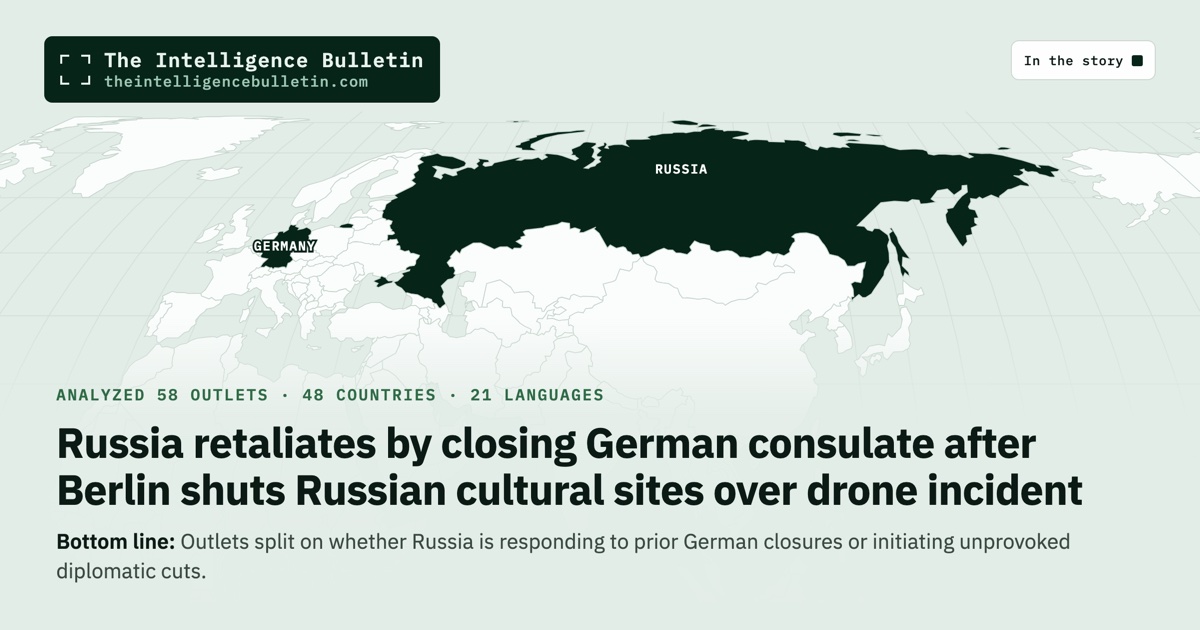
Outlets split on whether Russia is responding to prior German closures or initiating unprovoked diplomatic cuts.
All five outlets agree on the core sequence: Germany acted first against Russian sites after accusing Moscow of a hybrid drone attack at Leipzig airport, and Russia responded by ordering the St. Petersburg consulate and Goethe institutes closed. The divergence lies in framing the sequence as either defensive symmetry or one-sided Russian pressure. Russian domestic coverage stresses prior German warnings ignored and frames the drone blame as fabricated provocation tied to support for Ukraine. German reporting presents Berlin’s closures as a direct response to hybrid threats while noting the reciprocal nature. Australian and Turkish accounts treat the episode as mutual diplomatic freeze without assigning primary blame. Ukrainian coverage adds context on the Bonn consulate’s alleged intelligence role and views the Russian moves as attempts to fracture European support for Kyiv. The consistent thread across independent chains is that both sides are dismantling remaining cultural and consular footholds, with the drone allegation serving as the immediate trigger rather than a standalone cause. This pattern shows the spat is not an isolated escalation but the latest step in a longer cycle where each capital uses the other’s actions to justify its own reductions in presence.
Full analysis
Russia ordered the German consulate general in St. Petersburg to cease operations no later than September 18, with its staff required to leave Russian territory by that date. It also directed all branches of the Goethe-Institut in Russia to close by September 13, with personnel ordered out by then. Russian officials presented these steps as direct responses to German decisions announced earlier in September to shut the Russian consulate in Bonn and terminate the lease for the Russian House cultural center in Berlin. The German moves followed Berlin’s public accusation that Russia bore responsibility for an explosive-laden drone discovered at Leipzig/Halle airport on August 4. Moscow rejected the accusation as fabricated and stated that German authorities had provoked the latest round of escalation.
The Russian House, formally the Russian Center for Science and Culture, had operated on Friedrichstrasse in Berlin since 1984 under two bilateral agreements. One covered the land use for 99 years from 2013. The other, signed in 2011, governed cultural centers and allowed unilateral termination every five years. German Foreign Minister Johann Wadephul cited the Leipzig incident as the reason for ending the arrangement, describing it as a hybrid attack. Russian accounts note that the Russian embassy in Berlin had already rejected the blame and that Foreign Minister Sergei Lavrov had warned on September 3 that Moscow would close Goethe-Institut branches if the Russian House were shut. German reporting links the Bonn consulate closure to concerns over its alleged role in coordinating intelligence and hybrid operations across Western Europe. Ukrainian coverage adds that roughly one-third of the roughly 60 Russian diplomats ordered to leave Bonn by September 18 were affiliated with Russian intelligence services, according to sources cited in the German newspaper Bild.
Both governments framed their actions as reactions to the other’s prior steps. Russian statements emphasized that Berlin bore full responsibility for the consequences and that Moscow had issued advance notice of possible countermeasures. German accounts described the Russian response as expected tit-for-tat after Berlin coordinated with NATO and EU partners on the drone finding. The European Union characterized the Leipzig incident as bearing signs of state-sponsored terrorism. Russian officials countered that the episode served the interests of Kyiv and its European allies. Lavrov described the German accusations as the beginning of a real war. Finnish authorities separately announced a 200-kilometer fence along their border with Russia, citing hybrid warfare concerns, though that measure was not part of the bilateral exchange.
The closures remove the last major Russian cultural foothold in Germany and eliminate German cultural programming inside Russia. The Russian House had resumed activities in September 2022 after a security-related pause following the start of the full-scale war in Ukraine. It had hosted language classes, concerts, films and exhibitions for Berlin’s Russian-speaking community. Goethe-Institut branches in Moscow, St. Petersburg and Yekaterinburg ran parallel programs promoting German language and culture. Their simultaneous shutdowns mark the effective end of reciprocal state-supported cultural exchange between the two countries.
Coverage of the sequence converges on the timing and the reciprocal character of the measures. Every outlet reported the Russian announcement of the St. Petersburg consulate closure and the Goethe-Institut order as following Germany’s earlier actions against Russian sites. Every outlet also recorded Moscow’s denial of involvement in the Leipzig drone and its explicit description of the closures as retaliation. The single point of divergence on a concrete claim is the characterization of the Bonn consulate. Only the Kyiv Post article, drawing on Bild reporting, states that the site allegedly served as a coordination hub for Russian intelligence operations targeting Benelux nations, EU institutions and NATO headquarters. No other source in the set repeats or contradicts that specific allegation with independent sourcing.
Russian domestic reporting foregrounds the history of the bilateral agreements and Lavrov’s September 3 warning, presenting the German closures as the first move in the current round. German public broadcasting stresses Berlin’s defensive posture after the drone finding and notes the mutual impact on cultural presence. The Australian account treats the episode as a mutual diplomatic freeze within the wider Ukraine-related tensions, without assigning the initial provocation. The Turkish account adopts the language of Russian retaliation without adding independent verification of the drone claims. Ukrainian coverage connects the moves explicitly to ongoing hybrid threats and European support for Kyiv, including the alleged intelligence function of the Bonn site.
The pattern that emerges across the independent reporting chains is a continuing reduction in official presence rather than an isolated incident. Both capitals are using the other’s actions to justify the removal of consular and cultural infrastructure that survived earlier phases of the conflict. The drone allegation at Leipzig serves as the immediate trigger for the German steps, yet the Russian response rests on the prior German decisions and the advance warning issued by Lavrov. The single-source claim about Bonn intelligence operations adds context available only through one reporting chain and does not alter the corroborated sequence of closures.
What to Watch
The account that aligns most closely with the evidence across multiple outlets is the description of mutual, sequential reductions in diplomatic and cultural presence. That description is supported by the Russian Foreign Ministry statements carried in all five articles, the German government announcements referenced in four, and the explicit denial of drone involvement reported in four. The German side has an interest in presenting its actions as security-driven responses to hybrid threats, while the Russian side has an interest in framing its moves as proportionate replies to prior German steps. The reporting shows that both interests produce consistent descriptions of the sequence itself. The next likely development is further contraction of remaining bilateral channels, as each government cites the latest closure to justify additional measures. That contraction matters because it removes the last formal venues for official cultural and consular contact between two major European powers whose relations have already been reduced to the minimum required by the Ukraine conflict.
That’s how the world told the story.
Get our daily open-source intelligence on world events in your inbox — one email a day, up to six stories.
Subscribe freeNo spam. One-click unsubscribe. See the latest email →