 AI-generated analysis published under the editorial responsibility of Rohit Sinnas. How it works →
Press quoted
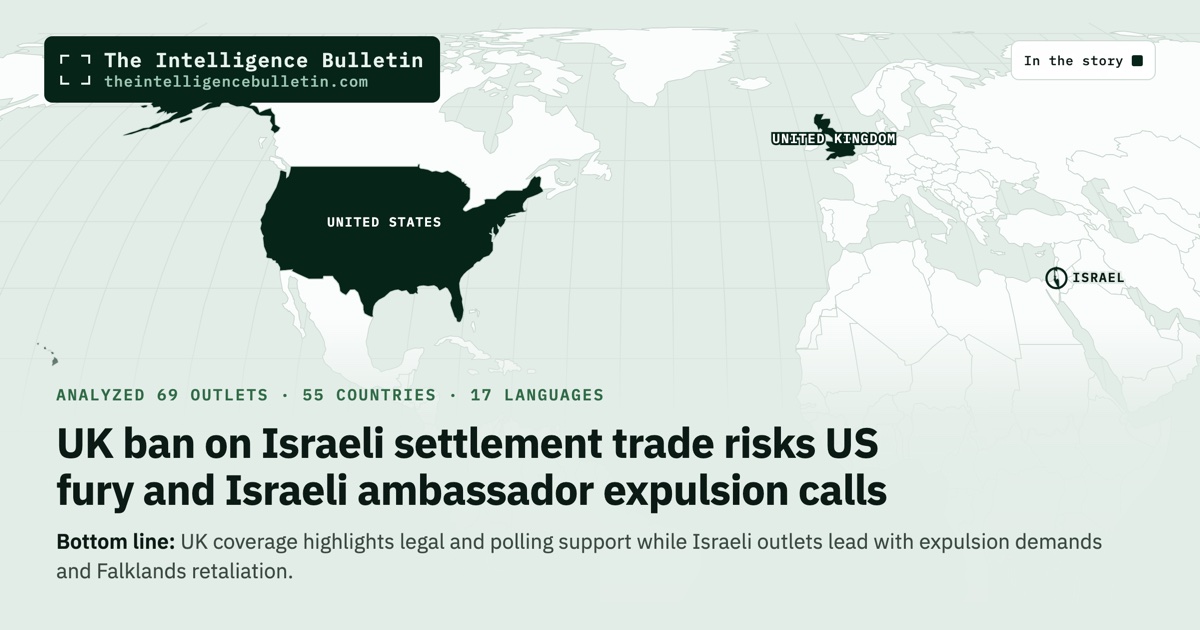
UK coverage highlights legal and polling support while Israeli outlets lead with expulsion demands and Falklands retaliation.
UK outlets converge on the announcement’s legal grounding and domestic polling support for the ban, while Israeli sources foreground immediate domestic fury and calls for ambassador expulsion. LBC and Guardian both detail Miliband’s reset language and E1 trigger but differ in emphasis on Trump risks versus two-state reassertion. JPost reports the timing shock to British Jews and legal challenges from UK Lawyers for Israel, relaying concerns over Palestinian workers. Kipa alone surfaces Smotrich’s expulsion demand and Ben Gvir’s Falklands recognition call, echoed by Milei. MEE stresses ICJ compliance and UN rapporteur pressure for paradigm shift. The reporting shows consistent core facts across chains yet reveals how national stakes shape what each treats as the central consequence: policy substance for UK readers, sovereignty affront and electoral fallout for Israeli ones. No source contradicts the Tuesday timing or settlement trade ban itself.
Full analysis
The United Kingdom will announce on Tuesday a ban on trade in goods and services from Israeli settlements in the West Bank, along with targeted sanctions on companies and individuals involved in settlement activity. Foreign Secretary Ed Miliband is expected to present the measures in a statement to Parliament in the afternoon, after a morning debate on Jewish safety in Westminster Hall. The package forms part of what Miliband has described as a comprehensive reset of British policy toward Israel and the Palestinians, with the explicit aim of upholding a two-state solution and bringing the United Kingdom into line with the International Court of Justice advisory opinion from July 2024.
That opinion declared the Israeli occupation of Palestinian territory illegal and required states not to aid or assist its maintenance. The British measures are expected to prohibit investment in settlement businesses, extend the existing prohibition on preferential tariffs for settlement goods, and make certain financing and advertising activities unlawful. The trigger cited across reporting is Israel’s recent tender for the E1 settlement project east of Jerusalem, which would cut the West Bank in two and sever its connection to the city. Additional context includes ongoing settler violence against Palestinians and restrictions on aid into Gaza that Miliband has called horrific.
Israeli officials have responded with warnings of retaliation. Foreign Minister Gideon Saar stated that if Britain acts against Israel, Israel will act against Britain. In the Hebrew-language Israeli press, Finance Minister Bezalel Smotrich called for the immediate expulsion of the British ambassador, describing the British government as antisemitic and under the influence of radical Islam. National Security Minister Itamar Ben Gvir proposed that Israel publicly recognize Argentine sovereignty over the Falkland Islands and impose sanctions on Britain in response. Argentine President Javier Milei amplified the Falklands suggestion on social media. British Jewish organizations, including the Board of Deputies and the Jewish Leadership Council, have expressed concern that the sanctions could damage the UK-Israel relationship and harm Palestinian workers employed in settlement enterprises. UK Chief Rabbi Ephraim Mirvis described the measures as counterproductive to peace and likely to affect British Jews through their family, religious, and educational ties to Israel.
US criticism has been direct. Ambassador to Israel Mike Huckabee accused Miliband of Jew hate, linking the sanctions to what he called the British government’s loss of factual grounding. Prime Minister Andy Burnham briefed President Donald Trump and Gulf allies on the plans. Total bilateral trade in goods and services between the United Kingdom and Israel stood at £6 billion in 2025, providing a measure of the potential economic exposure if reprisals materialize. British polling conducted by Opinium for the European Council on Foreign Relations found 46 percent of adults in favor of a settlement trade ban and 18 percent opposed, with support rising to nearly three-quarters when undecided respondents are excluded.
The announcement arrives after months of pressure from British MPs and civil society groups. Former diplomats associated with the Britain Palestine Project have set criteria for judging the package, including whether it ends UK involvement in the occupation, strengthens Palestinian statehood, and builds international support for consequences. The Foreign Office has previously argued that distinguishing settlement products from those of Israel proper is impractical, but the new steps move beyond guidance and labeling requirements that have been in place since 2005.
Coverage of the same core facts diverges sharply once the story moves from the measure itself to its likely consequences. British outlets place the decision inside a framework of international law and domestic opinion. The Guardian reports Miliband’s intent to place the settlement measures in the explicit context of International Criminal Court and International Court of Justice findings, and it alone publishes the Opinium polling numbers showing broad public backing. Middle East Eye adds the voice of UN Special Rapporteur Francesca Albanese, who framed the ban as part of a required paradigm shift rather than a discretionary choice. These accounts treat the legal obligation and the polling as central to understanding why the reset is occurring now.
Israeli reporting, by contrast, foregrounds the immediate political and communal fallout inside Britain and the risk of escalation. The Jerusalem Post notes the timing shock to British Jews ahead of the Jewish New Year and relays legal objections from UK Lawyers for Israel, who argue that a general ban would violate World Trade Organization rules, bilateral agreements, and EU law still applicable in Northern Ireland. It also records the absence of any conversation between Burnham and Israeli Prime Minister Benjamin Netanyahu in the fifty days since Burnham took office. The Hebrew outlet Kipa alone carries the specific ministerial calls for ambassador expulsion and Falklands recognition, presenting them as the leading Israeli response rather than background commentary.
No reporting chain contradicts the Tuesday timing or the settlement trade ban itself. The divergence lies in which consequences each national press treats as primary. British accounts emphasize compliance with court opinions and measurable public support; Israeli accounts emphasize damage to bilateral ties, harm to Palestinian employment, and the prospect of reciprocal diplomatic or economic moves. The single-source element in the Israeli domestic reaction—the precise expulsion and Falklands demands—appears only in the Hebrew press and is not echoed in the English-language Israeli reporting examined.
What to Watch
The accounts that tie the move most closely to an external legal standard and to domestic polling numbers rest on the largest number of independent reporting chains. The accounts that treat ambassador expulsion or Falklands recognition as the operative Israeli response rest on narrower sourcing. What happens next will depend on whether the announced package requires primary legislation, how Israel chooses to respond within the constraints of its own coalition politics ahead of its October election, and whether the United States converts rhetorical criticism into concrete pressure on trade or security cooperation. The £6 billion trade figure already on the table supplies one concrete boundary for assessing the scale of any subsequent disruption.
That’s how the world told the story.
Get our daily open-source intelligence on world events in your inbox — one email a day, up to six stories.
Subscribe freeNo spam. One-click unsubscribe. See the latest email →