 AI-generated analysis published under the editorial responsibility of Rohit Sinnas. How it works →
Press quoted
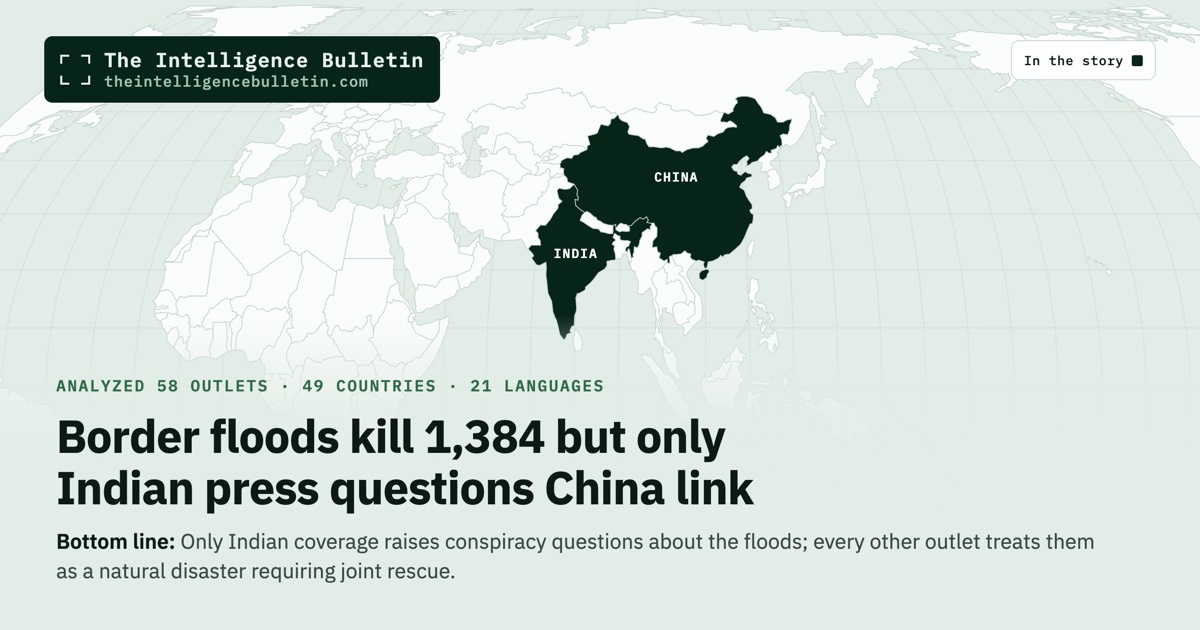
Only Indian coverage raises conspiracy questions about the floods; every other outlet treats them as a natural disaster requiring joint rescue.
National priorities dictate how each press frames the same disaster. Nepali coverage from Ekantipur presents the floods as the trigger for expanded Chinese satellite monitoring and data exchange, casting the event as an opportunity to strengthen bilateral cooperation on disaster response. Chinese material relayed via Baidu stresses the physical hardship of digging through mud and rubble at Gyirong and offers public tribute to rescuers, avoiding any discussion of cause or foreign involvement. Indian Hindi-language reporting stands apart by linking the timing of the floods to an April-May visit by US diplomat Sergio Gor to the affected border areas and by quoting unnamed sources who question whether the glacial collapse was natural or engineered. Al Jazeera and O Globo supply the cross-border humanitarian picture: joint operations hampered by terrain and weather, confirmed death and missing tallies from both governments, and the total erasure of the Gyirong customs building down to its foundation. The Indian angle has no counterpart in any other source; the cooperation narrative appears only in Nepali and Chinese accounts. This pattern shows how proximity, alliance and rivalry shape what each national press chooses to emphasise or omit when the same bodies are being recovered from the same gorge.
Full analysis
The floods struck after a glacial collapse hit the border region near Gyirong in late August. Waters swept through narrow gorges on both sides of the frontier, killing at least 1,384 people and leaving more than 5,500 others missing twelve days later. Nepal’s national disaster agency placed its death toll at 1,341 with roughly 4,996 people unaccounted for. Chinese state media reported 43 dead and 519 missing on the Tibetan side, including 261 foreigners. Rescue teams worked in mud and unstable terrain, pulling four survivors from flooded hydropower tunnels in Nepal since the previous Friday. On the Chinese side crews used shovels, excavators and ground-penetrating radar to search the debris field.
At Gyirong, once the main land port between Tibet and Nepal, nothing remained of a five-storey customs building. Workers described arriving to find only the foundation after the mudslide stripped away every structure above it. One rescuer, Zhang Xiaojun, told visiting journalists that the sight was heartbreaking and that many compatriots had lost their lives. The single road into the gorge reopened mid-week, allowing heavier equipment to reach the site. Chinese authorities brought foreign reporters to the location and stated that more than sixty specialists and three laboratories were cataloguing remains using fingerprints, genetic data and immigration records.
China responded to the disaster by expanding real-time satellite monitoring for Nepal. The Chinese Meteorological Administration reported that Fengyun-3 and Fengyun-4 satellites now feed data into an AI-based early-warning system called Maju, supplying rainfall, lightning, river-flow and glacial-slide observations. Chinese officials said the information supports emergency rescue, damage assessment and ongoing coordination with Nepali counterparts. Nepali coverage presented the arrangement as a direct follow-on to the floods and a strengthening of bilateral technical ties.
Indian reporting introduced a different line of questions. One outlet cited unnamed Nepali and Tibetan sources who noted that a US diplomat, Sergio Gor, had visited the same border districts in late April and early May, including the Everest base camp area where he conducted drone demonstrations. The same sources suggested the scale of the glacial release appeared inconsistent with known natural features in the Mustang region and raised the possibility that water had been artificially impounded and then released. No other outlet in the set carried these claims or any reference to the diplomat’s earlier trip.
Al Jazeera and O Globo supplied the shared operational picture. Both described joint search efforts slowed by weather, landslides and poor connectivity. Nepal requested assistance from the UN-backed Fund for Responding to Loss and Damage and filed a formal climate-compensation claim, arguing that major emitters bear historical responsibility for the costs now falling on vulnerable countries. The UN appealed for fifty million dollars to aid more than 84,000 people affected by the disaster. Survivors brought by helicopter to a monastery-turned-shelter in Kathmandu spoke of lost families and homes, with volunteers noting that children’s drawings still showed “happy” stickers even as trauma remained suppressed.
The corroborated elements across independent chains are the death and missing counts, the total destruction of the Gyirong post, and the continuation of rescue work into the second week. These details appear in reporting that draws on official tallies from both governments and on-site accounts from Chinese and international journalists. The satellite-monitoring expansion rests on statements carried only in Nepali coverage. The suggestion of a non-natural cause or diplomatic connection appears only in the Indian Hindi-language account and relies on unnamed sources.
What to Watch
A reader limited to any single national press would therefore miss either the scale of confirmed cross-border losses, the physical erasure of the border facility, or the absence of corroboration for the conspiracy framing. The humanitarian facts rest on multiple reporting lines that converge on the same numbers and the same destroyed infrastructure. The alternative explanation rests on one outlet’s sourcing and has not been repeated elsewhere in the set. Regional rivalry supplies a clear motive for the Indian framing, while proximity and alliance supply equally clear motives for the Nepali and Chinese emphasis on cooperation and operational effort. The next developments most likely to shape outcomes are the pace of body identification and the response, if any, to Nepal’s compensation request.
That’s how the world told the story.
Get our daily open-source intelligence on world events in your inbox — one email a day, up to six stories.
Subscribe freeNo spam. One-click unsubscribe. See the latest email →