 AI-generated analysis published under the editorial responsibility of Rohit Sinnas. How it works →
Press quoted
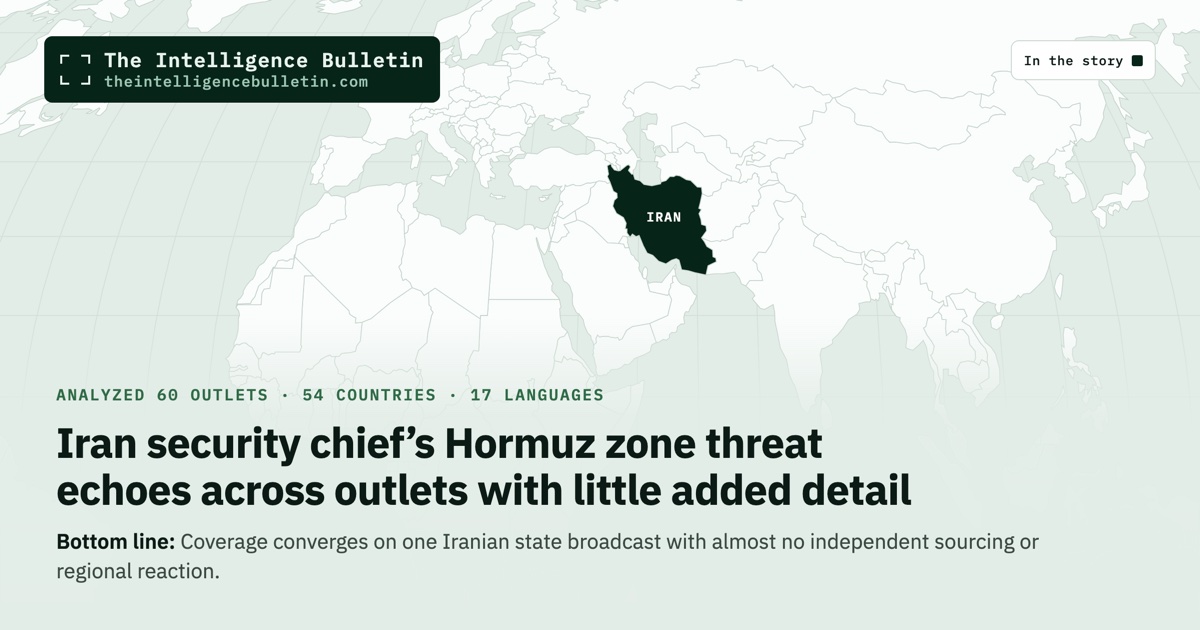
Coverage converges on one Iranian state broadcast with almost no independent sourcing or regional reaction.
All five outlets report the same core statement from Mohsen Rezaei on Iranian state television with only minor wording differences between “prohibited zone” and “exclusion zone.” Straits Times, SCMP via AFP, and Arab News via AP stay tightly focused on the timeline and geography of the zone. Israel National News adds immediate context on parallel petrol price hikes and US economic measures, framing the announcement as part of intensifying pressure. E24 alone highlights the Norwegian economic lens on potential shipping disruption while noting Bloomberg-sourced details on Iranian claims that the strait remains controlled. No outlet supplies independent verification of the zone’s exact coordinates or enforcement mechanism; every account traces directly to the same Iranian broadcast. The selected coverage therefore converges on the announcement itself rather than its practical effects or regional reactions, leaving the central tension—whether the zone will meaningfully alter tanker routes—unstated beyond Rezaei’s quoted threat.
Full analysis
Iran’s top security official Mohsen Rezaei told state television on September 6 that his country would announce a prohibited zone outside the Strait of Hormuz within days. The zone, he said, would begin at the line of the existing US naval blockade and extend into the Persian Gulf. Any ship entering the area with intent to transit the strait would be added to Iran’s sanctions list.
Rezaei’s remarks came one day after US forces struck three oil tankers linked to Iran’s Revolutionary Guards, an action taken in response to Iranian ballistic-missile fire at two American warships earlier that week. Iranian state media reported that Revolutionary Guards naval units had themselves targeted three tankers on an unauthorised route through the strait and three other vessels affiliated with the United States. The Guards also claimed an attack on a US naval drone attempting to enter the strait, a claim US Central Command dismissed as false. Rezaei framed the coming zone as a direct response to the blockade and to continued attempts by vessels to use routes Tehran does not control.
The Strait of Hormuz remains the critical passage for roughly one-fifth of global oil supplies before the current conflict. Rezaei stated that the strait is fully closed and under armed control, with Iranian forces intercepting vessels attempting to pass without approval. He added that Iran continues daily oil exports of one to one and a half million barrels despite the pressure. US Energy Secretary Chris Wright told American broadcasters the same day that average daily flows through the strait stood at nine million barrels, supported by naval escorts, though he acknowledged volumes remain well below pre-conflict levels.
Alongside the zone announcement, Iranian authorities raised the price of petrol for the highest consumption tier. Government spokeswoman Fatemeh Mohajerani said the third-tier rate would double to 10,000 tomans per litre beginning September 8. The first two tiers remain unchanged. The rial traded above 2.2 million to the dollar on the black market that day, down from roughly 1.7 million before the conflict began in February.
Five outlets covering the announcement carried essentially the same account of Rezaei’s televised statement. The Straits Times, South China Morning Post via Agence France-Presse, Arab News via the Associated Press, Israel National News, and E24 in Norway all quoted the security chief’s description of the zone’s location and the sanctions consequence for ships that enter it. Minor phrasing differences appeared between “prohibited zone” and “exclusion zone,” but the core geography and penalty remained identical across the reports.
The outlets diverged only in the additional context each chose to include. The Straits Times and South China Morning Post stayed close to the timeline and geography of the zone itself. Arab News noted the zone’s intended effect on vessels attempting transit and mentioned expert views that the move represented escalation. Israel National News placed the announcement inside a wider account of US economic measures, including the rial’s decline and the Treasury’s recent sanctions campaign. E24 alone supplied pre-conflict traffic figures and Iranian assertions that the strait stays under armed control, framing the development through its implications for shipping volumes.
No report supplied independent coordinates for the zone, enforcement procedures, or confirmation that the measure had already taken effect. Every account traced directly to the same Iranian state broadcast. The convergence therefore rests on a single originating statement rather than multiple independent reporting chains.
The practical reach of the announced zone cannot be assessed from the published coverage. Rezaei presented it as an extension of existing Iranian control over the strait, yet the reports contain no details on how the new boundary would be marked, patrolled, or enforced against vessels already under US escort. The simultaneous petrol-price increase and currency pressure appear in three of the five accounts as parallel domestic measures, but none of the pieces link those steps explicitly to the zone announcement or predict their combined effect on Iranian oil revenues.
What to Watch
The reporting shows that Iranian state media delivered a clear public signal of intent to tighten restrictions on the strait. Whether that signal produces measurable changes in tanker routing or oil-price volatility will depend on actions that none of the five accounts described. The absence of independent sourcing on enforcement leaves the announcement’s weight resting on the credibility of the broadcast itself and on whatever follow-up measures Tehran may take in the coming days.
That’s how the world told the story.
Get our daily open-source intelligence on world events in your inbox — one email a day, up to six stories.
Subscribe freeNo spam. One-click unsubscribe. See the latest email →