 AI-generated analysis published under the editorial responsibility of Rohit Sinnas. How it works →
Press quoted
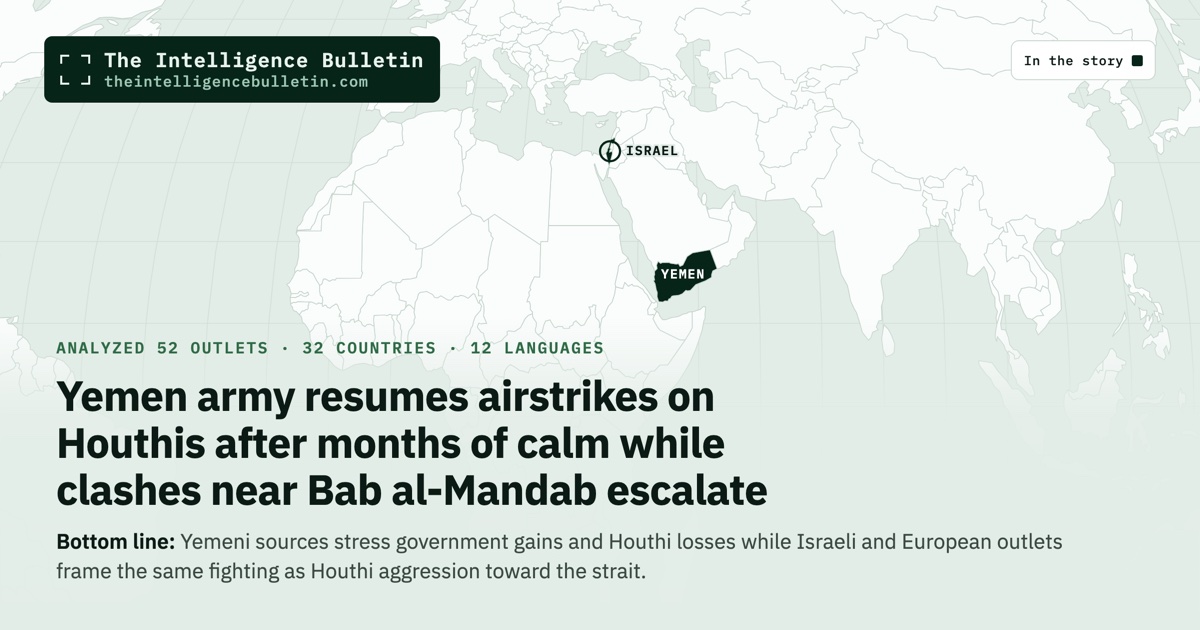
Yemeni sources stress government gains and Houthi losses while Israeli and European outlets frame the same fighting as Houthi aggression toward the strait.
Yemeni reporting from Khabar Agency frames the clashes as a government success that inflicted heavy losses on Houthis, including field commanders and minors, with hospitals in Hodeidah and Sanaa overwhelmed and bodies left on the battlefield. Israeli coverage in the Jerusalem Post, citing New York Times reporting, presents the same fighting as a Houthi escalation aimed at seizing Mocha to control the Bab al-Mandab Strait and international shipping. Middle East Eye and Turkish Star both highlight the airstrikes themselves as the central development, noting their resumption after months of relative calm and grounding the claim in an official Yemeni military statement. Austrian Krone leads instead with Houthi attacks on the army and a total of 120 dead, producing a casualty-focused European account. The pattern shows that only outlets with direct access to Yemeni military statements or local hospitals emphasize government initiative and Houthi losses; others either relay the Houthi offensive narrative or isolate the airstrike novelty without resolving who initiated the latest round. No source supplies independent verification of casualty totals or territorial control, leaving the battlefield outcome dependent on which side’s military communique each outlet chooses to foreground.
Full analysis
Yemen’s internationally recognized government forces launched more than 15 airstrikes against Houthi positions, gatherings and vehicles along the western coastal fronts in Taiz and Hodeidah provinces on September 4 and 5. The strikes marked the first use of Yemeni warplanes against Houthi targets since July and provided direct air support to ground troops holding the line near the Hays front in western Taiz. Fighting had intensified early on Thursday when Houthi forces opened a major offensive in the area, prompting the government to send additional reinforcements.
The same government statement described the airstrikes as targeting Houthi concentrations and military equipment while ground units repelled attempts to breach established contact lines. Turkish reporting carried by Star and UK reporting in Middle East Eye both drew directly from this official Yemeni military communique, noting the resumption of fixed-wing strikes after months of relative quiet along the Red Sea coast. Khabar Agency, a Yemeni outlet with access to local military sources, added that the strikes formed part of a broader effort in which government forces documented numerous Houthi remains left on the battlefield through video footage.
Houthi forces had sought to advance toward the port city of Mocha, less than 50 miles from the Bab al-Mandab Strait. The Jerusalem Post relayed reporting from the New York Times that cited two Yemeni security officials describing the offensive as an attempt to cut supply routes to Mocha and gain greater leverage over shipping through the narrow waterway. Mocha itself had come under Houthi missile fire earlier in August, when more than 25 projectiles struck the port and forced a temporary suspension of operations. Those earlier attacks were presented by the Houthis at the time as pre-emptive measures against an alleged Saudi-backed buildup.
Casualty accounts diverged sharply. Khabar Agency reported that hospitals in Hodeidah and Sanaa received dozens of Houthi fighters, including field commanders and minors, many arriving in critical condition or with remains charred beyond recognition. Facilities in Zabid, Bayt al-Faqih and central Hodeidah exceeded capacity, morgues filled to the point that commercial refrigeration containers were pressed into service, and appeals went out for blood donations. Government-aligned sources described these figures as only a partial count, with additional bodies still scattered across the front lines. Krone, an Austrian outlet, reported a total of 120 dead from Houthi attacks on army positions without specifying which side suffered the losses.
The clashes sit inside a longer pattern that began after the 2022 UN-brokered ceasefire. Relative calm along the west coast gave way in July to renewed exchanges of fire. The Houthis have controlled Sanaa and parts of the north since 2014, while the internationally recognized government and its allied forces hold most of the south, east and west. The current fighting occurs in territory that directly affects access to one of the world’s busiest maritime chokepoints.
A reader limited to Khabar Agency would conclude that government forces had seized the initiative and inflicted disproportionate losses on the Houthis, with the airstrikes serving as effective support for that advance. A reader limited to the Jerusalem Post would instead see the same days as the latest stage of a deliberate Houthi push to dominate the Bab al-Mandab Strait and threaten international shipping lanes. A reader limited to Middle East Eye or Star would register the airstrikes themselves as the notable development, the first concrete sign of renewed Yemeni air capability after months of restraint. A reader limited to Krone would take away only the raw death toll and the image of Houthi forces on the attack.
The airstrike claim rests on a single official Yemeni military statement carried independently by three outlets with different geographic bases. The assertion that the Houthis aimed specifically at Mocha and the strait rests on two unnamed security officials quoted in the New York Times and relayed without additional sourcing. The casualty numbers cannot be reconciled: one account supplies local hospital details and battlefield video, the other supplies an aggregate figure of 120 without attribution to any counting authority. No source in the set provides an independent count or on-the-ground verification from a third party.
The corroborated military action—the resumption of airstrikes after July—offers the clearest warrant for treating the government statement as the most reliable thread. That statement was issued by the party conducting the operations and was carried verbatim or in close paraphrase by outlets that do not share a common editorial line. The Houthi offensive narrative, while plausible given the port’s location and prior missile activity, lacks the same cross-chain support in this reporting window. Casualty claims remain unresolvable from the available accounts and should be treated as partisan tallies until additional reporting chains appear.
What to Watch
The immediate stakes center on whether the fighting expands along the coast or draws in additional external actors already active in Red Sea security. Government forces have demonstrated renewed air support capacity; Houthi forces have shown willingness to press ground offensives near a critical strait. The next several days of contact-line reports from either side will indicate whether the current round settles into another period of attrition or escalates further.
That’s how the world told the story.
Get our daily open-source intelligence on world events in your inbox — one email a day, up to six stories.
Subscribe freeNo spam. One-click unsubscribe. See the latest email →