 AI-generated analysis published under the editorial responsibility of Rohit Sinnas. How it works →
Press quoted
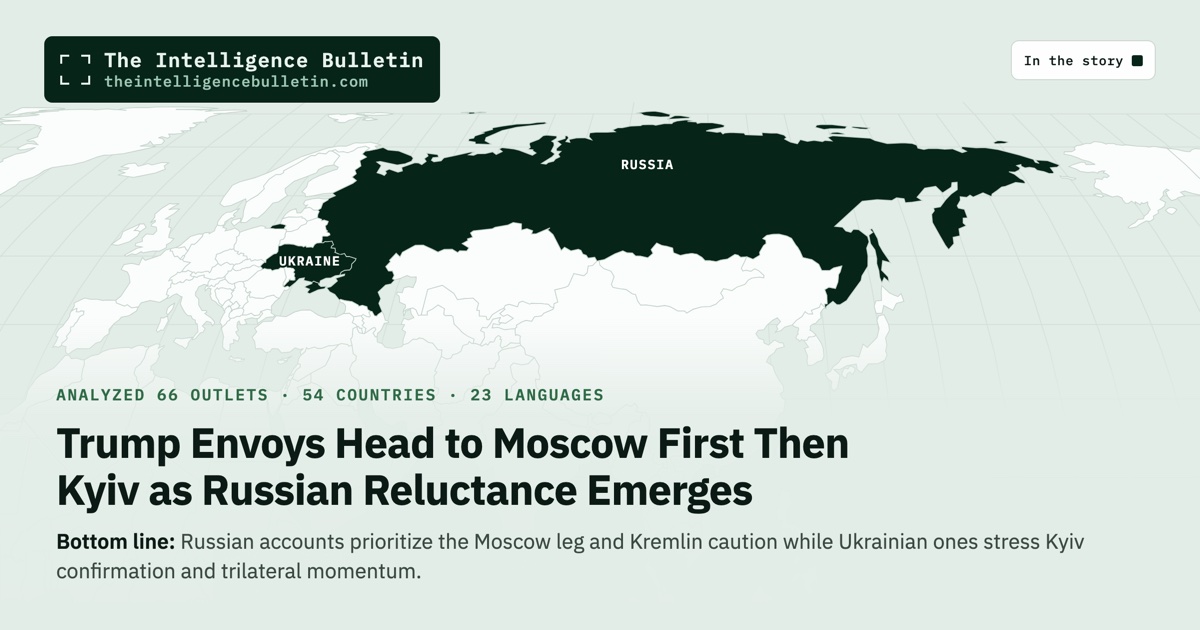
Russian accounts prioritize the Moscow leg and Kremlin caution while Ukrainian ones stress Kyiv confirmation and trilateral momentum.
The reporting converges on the envoys’ planned itinerary and purpose but splits sharply on emphasis and caveats. Russian and TASS-relayed accounts lead with Moscow as the primary stop and note Kremlin reticence on dates, while Ukrainian outlets tie the trip explicitly to restarting talks with Kyiv as endpoint and highlight Zelensky’s confirmation of both meetings. Polish coverage, drawing on Kyiv Independent sources, stresses Russian reluctance and possible last-minute changes due to security concerns in Kyiv, where strikes continue. CNN frames it as a US diplomatic push and the envoys’ first Ukraine trip. The pattern shows actor-country outlets anchoring the story in their capital’s role, with the Polish angle surfacing the clearest friction: Moscow’s reported pressure to alter plans. This cross-border consistency on the dates and sequence, paired with the neighbor caution on delivery, points to a negotiation step that remains tentative despite the announcements.
Full analysis
US President Donald Trump’s special envoys Steve Witkoff and Jared Kushner are scheduled to arrive in Moscow on September 5 and then travel to Kyiv on September 6. The sequence comes from a source cited by Russia’s state news agency TASS, which updated its reporting to state that the two men will visit Moscow first before proceeding to the Ukrainian capital. Ukrainian President Volodymyr Zelensky confirmed on September 3 that his negotiating team had maintained near-constant contact with the US side and that meetings would occur in both cities in the coming days. A US official told CNN that the visits were planned, marking the first time either envoy would travel to Ukraine.
The envoys have maintained contacts with Russian officials since earlier in the year. In late July Trump said the pair would visit Ukraine soon, though that trip did not occur. Russian presidential spokesman Dmitry Peskov told reporters that the Kremlin would not announce dates in advance but would inform the public once the contacts take place. Zelensky described his most recent conversation with the envoys on August 31 as detailed and constructive, adding that the trip would be useful for working out decisions toward peace. Both men have also been involved in Trump’s parallel efforts on Gaza and the conflict involving Iran.
Russian attacks on Kyiv have continued for eight consecutive days through early September. A drone struck the central headquarters of Ukraine’s Security Service on September 4. Ukrainian reports also described strikes on a Coca-Cola production facility and on two Soviet-era Yak-40 planes parked at Zhulyany Airport, an unused airfield southwest of the city center. Verkhovna Rada deputy Oleksiy Honcharenko linked the airport incident to the planned envoy visit, suggesting the Americans had considered flying from Moscow to Kyiv but would now likely arrive by train instead. No independent confirmation of the plane damage has appeared in the published accounts.
Zelensky warned earlier in the week that Ukrainian drones would make Russian airspace effectively closed to foreign flights, yet he stated that Ukraine would ensure safe passage if diplomats traveled to Moscow. Ukrainian forces have conducted their own long-range strikes on Russian oil facilities and warehouses during the same period. The envoys’ visit is expected to focus on restarting trilateral talks among Ukraine, Russia and the United States.
Russian outlets carrying the TASS dispatch present Moscow as the first stop and note that the Kremlin has declined to pre-announce any schedule. Ukrainian coverage, including Kyiv Post reporting, places the Kyiv meeting on equal footing with the Moscow stop and ties the trip directly to Zelensky’s confirmation of both venues. CNN reporting adds an American official’s confirmation of the planning and notes that the Kyiv leg would be the envoys’ first visit to the country. The Polish daily Rzeczpospolita, citing the Kyiv Independent, reports that Russian officials have expressed security concerns about a Kyiv stop and that Witkoff has grown wary, prompting discussion of alternative plans. Middle East Eye’s live-blog entry relays the same TASS source claiming that Moscow prefers the envoys avoid Kyiv.
The date sequence itself appears in multiple independent chains: TASS reporting, Zelensky’s public statement, and the US official cited by CNN. The claim that the Kyiv visit would be the envoys’ first trip to Ukraine rests on the same US and Ukrainian accounts. The assertion that Russia is actively seeking to alter or block the Kyiv leg rests on a single reporting chain running through the Kyiv Independent and echoed in one TASS-sourced remark carried by Middle East Eye.
A reader limited to Russian-language outlets would see the Moscow stop emphasized and the Kremlin’s preference for advance silence on dates. A reader limited to Ukrainian outlets would see equal weight given to both capitals and local context on recent strikes. The Polish account supplies the clearest indication that the Kyiv portion remains subject to last-minute pressure. The shared element across all published pieces is the reported itinerary of September 5 in Moscow followed by September 6 in Kyiv, with no outlet contradicting that order.
What to Watch
The corroborated sequence of dates and the confirmation from both Zelensky and a US official provide the strongest ground for treating the visit as scheduled rather than speculative. The single-source reports of Russian reluctance carry less weight because they trace to one investigative thread rather than overlapping independent chains. Actor-country coverage predictably foregrounds the role of its own capital, while the neighbor perspective from Poland surfaces the friction that the direct participants have not placed on the record. The next concrete signal will be whether the Kyiv leg occurs on the stated date or whether security or diplomatic adjustments alter the plan before the weekend.
That’s how the world told the story.
Get our daily open-source intelligence on world events in your inbox — one email a day, up to six stories.
Subscribe freeNo spam. One-click unsubscribe. See the latest email →