 AI-generated analysis published under the editorial responsibility of Rohit Sinnas. How it works →
Press quoted
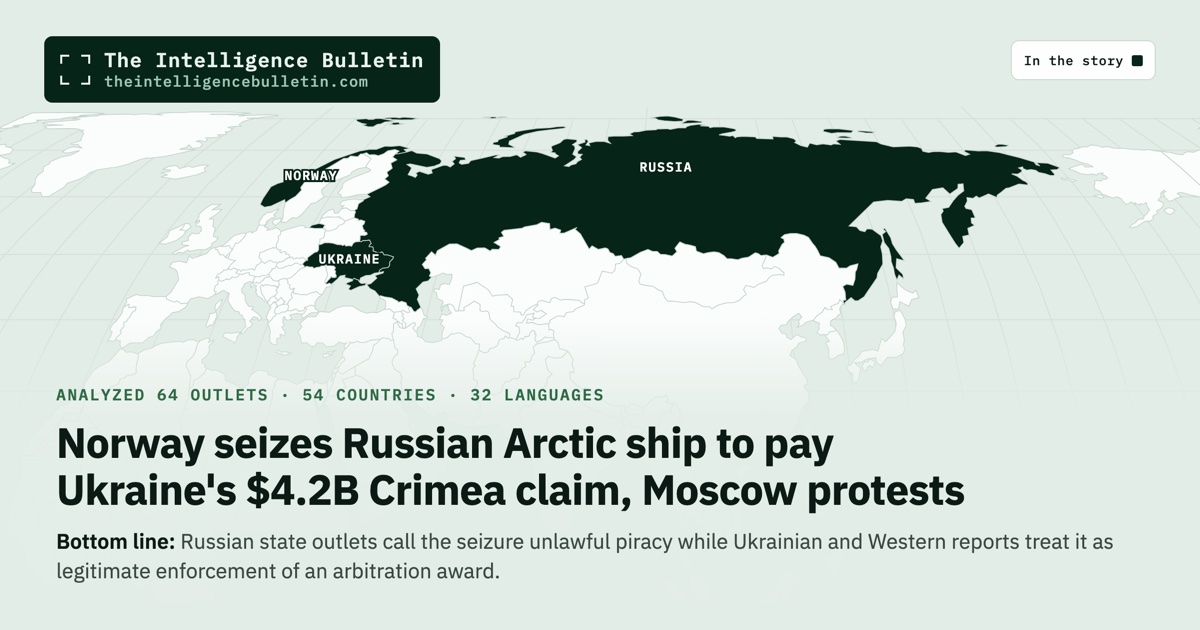
Russian state outlets call the seizure unlawful piracy while Ukrainian and Western reports treat it as legitimate enforcement of an arbitration award.
Norwegian, Ukrainian and most Western reporting presents the seizure as straightforward enforcement of an international arbitral award, while Russian state coverage centers Moscow’s formal protest and labels the detention piracy or lawlessness. The Moscow Times, publishing from exile, sticks to factual detail on the standoff and Russian diplomatic response without adopting the piracy framing used domestically. Al Jazeera alone adds explicit Russian quotes calling the move piracy and situates the incident inside wider Arctic tensions tied to Crimea. AFP copy underpins the Norwegian, Ukrainian and some Western accounts, producing near-identical factual cores on the vessel, location and Naftogaz statement, yet the same facts support sharply different conclusions depending on the outlet’s national vantage. Russian reporting omits Naftogaz’s claim of pursuing assets globally and instead highlights embassy contact with the crew, underscoring sovereignty concerns absent from the compensation-focused pieces. The split reveals that agreement on the seizure itself does not extend to whether an arbitration award overrides territorial or diplomatic protections for a vessel in a Russian-settled Arctic settlement.
Full analysis
Norway seized the Russian research vessel Professor Molchanov in the port of Barentsburg on Norway’s Svalbard archipelago on 2 September 2026. A Norwegian district court had approved the arrest the day before at the request of Ukraine’s state energy company Naftogaz, which sought to enforce a 2023 arbitration award from The Hague ordering Russia to pay approximately $4.2 billion plus interest and costs for assets expropriated after the 2014 annexation of Crimea. The ship, a Russian-owned cruise vessel used for commercial expeditions, had arrived the previous day carrying Russian scientists and docked without incident in the Russian-operated mining settlement. Norwegian authorities took control of the vessel under the court order and stated they would supervise it and ensure it remained in port.
Naftogaz acting chief executive Sergii Fedorenko described the seizure as another step toward restoring justice and said the company would continue pursuing Russian assets worldwide until the full award was paid. The Svalbard governor’s office confirmed the ship would be held in the archipelago and that it would care for the crew and passengers on board. Vessel-tracking data showed the Professor Molchanov anchored at Barentsburg. The Moscow Times, drawing on reporting from the U.S. law firm Covington representing Naftogaz, added that the seizure followed a 24-hour standoff with the Norwegian Coast Guard. Russian officials, including the ambassador to Norway, Nikolai Korchunov, responded by insisting on the vessel’s immediate release and the safety of those aboard, stating that Moscow would pursue the matter through legal channels.
Russia’s Foreign Ministry summoned Norway’s ambassador to Moscow, Heidi Olufsen, on 3 September and delivered a formal protest against the arrest of the vessel in the port of the Russian settlement on Spitsbergen. The ministry described the Norwegian action as unlawful. Russian state reporting highlighted ongoing contact between the Russian embassy in Oslo, the consulate in Barentsburg, and the crew and passengers. One account noted that expedition participants had gone ashore before the seizure became public and that no one had been arrested. Russian ministers quoted in some coverage called the detention an example of Western legal nihilism and lawlessness.
The $4.2 billion figure originates from the 2023 Hague tribunal ruling that found Russia liable for the expropriation of Naftogaz property in Crimea. Naftogaz has pursued the claim since 2016 and has stated it is coordinating enforcement actions in multiple jurisdictions, including the United States, France, the United Kingdom and Finland. Svalbard itself operates under a 1920 treaty that grants Norway sovereignty while allowing citizens of signatory states, including Russia, to settle and conduct economic activity without visas. Barentsburg remains one of the few permanently inhabited Russian communities on the archipelago.
The core facts of the seizure, the court order, the location, the vessel’s identity, the amount of the award, and the Russian diplomatic protest appear across independent reporting chains. The Local, Kyiv Post and Al Jazeera all carried versions of the Naftogaz statement and the Svalbard police confirmation. The Moscow Times added details on the coast-guard standoff drawn from Covington. RT reported the ministry protest and embassy contacts directly from official Russian releases. These accounts converge on the sequence of events without contradiction.
Where the accounts diverge is in the framing of the same events. Norwegian and Ukrainian coverage presents the detention as lawful enforcement of an international ruling, foregrounding the Naftogaz statement and the court order. Russian state coverage centers the protest and the location inside a Russian settlement, describing the action as unlawful without referencing the arbitration award or Naftogaz’s global pursuit of assets. The exiled Moscow Times reports the standoff and the ambassador’s response in detail but does not adopt the piracy language used by Russian officials in other outlets. Al Jazeera alone incorporates explicit Russian ministry quotes labeling the seizure piracy while also situating the incident within Arctic and Crimea-related tensions. No single national press carried both the full Naftogaz enforcement narrative and the Russian sovereignty protest in equal measure.
A reader limited to Norwegian or Ukrainian outlets would encounter the seizure as a routine step in asset recovery with no mention of Russian diplomatic steps or the settlement’s status. A reader limited to Russian state reporting would encounter a protest against an unlawful arrest but would not see the arbitration award or Naftogaz’s statements about continued global enforcement. The exiled Moscow Times provides a narrower factual bridge but still omits the piracy characterization carried elsewhere. Al Jazeera supplies the missing Russian language on piracy while adding regional context not foregrounded in the actor-country pieces.
What to Watch
The corroborated elements—the seizure itself, the $4.2 billion award tied to the 2014 Crimea expropriations, and the Russian protest—rest on multiple independent chains and form the factual spine. The description of the action as piracy or lawlessness appears only through one chain that cites TASS and Russian ministers. Ukraine has a direct financial interest in portraying the seizure as legitimate recovery of war-related losses. Russia has a direct interest in portraying it as an infringement on sovereignty and diplomatic protections for a vessel in one of its Arctic settlements. The next development will likely be Russian legal challenges in Norwegian courts or further asset pursuits by Naftogaz in other jurisdictions, testing whether arbitration awards can be enforced against state property in third countries without triggering broader diplomatic escalation.
That’s how the world told the story.
Get our daily open-source intelligence on world events in your inbox — one email a day, up to six stories.
Subscribe freeNo spam. One-click unsubscribe. See the latest email →