 AI-generated analysis published under the editorial responsibility of Rohit Sinnas. How it works →
Press quoted
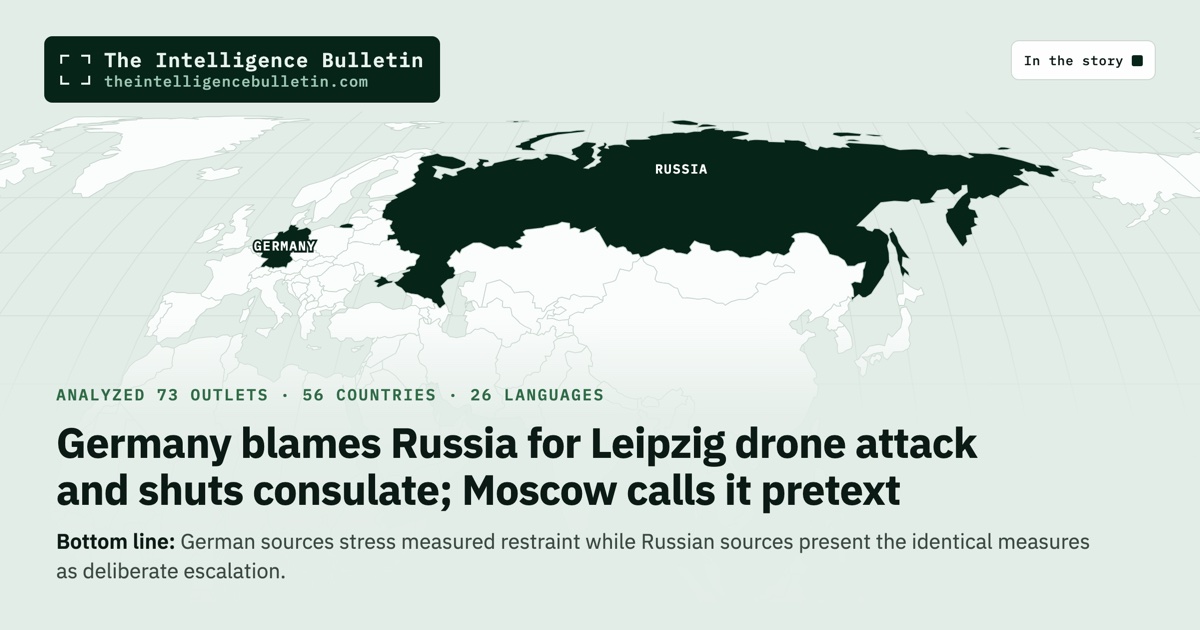
German sources stress measured restraint while Russian sources present the identical measures as deliberate escalation.
German reporting stresses a calibrated response coordinated with allies and explicitly rules out overreaction, while Russian coverage frames the same diplomatic steps as a long-sought pretext for closing cultural and consular sites. Western European and Irish accounts converge on the official attribution to Russia, citing police, intelligence and modus operandi, and note NATO and EU solidarity. The Spanish piece alone highlights the airport’s NATO logistics role, a detail absent from the German domestic account. UK tabloid framing adds confrontation language that none of the primary sources use. Russian outlets alone report the embassy’s on-record rejection of the claims as absurd and beneficial to Ukraine. The pattern shows that the core factual attribution travels across independent chains, yet the motive and proportionality of the German response remain points of direct contradiction between Berlin and Moscow.
Full analysis
An explosive drone was discovered in the secure area of Leipzig/Halle Airport on the night of 4 August near parked Ukrainian Antonov cargo planes. German authorities later described the device as fitted with explosives and a detonator. It did not explode and was disarmed by bomb experts, who also closed nearby runways while they worked.
On 1 September Interior Minister Alexander Dobrindt and Foreign Minister Johann Wadephul held a joint press conference in Berlin. Dobrindt stated that police investigations, the pattern of the offence and intelligence findings together established Russian responsibility. He added that the incident formed part of a broader pattern of Russian hybrid operations in Europe and that further such attacks on Germany were assumed. Wadephul said Germany would respond but would not overreact, and that any measures would be coordinated with European partners and within NATO. The same day Berlin announced it would close the Russian consulate general in Bonn on 18 September and terminate the agreement governing the Russian House cultural centre in Berlin. It also said it would seek additional EU sanctions listings and travel restrictions on Russian nationals as well as increased pressure on Russia’s shadow fleet.
Russian officials rejected the attribution outright. Foreign Ministry spokeswoman Maria Zakharova told Lenta.ru that German authorities had long wanted to close both the Russian House in Berlin and the consulate in Bonn and had simply been looking for a pretext. The Russian embassy in Berlin called the accusations absurd, baseless and contrary to common sense, and said they served the interests of Ukraine, the militaristic wing of Europe’s elite and arms manufacturers. It described the announced measures as an unprecedented escalation that would not remain without consequences.
NATO Secretary General Mark Rutte posted that the alliance stood in full solidarity with Germany after the Russian hybrid attack and would continue to strengthen its ability to deter and defend allies. European Commission President Ursula von der Leyen wrote that the EU was united against Russian aggression and would deter anyone seeking to undermine European freedom and security; she said foreign ministers would prepare a response at their upcoming meeting. French President Emmanuel Macron and Finnish President Alexander Stubb also expressed support for new sanctions. Irish Defence Minister Helen McEntee noted that Russian activity in the EU had moved from threats to incursions on EU territory and called for higher defence spending.
German domestic coverage, led by Die Zeit, foregrounded the ministers’ insistence on a measured and carefully prepared response. Wadephul was quoted saying there would be “no overreactions, but reactions” and that Germany would not be intimidated. The outlet also reported that the government wanted its steps aligned with EU and NATO partners. Spanish reporting in El Mundo added that Leipzig/Halle functions as a major European cargo hub participating in NATO logistics and Ukraine support operations, giving the target a strategic character beyond its civilian status. Irish public broadcaster RTÉ summarised the official German conclusions, the announced diplomatic steps and the statements of allied solidarity without adding interpretive framing. The UK Daily Mirror account used the word “horror” in its headline and linked the episode to rising NATO-Russia tensions and Putin’s concerns over his safety and the war in Ukraine.
Russian coverage, as carried by Lenta.ru, placed the emphasis on Zakharova’s claim that Berlin had been seeking an excuse to shut the cultural and consular sites for some time. It reported the embassy’s on-record rejection of the accusations as fabricated and beneficial to Ukraine, and it quoted the promise of a “dignified response” from Moscow. No other source in the set carried Zakharova’s specific assertion about long-standing German interest in closing the sites.
A reader limited to German reporting would conclude that Berlin had acted with deliberate restraint and in concert with allies. A reader limited to Russian reporting would conclude that the episode was manufactured to justify pre-planned diplomatic expulsions. A reader limited to the UK tabloid account would see an episode of NATO-Russia confrontation framed in alarmist terms that none of the primary German statements employed. The Spanish account alone supplied the detail that the airport’s role in NATO logistics made the target more than purely civilian. The Irish account supplied the cleanest neutral summary of the official findings and allied reactions.
The core claim that Russia bears responsibility rests on statements from four independent reporting chains: the German domestic outlet that quoted the ministers, the Irish public broadcaster, the Spanish daily and the UK tabloid. All four cite the same 1 September press conference and the same combination of police work, intelligence and modus operandi. The Russian denial rests on a single chain, the Russian Foreign Ministry statements relayed by Lenta.ru. The claim that the measures were a long-sought pretext for closing the sites appears only in the Russian chain. The claim that the airport carried strategic NATO significance appears only in the Spanish account.
What to Watch
The German emphasis on measured response is consistent across the domestic reporting and is supported by direct ministerial quotes. Russian officials have an obvious interest in portraying the episode as anti-Russian theatre rather than evidence of their own operations. German officials have an interest in signalling resolve to allies and domestic audiences while avoiding uncontrolled escalation. The corroborated attribution across multiple Western European and Irish outlets gives that account greater weight than the single-chain Russian denial. The next moves are likely to be additional EU sanctions listings and further diplomatic expulsions, because those steps have already been announced and because the episode has been placed inside a declared pattern of hybrid activity rather than treated as an isolated event.
That’s how the world told the story.
Get our daily open-source intelligence on world events in your inbox — one email a day, up to six stories.
Subscribe freeNo spam. One-click unsubscribe. See the latest email →