 AI-generated analysis published under the editorial responsibility of Rohit Sinnas. How it works →
Press quoted
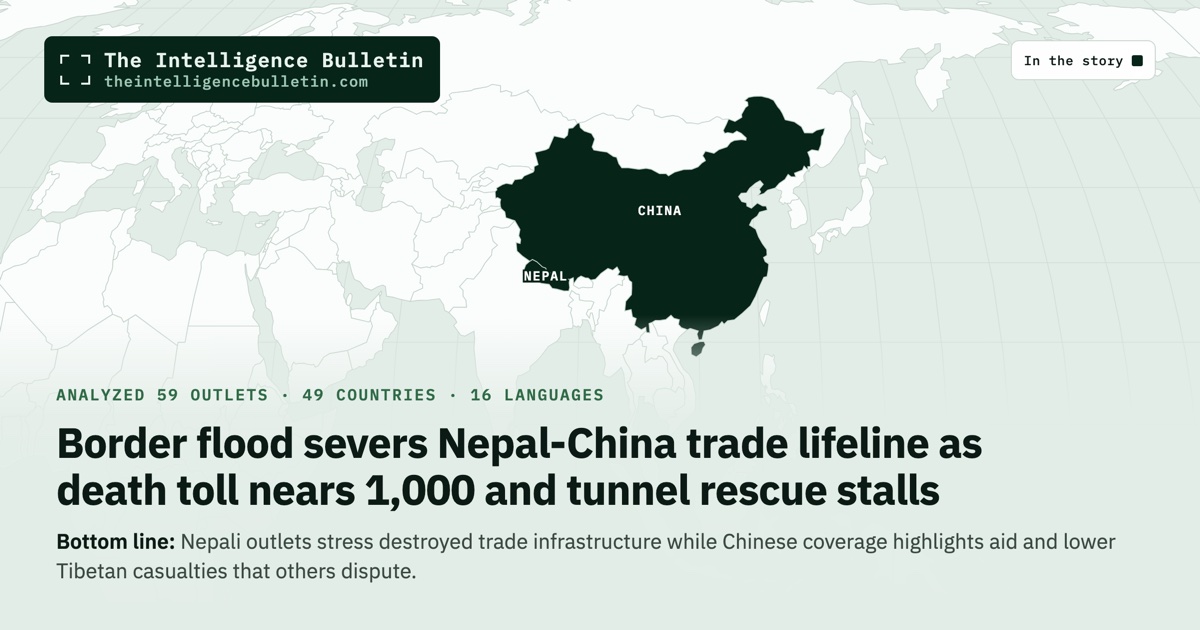
Nepali outlets stress destroyed trade infrastructure while Chinese coverage highlights aid and lower Tibetan casualties that others dispute.
The reporting reveals a sharp split between casualty counts and priorities rather than a unified regional crisis narrative. Nepali coverage centers on the destroyed Rasuwagadhi trade corridor and its immediate economic fallout for Kathmandu supplies, treating the border crossing as the story’s core loss. Chinese state outlets emphasize rapid aid shipments and joint rescue gestures while listing far lower figures on the Tibetan side. Western and regional English-language accounts track the rising Nepali toll and stalled tunnel operation in detail, including foreign nationals among the missing. The Tibetan exile outlet directly challenges the Chinese numbers by documenting removed footage from Kyirong and restricted access. These framings cannot be reconciled on the scale of deaths and missing persons across the border; independent chains show Nepal’s higher confirmed figures alongside China’s insistence on its own lower tally and censorship allegations that no other outlet corroborates on the record. The divergence shows how national interests shape what each press treats as the measurable human cost versus the visible diplomatic response.
Full analysis
A glacier in Nepal’s Langtang-Lirung range collapsed before dawn on August 26 and sent a wall of water, ice, rock and mud through mountain valleys on both sides of the Nepal-Tibet border. The surge reached Gyirong Port within six to seven minutes on the Chinese side. It destroyed the primary land crossing between the two countries, which handles roughly a third of bilateral trade, along with at least 35 bridges and about 40 kilometers of road. The Trishuli River rose as much as nine meters in thirty minutes and carried debris and bodies nearly 240 kilometers downstream into India.
Nepal reports 919 confirmed dead and 4,247 missing as of the latest counts. China reports 16 dead and 546 missing on its side of the border. The combined missing total stands at 4,793. The disaster struck at the height of the Kailash Mansarovar pilgrimage season, catching traders, pilgrims and hydropower workers along the exposed river system. At least 897 workers tied to hydropower projects in the zone remain unaccounted for.
Rescue teams located the crown of the Trishuli 3A hydropower tunnel after three days of drilling and excavation. They installed a pipe to pump air inside but received no response from within. Indian and Chinese tunnel specialists joined Nepali army engineers at the site. A barrier lake formed by the initial landslide overflowed on Sunday, briefly halting operations on the Chinese side before teams resumed. A second smaller lake upstream remains under monitoring.
The Rasuwagadhi crossing, upgraded to international status in 2017 and positioned as Nepal’s main overland trade route with China after the 2015 earthquake damaged the Tatopani alternative, was swept away. Containers carrying roughly one thousand electric vehicles and spare parts vanished in the flood. Nepal’s main supply line for Chinese goods, including vehicles, industrial inputs and festival merchandise bound for Kathmandu markets, is now severed. Alternative routes through Tatopani and Korala face higher costs, weaker infrastructure and greater geographic risk, offering no immediate substitute.
China dispatched two Y-20 transport planes carrying emergency supplies and four rescue experts to Tribhuvan International Airport in Kathmandu on August 30. The Chinese Agency for International Development Cooperation activated a special package that includes financial aid and humanitarian materials. Chinese teams simultaneously conducted operations on their own territory and shared satellite imagery, hydrological data and other information with Nepali counterparts. Officials described the two countries as a community linked by mountains and rivers that would face the catastrophe together.
Coverage of the same event diverges sharply on what counts as the central loss. Ekantipur treats the destruction of the Rasuwagadhi trade corridor as the defining damage, detailing lost shipments of BYD electric vehicles, severed supply chains for Kathmandu consumers and the strategic setback to a route China had promoted under the Belt and Road Initiative for broader South Asian connectivity. No other outlet in the set foregrounds these commercial consequences with comparable specificity.
Chinese state reporting centers on the aid package and joint gestures. It lists the lower casualty figures on the Tibetan side without reconciling them against the higher Nepali totals reported elsewhere. The South China Morning Post notes rescue coordination across the border and tracks the combined death toll approaching one thousand while citing both Nepali and Chinese data. HNGN aggregates the Nepali toll of 919 dead and the full missing count of 4,793, adding details on foreign nationals among the missing and the lack of response from the buried tunnel.
Phayul reports that footage of the surge through Kyirong Port circulated briefly on Chinese platforms before being removed and that official Chinese casualty figures on the Tibetan side are substantially lower than independent accounts suggest. No other outlet in the set records the removal of specific videos or levels the same direct accusation of underreporting.
The casualty split cannot be reconciled from the published accounts. Nepal’s higher confirmed dead and missing figures appear in HNGN, the South China Morning Post and earlier Nepali reporting, while China’s lower tally on its side stands alone in the Chinese state material and is challenged only by the Tibetan exile outlet. The trade-route destruction is documented in detail only by the Nepali daily. The aid dispatch and data-sharing appear only in the Chinese state piece. The tunnel silence and foreign missing numbers are carried in the American outlet. These are not variations in emphasis but distinct factual baselines that a reader limited to one source would accept as the complete picture.
The higher Nepali casualty count rests on the most independent reporting chains. HNGN and the South China Morning Post both cite Nepali government authorities for the 919 dead and thousands missing, and earlier Ekantipur reporting already recorded hundreds of deaths and thousands missing before the final update. China’s lower figures on the Tibetan side receive no corroboration from any other outlet and are directly disputed by Phayul on the basis of removed footage and restricted access. The trade destruction carries concrete detail—lost containers, specific vehicle counts, the route’s post-earthquake role—that appears nowhere else and aligns with the physical destruction corroborated across multiple accounts. The Chinese aid operation is presented only by the state outlet itself and therefore stands as a single-source claim.
What to Watch
China has an institutional interest in presenting its response as rapid and cooperative while limiting visibility into losses on the Tibetan side of a sensitive border region. Nepal has an immediate economic stake in highlighting the severed trade artery that supplies its capital and powers a growing electric-vehicle market. The tunnel rescue remains the highest operational priority for Nepali authorities, with air already inside the structure and multinational specialists on site. Continued monsoon rains through September raise the risk of secondary flooding along already saturated riverbanks. Trade recovery will depend on whichever alternative crossing can be made operational first, at higher cost and lower capacity than the lost Rasuwagadhi route. The gap between the two casualty counts will persist in public records unless one side revises its figures with supporting evidence.
That’s how the world told the story.
Get our daily open-source intelligence on world events in your inbox — one email a day, up to six stories.
Subscribe freeNo spam. One-click unsubscribe. See the latest email →