 AI-generated analysis published under the editorial responsibility of Rohit Sinnas. How it works →
Press quoted
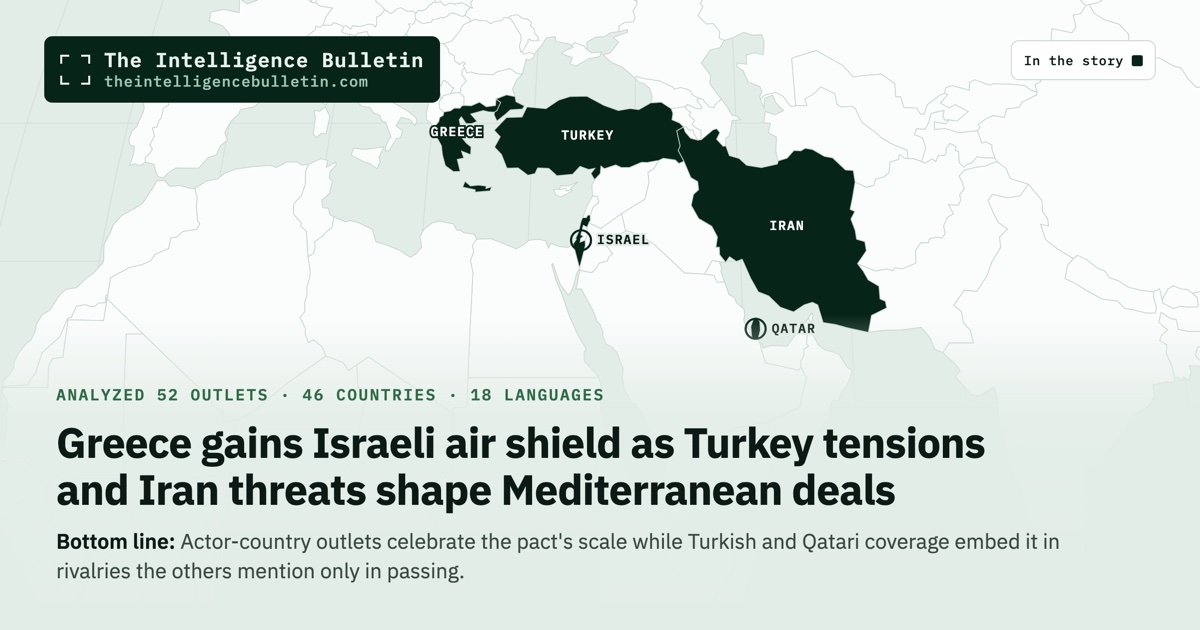
Actor-country outlets celebrate the pact’s scale while Turkish and Qatari coverage embed it in rivalries the others mention only in passing.
The reporting across actor and neighbor outlets converges on the deal’s scale and Israeli technological core while diverging sharply on motive and context. Israeli coverage frames it as a record export strengthening bilateral ties through proven systems. Greek accounts stress domestic modernization, technology transfer and strategic autonomy under a three-year negotiation. Turkish reporting notes the export without alarm but places it against Aegean disputes and NATO spending. Qatari analysis questions Greece’s timing, tying the purchase to Iranian threats and Turkish drone capabilities while noting domestic Greek opposition to closer Israel ties. Hong Kong reporting treats it primarily as a global arms-trade milestone driven by battle-tested Israeli weapons amid record exports. The consistent absence of Turkish official reaction in the set and the uniform emphasis on Greece receiving source-code access point to a pact designed for operational independence rather than off-the-shelf purchase. This cross-border pattern shows the agreement functions simultaneously as Israeli industrial success, Greek deterrence upgrade and regional signaling whose meaning shifts by the reader’s location.
Full analysis
Israel and Greece signed a €3 billion defense agreement on August 31 in Tel Aviv. The contract covers Greece’s Achilles Shield multilayered air defense network, built around Israeli platforms and scheduled for full operational deployment within 35 months. Israeli Defense Ministry statements list the core components as David’s Sling for medium- to long-range ballistic and cruise missiles, Spyder for low-altitude aircraft and drones, Barak MX for a wider spectrum of threats, multi-mission radars, and an artificial-intelligence-enabled command-and-control system that fuses data from multiple sensors. A separate €26 million deal supplies Rafael’s Drone Dome systems for unmanned aerial threats.
Greek procurement officials, including Major General Ioannis Bouras, signed alongside Israeli counterparts from SIBAT and MAFAT. The agreement integrates systems Greece already operates, including Patriot batteries, into a single network that can assign the cheapest suitable interceptor to each incoming threat. Israel Aerospace Industries, Rafael, and ELTA Systems will supply the equipment, with roughly 12 Greek companies participating in work valued at more than €700 million, or about 25 percent of the total project. Negotiators secured Greek access to the source code, allowing future maintenance and upgrades without continuous Israeli involvement.
Greek Defense Minister Nikos Dendias described the project as a decisive step in the structural modernization of the armed forces and the creation of an uninterrupted protective shield over national territory. Israeli Defense Minister Israel Katz said the two countries share strategic interests and face common regional challenges from actors seeking to expand influence. The signing followed nearly three years of negotiations and launches the implementation phase of a program Greece has positioned as its largest-ever defense reform.
Israeli reporting presents the contract as the largest defense export in the history of Israel-Greece relations and one of the largest in Israel’s history. Greek accounts emphasize the industrial return and technology transfer that accompany the purchase. Turkish coverage records the export value and notes Greece’s decision to spend at least 3 percent of GDP on defense while facing long-standing maritime disputes in the Aegean and eastern Mediterranean. Qatari analysis connects the timing to Greek concerns over Iranian strikes on U.S. allies and Turkish drone capabilities, citing expert views that the first elements of the shield are likely to appear in the Aegean. Hong Kong reporting places the transaction inside Israel’s record defense exports, which exceeded $19 billion last year.
All five outlets agree on the monetary value, the signing date and location, the named Israeli systems, the supplementary drone contract, and the involvement of local Greek industry. They also agree that Greece will receive source-code access. No outlet disputes the participation of the listed Israeli manufacturers or the 35-month deployment timeline.
The accounts diverge on emphasis and surrounding context. Israeli and Greek pieces foreground national achievement and bilateral deepening. Turkish reporting embeds the deal inside existing Aegean tensions without quoting an official Turkish reaction. Qatari coverage adds Greek public-opinion data showing 76 percent of respondents do not believe Israeli Prime Minister Benjamin Netanyahu will do the right thing, and it quotes domestic critics who describe the relationship as turning Greece into an Israeli satellite. The Hong Kong account stresses the global arms-market implications and the appeal of battle-tested equipment.
These differences shape what a reader encounters depending on the single outlet consulted. A reader limited to Israeli or Greek sources receives the industrial and modernization details but little on Greek domestic opposition or explicit Iranian threat linkages. A reader limited to the Turkish outlet sees the export framed against regional rivalry but without the Greek ministerial language on autonomy. A reader of the Qatari analysis encounters the public-opinion figures and expert commentary on timing that do not appear in the actor-country reports. The Hong Kong piece supplies the export-volume statistic that places the deal inside broader Israeli sales trends.
The convergence across independent reporting chains on the core transaction supplies the strongest warrant for treating the €3 billion figure, the listed systems, the local-industry share, and the source-code provision as settled. The consistent placement of these facts alongside references to Turkey tensions or Iran concerns, even when worded differently, indicates that the deal functions as regional signaling whose precise meaning shifts with the reader’s vantage. No outlet supplies an on-record Turkish government reaction, leaving that dimension visible only through contextual framing rather than direct quotation.
What to Watch
The reporting therefore supports reading the agreement as simultaneously an Israeli export success, a Greek modernization milestone, and a Mediterranean security adjustment whose longer-term consequences will depend on how Athens deploys the new network and how Ankara responds to its presence in the Aegean.
That’s how the world told the story.
Get our daily open-source intelligence on world events in your inbox — one email a day, up to six stories.
Subscribe freeNo spam. One-click unsubscribe. See the latest email →