 AI-generated analysis published under the editorial responsibility of Rohit Sinnas. How it works →
Press quoted
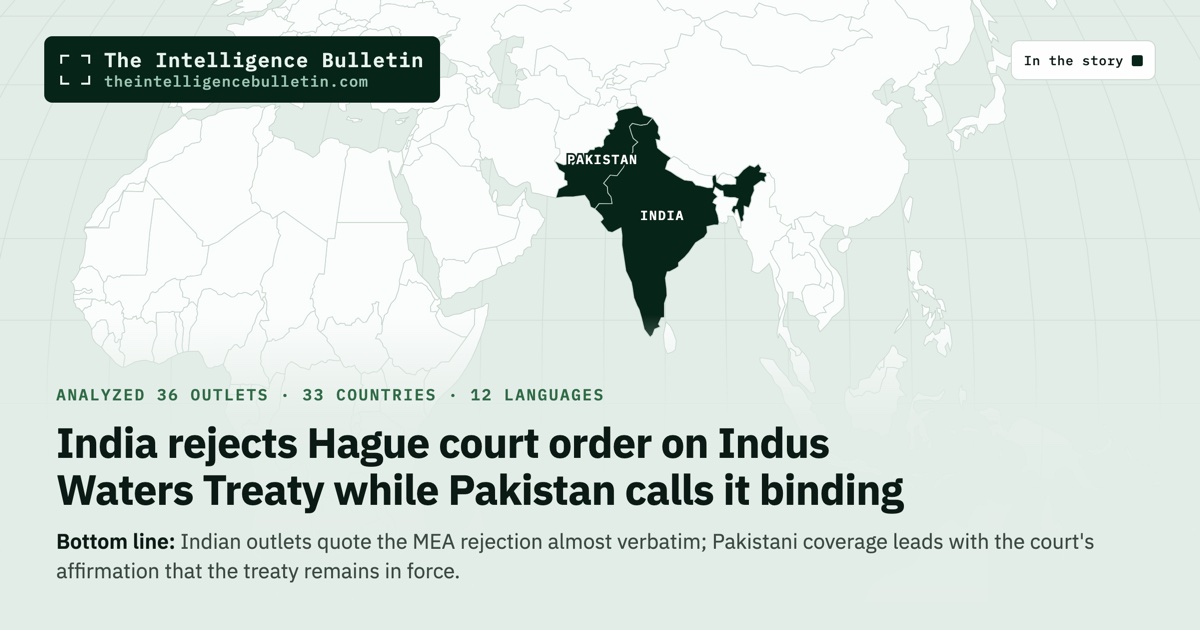
Indian outlets quote the MEA rejection almost verbatim; Pakistani coverage leads with the court’s affirmation that the treaty remains in force.
Indian reporting across multiple outlets uniformly centers the Ministry of External Affairs statement that rejects the court’s legitimacy outright, repeating the phrase ‘illegally constituted’ and insisting the abeyance decision stands unchanged. Pakistani coverage instead highlights the court’s unanimous finding that the treaty stays fully operational and frames the outcome as a direct setback for New Delhi’s hydropower plans. International outlets such as Reuters via SCMP and Anadolu Agency report both positions without emphasis, noting the court’s interim restrictions on construction and India’s non-participation in proceedings. The divergence stems from sourcing: Indian pieces derive from the official MEA release while the Pakistani account incorporates the tribunal’s own media statement on treaty status and project limits. This pattern shows how actor outlets treat the same legal event as either a sovereignty victory or an enforceable obligation, with no independent verification of the court’s composition or the 2025 suspension trigger appearing in any dispatch.
Full analysis
India placed the 1960 Indus Waters Treaty in abeyance in April 2025 after the Pahalgam attack that killed 26 civilians at a tourist site in Jammu and Kashmir. Indian authorities identified two of the three assailants as Pakistani. The treaty, signed in 1960 with World Bank mediation, divides the waters of the Indus river system and has endured three wars and repeated crises between the two countries. Pakistan responded by taking the suspension to the Permanent Court of Arbitration in The Hague in March 2026.
On 31 August 2026 the court issued two linked decisions. It ruled unanimously that none of the grounds India had advanced justified suspension or termination. The treaty therefore remained fully in force, and India must continue to meet its obligations on the design and operation of hydroelectric projects on the western rivers. The court also issued interim measures restricting certain construction activities at the Ratle hydroelectric plant on the Chenab until 90 days after a Neutral Expert issues a final technical determination expected around July 2027. India must supply information on its construction schedule.
India’s Ministry of External Affairs responded the same day. It described the court as “illegally constituted” by the World Bank in breach of the treaty’s terms and stated that the body had no jurisdiction over New Delhi’s sovereign decisions. The MEA repeated that India had never recognised the court’s existence in law, had never appeared before it, and would treat its pronouncements as having no effect on ongoing projects. The decision to keep the treaty in abeyance therefore remained in force until Pakistan credibly and irrevocably ended support for cross-border terrorism.
Indian outlets that carried the Ministry statement, including Siasat, reproduced the language of rejection in full and placed it at the top of their accounts. They noted that India had already accelerated work on several hydropower projects in Jammu and Kashmir that Pakistan had previously opposed under the treaty. Pakistani reporting, by contrast, opened with the court’s conclusion that the treaty stayed fully operational and described the outcome as a setback for India’s plans at Ratle and similar sites. It recorded the interim restrictions on concreting work and the requirement to provide project schedules.
The court examined India’s public statements and conduct outside the proceedings, including government communications to Pakistan and the neutral expert. It considered but rejected the argument that Pakistan’s alleged sponsorship of terrorism constituted a material breach allowing suspension. The treaty, the court noted, addresses only the rights and obligations concerning the use of the waters and contains no provision for unilateral suspension or termination; any change requires mutual agreement.
International coverage, including the Reuters dispatch carried by the South China Morning Post and the shorter Anadolu Agency account, recorded both the Indian rejection and the court’s orders without emphasis on either. These pieces noted that the treaty supplies water to 80 per cent of Pakistani farms and that India had begun steps to increase reservoir capacity at disputed projects.
The accounts converge on the sequence of events and on the content of the two official statements. Every source that addressed the court’s ruling reported its finding that the treaty remains in force. Every source that addressed the Indian response reported the Ministry’s assertion that the court lacks jurisdiction and that abeyance continues. No outlet supplied independent evidence on the court’s composition or on the factual basis of the 2025 suspension.
Where the accounts diverge is in selection and framing. Indian reporting foregrounds the Ministry’s characterisation of the court and the continued validity of the abeyance decision. Pakistani reporting foregrounds the court’s conclusions on treaty status and the concrete limits placed on the Ratle project. The international wires present both elements in roughly equal measure. A reader limited to Indian sources would encounter the court’s specific interim construction order only in passing or not at all. A reader limited to the Pakistani account would encounter the Ministry’s detailed jurisdictional objection only after the court’s position had already been established as the lead fact.
The underlying disagreement is therefore not over what each side said on 31 August but over which statement carries legal weight. India treats the treaty suspension as a sovereign response to terrorism that cannot be reviewed by a body it regards as improperly constituted. Pakistan treats the treaty as an enduring international obligation whose terms the court is competent to interpret and enforce. The court itself applied the principle that agreements must be honoured and found that the word “abeyance” has no established meaning in the treaty or in general international law that would permit unilateral action.
The pattern of sourcing explains the divergence. Indian pieces largely reproduced the Ministry statement. The Pakistani piece incorporated the court’s own media release on both the status award and the interim order. The Reuters and Anadolu accounts balanced the two primary documents. No reporting chain supplied external verification of either the court’s legitimacy or the scale of any Pakistani involvement in the 2025 attack.
What to Watch
The most durable element across the record is the court’s explicit order on the Ratle project. That restriction is described in concrete terms—limits on concreting above prescribed levels and a reporting obligation—while the broader status ruling rests on the legal interpretation of the treaty’s silence on unilateral suspension. India’s rejection does not alter the fact that the tribunal has asserted continuing authority over the project’s construction schedule. Pakistan’s emphasis on the ruling does not alter the fact that India has stated it will proceed with the projects regardless. The next measurable development will therefore be whether India alters the physical work at Ratle or at other western-river sites before the Neutral Expert’s July 2027 deadline, and whether Pakistan returns to the court for enforcement measures.
That’s how the world told the story.
Get our daily open-source intelligence on world events in your inbox — one email a day, up to six stories.
Subscribe freeNo spam. One-click unsubscribe. See the latest email →