 AI-generated analysis published under the editorial responsibility of Rohit Sinnas. How it works →
Press quoted
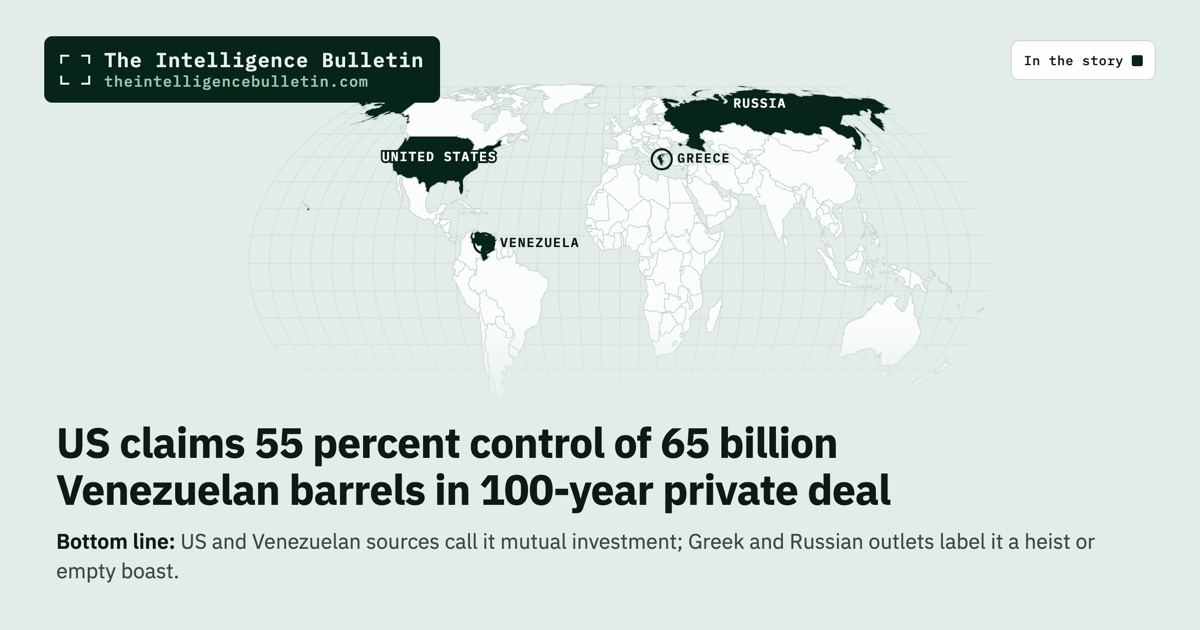
US and Venezuelan sources call it mutual investment; Greek and Russian outlets label it a heist or empty boast.
The reporting converges on the core announcement from Trump and Rodríguez but splits immediately on framing and implications. North American and UK outlets relay US claims of a historic partnership yielding investment and lower prices for both sides, while noting Maduro’s removal as context. Venezuelan coverage from La Patilla casts the broader negotiation process as a concrete concession extracted under US pressure, though its specific article addresses judicial reforms tied to the talks rather than oil details. Greek Banking News portrays the 100-year private-company structure as a coup-like heist securing US majority control. Russian BFM.ru treats it skeptically as another claimed historic deal whose investment promises face doubt. The pattern shows actor outlets emphasizing mutual gains and scale, while distant observers highlight power imbalance and long-term extraction, with no independent verification of production timelines or legal enforceability under Venezuelan law.
Full analysis
US President Donald Trump announced on August 28 that his administration had reached an agreement with Venezuela granting the United States majority control over 65 billion barrels of proven oil reserves. The announcement came through a social media post stating that Secretary of State Marco Rubio and Secretary of War Pete Hegseth had negotiated the pact with interim President Delcy Rodríguez. Trump described it as the biggest oil deal in world history and said it would more than double American oil reserves while eventually lowering gasoline prices for US consumers.
The deal centers on 17 fields with a combined proven potential of 65 billion barrels. Under the terms described by a US official, a new private company would hold 100-year rights to develop those fields. The United States would receive 55 percent of effective output through a combination of equity stake and rights to purchase oil at cost. That oil would supply the US strategic petroleum reserve and meet military needs. Rodríguez’s government issued a statement confirming the outline and adding that the projects would attract roughly 100 billion dollars in private investment while generating more than 209 billion dollars in taxes for Venezuela over time. She predicted a significant impact on national revival.
This arrangement follows the US military operation nine months earlier that captured former President Nicolás Maduro and brought him to the United States to face federal charges. Rodríguez, who took power as interim leader after that operation, had already signed legislation opening the oil sector to greater private and foreign participation. Trump had met with US oil executives shortly afterward and urged them to return to Venezuela, though some expressed caution at the time given past nationalizations and damaged infrastructure. Venezuela holds an estimated 303 billion barrels of crude in total, the largest proven reserves in the world, yet produces only about 1 percent of global supply because of dilapidated facilities and years of underinvestment.
Venezuelan coverage of the broader negotiation process presents the oil agreement as the latest in a series of concrete concessions extracted under sustained US pressure. One domestic report ties recent parliamentary approval of reforms to the Supreme Court law directly to commitments discussed between Venezuelan officials and the 2015-elected assembly. That reform, passed unanimously in first discussion, expands the judicial nominations committee from 21 to 23 members and is framed as evidence that the balance of power has shifted enough to force institutional adjustments the regime long resisted.
North American and British reporting relays the official US and Venezuelan statements with emphasis on projected investment, job creation, and eventual price relief at the pump. These accounts note the post-Maduro context and the involvement of private business in the new company structure but do not question the scale or timeline of production increases. They record Rubio’s claim that the deal represents a huge win for both peoples and Trump’s assertion that no American taxpayer funds are required.
Greek financial coverage describes the same 100-year private-company structure as a coup-like seizure of resources. It highlights the majority US effective control and the channeling of output toward American strategic and military use, presenting the arrangement as an appropriation of Venezuelan wealth achieved through prior regime change. Russian reporting treats the announcement as another instance of claimed historic deals whose economic promises remain unproven, citing expert commentary that questions whether political control alone will overcome Venezuela’s infrastructure and governance barriers to rapid investment.
The accounts converge on the basic sequence: Trump made the announcement, Rodríguez confirmed the field count and revenue projections, and the deal was reached after Maduro’s removal. They diverge on whether the outcome reflects partnership, duress, or outright extraction. The single-source figures on exact investment totals and the 55 percent split appear only in statements from the two governments and one anonymous US official. No independent reporting chain in the set provides alternative numbers or timelines for when meaningful production increases might begin.
The corroborated elements—the announcement itself, the 65 billion barrel figure, the Maduro context, and the stated goal of lowering US gas prices—rest on overlapping statements from Trump, Rodríguez, and Rubio carried across multiple outlets. These facts form the spine that any reader encounters regardless of which account they consult. The framing differences track the interests of the outlets’ home audiences: those closest to the actors stress mutual gains and scale, while those farther away foreground long-term control and historical patterns of resource access. Venezuela’s domestic press links the oil talks to parallel institutional concessions, underscoring leverage rather than partnership. Distant observers question whether promised inflows will materialize given Venezuela’s record of production shortfalls.
What to Watch
The core announcement holds because it originates in on-record statements from the principals and is repeated without contradiction in every piece examined. Claims about exact percentages and dollar amounts remain narrower because they trace to single reporting chains. Production realities and legal enforceability under Venezuelan constitutional rules receive no independent corroboration in the coverage, leaving open the question of how quickly or fully the 100-year rights translate into barrels. The next steps likely hinge on whether US companies commit capital amid lingering political uncertainty and whether Venezuela’s new hydrocarbons framework survives domestic challenges. The deal’s durability will be measured by actual investment flows and output numbers rather than the scale of the initial announcement.
That’s how the world told the story.
Get our daily open-source intelligence on world events in your inbox — one email a day, up to six stories.
Subscribe freeNo spam. One-click unsubscribe. See the latest email →