 AI-generated analysis published under the editorial responsibility of Rohit Sinnas. How it works →
Press quoted
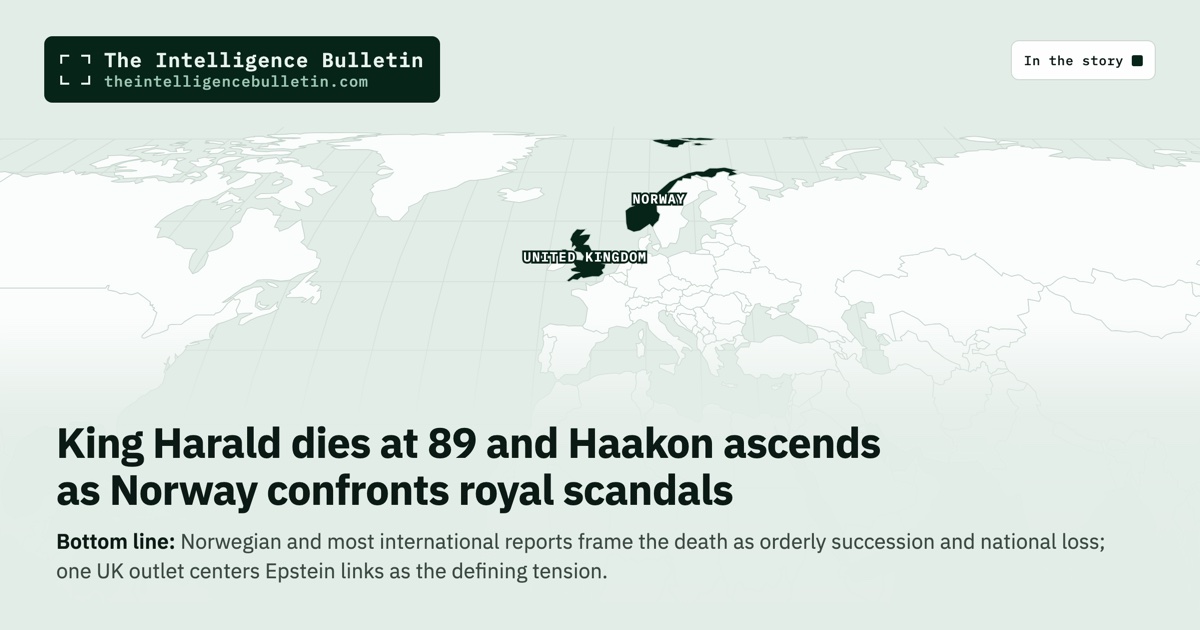
Norwegian and most international reports frame the death as orderly succession and national loss; one UK outlet centers Epstein links as the defining tension.
All five outlets report the same core sequence from the palace announcement: Harald’s death at Oslo University Hospital, Haakon’s automatic succession, and the public response of mourning and lowered flags. The Local and ABC present this as a moment of national unity and continuity, with the Norwegian domestic piece dwelling on Harald’s 35-year reign and unifying speeches. CBC and Al Jazeera add biographical detail on his reformist legacy and wartime exile while noting the timing of his death. The Guardian alone places the Epstein correspondence and poll declines at the center of the story, framing succession as turbulent rather than straightforward. This split is not about disputed facts but about editorial choice: four accounts treat the scandals as background to a ceremonial transition, while one treats them as the defining context for the new reign. The pattern shows that domestic and distant international coverage converge on continuity, whereas the UK outlet surfaces the domestic tensions already visible in Norwegian polling.
Full analysis
On the morning of August 28, 2026, the Royal Palace of Norway announced that King Harald V had died at Oslo University Hospital at 6:35 a.m. local time. The 89-year-old monarch, Europe’s oldest reigning head of state, had been admitted eleven days earlier with haemolytic anaemia and was later treated for a bacterial infection in his blood. He passed peacefully, the palace statement said, surrounded in his final hours by Queen Sonja, Crown Prince Haakon, Crown Princess Mette-Marit and their adult children.
Flags at the Royal Palace and across the country were lowered to half-mast. Crowds gathered in the palace courtyard in central Oslo, laying flowers and candles, some keeping vigil through the night. Prime Minister Jonas Gahr Støre issued a statement expressing “deep sorrow” and noting that “an entire nation mourns” while remaining “profoundly grateful for a long life devoted to Norway.” He added that “King Harald loved Norway. And Norway loved its king.” Neighbouring monarchs sent condolences: Sweden’s King Carl XVI Gustaf called Harald “an outstanding representative of his country” who gave “All for Norway,” while Denmark’s King Frederik described him as “an extraordinary man.” Britain’s King Charles III mourned his “dear cousin,” calling him a “towering figure.” Israeli President Isaac Herzog also expressed sadness, recalling the Oslo Accords period.
Harald had ruled since January 17, 1991, succeeding his father King Olav V. He was the first Norwegian-born king since the fourteenth century. Throughout his 35-year reign he maintained a low-key style, refusing to abdicate despite repeated health setbacks that included heart surgery, joint operations, a pacemaker fitted in 2024, and an earlier infection treated during a 2024 holiday in Malaysia. He consistently cited the lifelong oath he had sworn before parliament. In his final days, family members kept watch at the hospital, with media reports noting that Haakon remained overnight on the eve of the death.
The succession occurred immediately under Norway’s constitutional rules. Crown Prince Haakon, 53, became King Haakon VIII. Crown Princess Mette-Marit, also 53, became queen consort. Haakon is expected to inform the government of his chosen regnal name at an extraordinary council of state in the coming days, though he is widely anticipated to retain Haakon. The new king had already taken on additional duties during his father’s illness. He was educated at a state primary school, attended private secondary school, studied at the University of California, Berkeley and the London School of Economics, and served in the navy. His interests include music and surfing.
Harald’s public image rested on two signature speeches. After the 2011 attacks by Anders Behring Breivik that killed 77 people, he told mourners that “the belief in freedom is stronger than fear.” In 2016 he delivered a widely cited address on inclusion, declaring that “Norway is its people” and that Norwegians could come from Afghanistan, Pakistan, Poland, Sweden, Somalia or Syria, and that shared values mattered more than origin or religion. He had married the commoner Sonja Haraldsen in 1968 against initial resistance and later welcomed Mette-Marit, a single mother, into the family when Haakon proposed. Those choices were presented at the time as modernising steps.
Mette-Marit’s background has drawn renewed attention. Documents released in the United States in January showed correspondence between her and Jeffrey Epstein between 2011 and 2014, years after Epstein’s conviction. She later issued a statement through the royal household expressing “deepest regret for my friendship with Jeffrey Epstein” and apologising for “the situation that I have put the royal family in, especially the king and queen.” Her son Marius Borg Høiby, from a previous relationship, was sentenced in June to four years in prison on two counts of rape and 32 other charges, including domestic violence; both he and the prosecution have appealed. Mette-Marit herself underwent a lung transplant in July and marked a silver wedding anniversary with Haakon in August. Polls conducted by Norstat and published by public broadcaster NRK showed support for the monarchy at 60 percent in February, down from 70 percent the previous month, before rising slightly to 64 percent in May. Harald personally retained high personal ratings even as overall backing slipped.
The five outlets that covered the death in detail all drew from the same palace announcement and prime ministerial statement for the core timeline. Four of them placed national mourning and the orderly transfer of power at the centre of their accounts. The Local, published in Norway, emphasised the public gathering outside the palace, the prime minister’s words on gratitude, and Harald’s record of unifying speeches. ABC News, reporting from Australia, similarly opened with the palace statement and the prime minister’s tribute before noting the “tumultuous time” for the family. CBC, the Canadian public broadcaster, framed the obituary around Harald’s emergence as a reform-minded figure who modernised the court while recording the recent family pressures. Al Jazeera, drawing on its own staff and AP material, gave a concise account of the hospitalisation and succession, mentioning the Epstein correspondence only as one element of a “fraught time.”
The Guardian took a different approach. Its account led with the death but immediately situated it against the Epstein documents and the drop in polling support, describing the succession as “stormy” and devoting substantial space to Mette-Marit’s correspondence, her apology, the rape conviction of her son, and the prime minister’s earlier public criticism of her “poor judgment.” No other outlet in the set gave comparable prominence to those elements on the day of the announcement.
A reader limited to Norwegian domestic English-language coverage would see an unambiguous picture of national unity and institutional continuity. A reader limited to the Guardian would see the death as the opening of a legitimacy crisis already visible in opinion surveys. The other three outlets sit between those poles, each recording the scandals but treating them as context rather than the defining frame. The convergence on the palace’s account of the time, place and manner of death across all five pieces, drawn from independent newsrooms in four countries, supplies the factual spine. The divergence appears only in the weight each assigns to prior reporting on the royal family’s private entanglements.
The four accounts that treat the scandals as background rather than foreground rest on the same primary document: the palace statement itself, which contained no reference to Epstein or polling. That statement was issued under the authority of the institution whose continuity the new king must now maintain. The Guardian’s emphasis draws on documents already in the public domain and on Norwegian polling data that the other outlets also cite when they mention public opinion at all. The split therefore reflects editorial judgment about what readers need to know on the day of the announcement, not a factual dispute.
What to Watch
The new king’s immediate task will be to signal whether the monarchy intends to address the sources of the polling decline or to let the ceremonial transition stand on its own. The next measurable indicator will be whether support stabilises or continues to erode once the period of official mourning ends. The reporting pattern suggests that most outlets will continue to separate the institutional event from the private controversies, while at least one major international voice will keep linking the two.
That’s how the world told the story.
Get our daily open-source intelligence on world events in your inbox — one email a day, up to six stories.
Subscribe freeNo spam. One-click unsubscribe. See the latest email →