 AI-generated analysis published under the editorial responsibility of Rohit Sinnas. How it works →
Press quoted
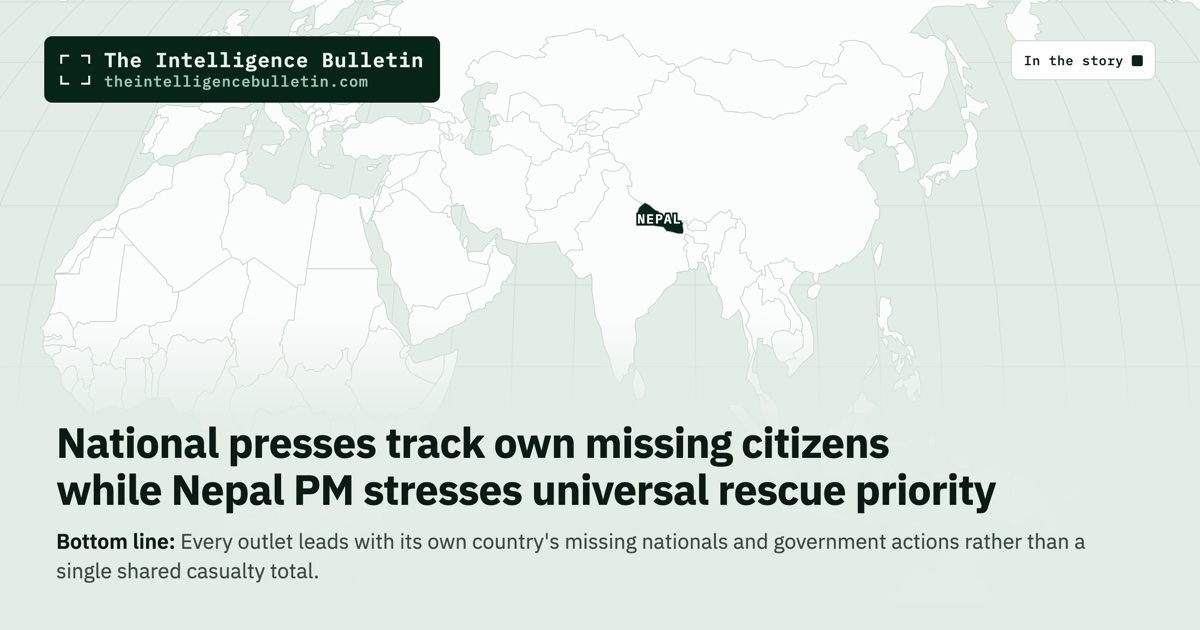
Every outlet leads with its own country’s missing nationals and government actions rather than a single shared casualty total.
Nepal’s domestic press centers the story on the prime minister’s direct pledge to treat every citizen’s survival as the absolute first duty, detailing troop deployments, helicopter evacuations and relief distributions in districts like Rasuwa and Nuwakot. Chinese state media, relaying Nepal’s Prime Minister’s Office, publishes the lowest casualty figures and lists foreign missing persons by nationality, including 134 Indians and smaller numbers of Americans, Britons and Australians. Indian outlets instead lead with the Nepal foreign minister’s confirmation of more than 300 missing Indians, many pilgrims, and note embassy coordination plus Indian air-force supply flights. Australian coverage tracks specific families and tour groups unaccounted for, adding government aid pledges and consular hotlines. British reporting, carried by a wire service, supplies names and ages of over 30 missing Britons on similar pilgrimage tours while describing the scale of destruction. The pattern shows each national press foregrounding its own citizens’ fate and its government’s response, while the same underlying Nepal government statements produce different headline emphases and casualty counts that are never reconciled in any single dispatch. The result is parallel national stories rather than one shared account of the event.
Full analysis
A glacial flash flood triggered by an avalanche blocking the Lhende tributary of the Bhotekoshi River swept through Nepal’s Rasuwa, Nuwakot and Dhading districts on August 27, 2026. The waters destroyed bridges, hydropower projects, roads and houses along the Trishuli river system near the Tibet border. Nepal’s Prime Minister Balendra Shah, who had traveled to the affected zone and returned to Kathmandu, posted that the government’s first priority remained saving every citizen’s life through search and rescue, treatment of the injured and immediate relief for affected families. He described the situation in the districts as still challenging and listed twelve specific measures already under way, including the deployment of 13,295 security personnel from the Nepali Army, Armed Police Force and Nepal Police, 69 helicopter flights that had evacuated 573 people that day, temporary shelter for roughly 3,500 residents in schools and public buildings, cash allocations of 10 million rupees each to Rasuwa and Nuwakot plus 5 million to Dhading, and ten trucks of food and non-food items plus additional helicopter drops. Free medical treatment was guaranteed at designated hospitals in the capital, with field hospitals and satellite communications equipment being rushed forward.
Chinese state media reported the same day that Nepal’s Prime Minister’s Office had placed the death toll at 95 with 484 people still missing, of whom 391 were foreign tourists. The breakdown listed 134 Indians, 47 Americans, 33 Britons and 34 Australians among the missing foreigners. The account noted that security forces had rescued 88 people and that the Nepali Army had intensified operations in the hardest-hit districts, with the greatest damage reported in Rasuwa. It added that authorities in India’s Bihar state had raised alerts along the Gandak river system in anticipation of possible downstream flooding.
Indian reporting quoted Nepal Foreign Minister Shishir Khanal stating that more than 300 Indians were missing, an increase from 133 reported the previous day. Many of those unaccounted for were pilgrims traveling to Mount Kailash. The same dispatches recorded Nepal Police placing the overall death toll at 162 and noted that the Indian Embassy in Kathmandu had issued emergency helplines while the embassy in Beijing activated a WhatsApp contact for assistance. Indian Air Force transport aircraft were preparing to fly relief supplies into Nepal.
Australian coverage identified at least 39 missing nationals, including six families and children aged 11 and 14 from the Muralitharan family of Sydney. Four members of the Iyer family from Cherrybrook were also listed among the unaccounted, along with others from Melbourne and Queensland who had been part of US-organized pilgrimage tours. The Australian government announced a 5 million Australian dollar assistance package and deployed additional consular and crisis-response personnel to Kathmandu. Families described last contacts occurring shortly before the flood reached the border area at approximately 9:15 a.m. local time.
British reporting, drawing on Nepal Tourism Board and National Disaster Risk Reduction and Management Authority figures, placed more than 30 Britons among the missing, including a 13-year-old girl and groups of pilgrims whose ages ranged from 14 to 65. One tour operator reported nine British nationals unaccounted for after losing contact at the Chinese immigration point on the border. At one point the missing total across all nationalities had risen from 403 to 826, with 165 bodies recovered. The same accounts described villages completely inundated and infrastructure so extensively damaged that only helicopters could reach many sites.
The casualty and missing-person counts supplied by these outlets do not reconcile. One account attributes 95 dead and 484 missing to Nepal’s Prime Minister’s Office. Other independent reports from Nepal, India, Australia and the United Kingdom cite death tolls above 160 and missing figures ranging from several hundred to more than 1,400. No single dispatch presents both the lower and higher totals side by side or explains the difference.
Nepal’s domestic coverage centers on the prime minister’s enumeration of security deployments, helicopter evacuations and relief distributions inside the affected districts. Chinese reporting foregrounds the lower official toll and a nationality-by-nationality list of foreign missing persons. Indian outlets lead with the foreign minister’s confirmation of more than 300 missing Indians and the embassy’s response measures. Australian and British accounts supply named families and age ranges for their own nationals while noting pilgrimage itineraries that placed those citizens in the border zone at the moment of the flood. Each national press therefore foregrounds its own citizens’ fate and its government’s actions rather than a single reconciled picture of total losses.
What to Watch
The single-source lower casualty figures originate in one relayed statement attributed to Nepal’s Prime Minister’s Office. The higher figures appear across multiple independent reporting chains that cite Nepal Police, the National Disaster Risk Reduction and Management Authority, the Nepal Tourism Board and statements from the foreign minister. Because the sources themselves supply no reconciliation, a reader relying on only one country’s coverage receives either the lowest available toll or a higher range without learning that the two cannot both be accurate. The parallel national emphases leave the overall scale of the disaster visible only when the separate accounts are placed beside one another.
That’s how the world told the story.
Get our daily open-source intelligence on world events in your inbox — one email a day, up to six stories.
Subscribe freeNo spam. One-click unsubscribe. See the latest email →