 AI-generated analysis published under the editorial responsibility of Rohit Sinnas. How it works →
Press quoted
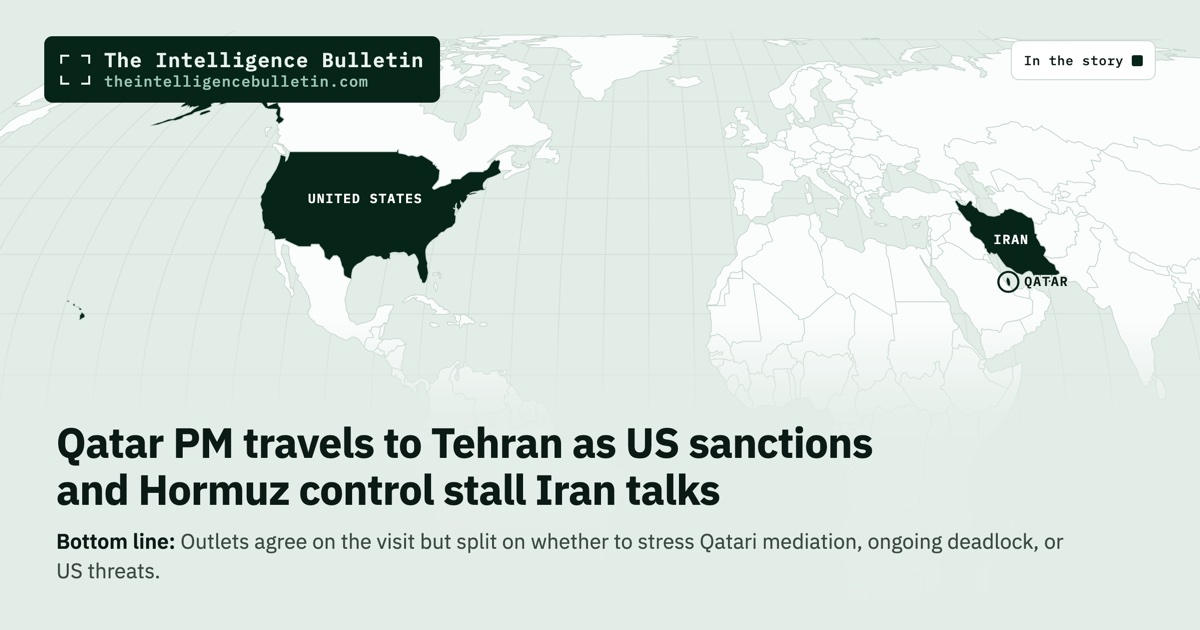
Outlets agree on the visit but split on whether to stress Qatari mediation, ongoing deadlock, or US threats.
The reporting across these outlets converges tightly on the bare facts of the announced visit and its stated purpose, yet the chosen framing reveals distinct editorial priorities shaped by each outlet’s position in the story. Al Jazeera leads with Qatar’s own agency in pushing dialogue, drawing on its foreign ministry statements to position Doha as the active mediator. Indian and Australian pieces embed the same announcement inside a longer account of stalled diplomacy and Hormuz leverage, treating the visit as one more move in a prolonged impasse rather than a breakthrough effort. The Somali outlet follows the mediation thread but layers in the same Reuters-sourced details on shipping incidents and oil volumes that appear across multiple wires. Indonesia’s Republika stands apart by foregrounding Trump’s threats to Iran’s partners and Qatar’s own economic stake in reopening the strait, shifting emphasis from neutral diplomacy to adversarial pressure and financial pain. Several pieces carry identical passages on the Oman talks and the internal Iranian contradiction between IRGC claims and a senior source’s clarification, confirming they relay the same agency copy rather than independent reporting. The selected sources therefore show a shared factual base with variation only in what each chooses to foreground: Qatari initiative, persistent deadlock, or external threats.
Full analysis
Qatar Prime Minister Sheikh Mohammed bin Abdulrahman Al Thani is scheduled to arrive in Tehran on Thursday for meetings with Iranian officials aimed at lowering tensions and laying groundwork for renewed talks between Iran and the United States. The announcement came from Qatar’s Foreign Ministry spokesman Majed al-Ansari, who said the prime minister, who also serves as foreign minister, would discuss ways to de-escalate the conflict and create conditions for dialogue. Iran’s Foreign Ministry spokesman Esmaeil Baghaei confirmed the trip, stating it would cover the continuation of Qatar’s mediation efforts along with other regional developments.
The visit occurs as the conflict between the United States and Israel on one side and Iran on the other approaches its sixth month. Major fighting has largely paused, yet no lasting diplomatic settlement has emerged. One persistent point of friction is control of the Strait of Hormuz, the narrow waterway between Iran and Oman through which roughly one-fifth of global oil supplies once moved. Before the war began on February 28, ship-tracking data showed about 20 million barrels per day transiting the strait. By the most recent readings cited in several reports, that volume had fallen to about 5 million barrels per day, the lowest level in three months. The United Nations International Maritime Organization recorded 70 incidents in the strait since late February that resulted in 19 seafarer deaths.
Qatar has positioned itself as a back-channel between Washington and Tehran. It helped broker a June memorandum of understanding that produced a temporary pause in hostilities, but that accord unraveled in July. The prime minister’s trip comes two days after Omani Foreign Minister Badr Albusaidi met his Iranian counterpart, Abbas Araghchi, in Tehran. Following those talks, Iran’s deputy foreign minister Kazem Gharibabadi described an agreement on a new temporary shipping route. Yet statements on that arrangement diverge. Brigadier General Hossein Mohebbi, a spokesperson for Iran’s Islamic Revolutionary Guard Corps, said the two countries had reached results acceptable to both sides on control of the strait and its revenues, and that the waterway would remain closed until the United States met Tehran’s conditions from the June deal, including an end to port blockades, compensation, and removal of sanctions. A senior Iranian source later told Reuters that no agreement with Oman had been finalized and that talks on details were continuing.
On the sanctions front, the United States has signaled plans to intensify economic pressure by targeting countries and companies that continue trading with Iran. President Donald Trump told Al Jazeera he was in no hurry to resume talks, stating that both economic and military measures had proven effective. Iran’s Foreign Minister Abbas Araghchi wrote to the United Nations describing the new sanctions as an act of state and economic terrorism that harms civilians by restricting access to food, medicine, energy, and other essentials. Qatar’s Foreign Ministry noted that the prime minister would also raise the need to restore freedom of navigation in the Strait of Hormuz to its pre-February 28 status.
Several outlets carried nearly identical passages on the oil-flow decline, the 70 incidents, and the 19 deaths, along with the same description of the internal Iranian disagreement over the Oman arrangement. Those passages trace to the same agency reporting. The Somali site Jowhar and the Australian Examiner both reproduced the Reuters-sourced material on shipping volumes and the Mohebbi versus senior-source contradiction, while adding the detail that Pakistan’s army chief had visited Tehran earlier in the week. The Times of India embedded the visit announcement inside an account of stalled progress and unresolved Hormuz leverage, noting that Iran’s Revolutionary Guards had claimed an agreement on revenue sharing that a senior source later qualified.
Al Jazeera, drawing on its own foreign ministry contacts, led with Qatar’s role as the active mediator and quoted the spokesman directly on the diplomatic path as the best means of resolving differences. The Indonesian site Republika placed the trip inside a frame of Trump’s threats to Iran’s partners and added that Qatar’s liquefied natural gas exports had dropped 96 percent since the war began, costing the country an estimated 24 billion dollars in revenue. That economic angle does not appear in the other four pieces.
The accounts converge on the core sequence: the prime minister’s travel date, the stated purpose of reviving dialogue, the sanctions escalation, the Hormuz dispute, and the recent Oman contacts. They differ mainly in emphasis. The Qatari outlet foregrounds Doha’s initiative. The Indian and Australian pieces treat the visit as one incremental step inside a longer deadlock. The Somali and Australian reports add the same layer of shipping and casualty data. The Indonesian piece alone highlights the sanctions pressure on third parties and Qatar’s direct financial exposure. No outlet in the set contradicts the visit itself or the basic purpose described by both governments.
The most consistent factual spine comes from the pieces that carried the Reuters material on volumes, incidents, and the explicit contradiction between the Revolutionary Guard Corps statement and the senior source. That internal Iranian divergence is presented plainly as two claims that cannot both be accurate on the question of whether an agreement has been reached. The Qatari outlet supplies the clearest on-record statements from Doha about its own mediation goals. The Indonesian piece supplies the only explicit quantification of Qatar’s LNG losses tied to the strait’s closure.
What to Watch
The wire-relayed accounts therefore give the fullest picture of what multiple independent reporting chains agree upon, while the Qatari and Indonesian pieces add distinct vantage points that the others omit. The visit itself is scheduled for the day after these reports appeared. Whether it produces any movement on sanctions relief or Hormuz access will depend on whether the United States and Iran treat the same set of conditions as negotiable or as non-starters.
That’s how the world told the story.
Get our daily open-source intelligence on world events in your inbox — one email a day, up to six stories.
Subscribe freeNo spam. One-click unsubscribe. See the latest email →