 AI-generated analysis published under the editorial responsibility of Rohit Sinnas. How it works →
Press quoted
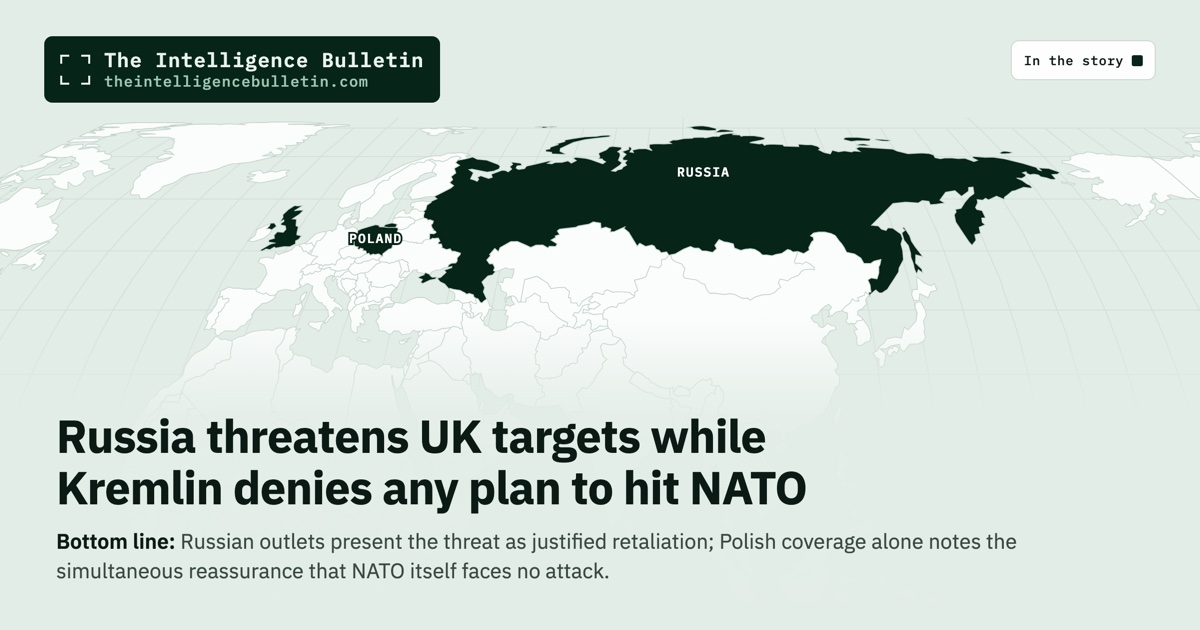
Russian outlets present the threat as justified retaliation; Polish coverage alone notes the simultaneous reassurance that NATO itself faces no attack.
Russian and British reporting both treat the threat as a direct response to London’s decision to transfer Storm Shadow assembly technology, but they invert the causal arrow: Vedomosti presents Zakharova’s statement as a defensive warning against British provocation, while LBC frames the same words as Kremlin escalation risking NATO territory. The Polish Rzeczpospolita alone flags the internal Russian contradiction between Peskov’s public reassurance that Moscow will not strike NATO and Zakharova’s explicit inclusion of targets ‘beyond’ Ukraine, a tension neither actor-country outlet foregrounds. Al Jazeera’s Reuters-sourced account aligns with the British emphasis on the threat’s novelty yet situates it within wider Western supply lines, without the Polish observation of Moscow’s mixed signals. The pattern shows that coverage diverges less on the facts of what Zakharova said than on whether those facts reveal a coherent Russian position or deliberate ambiguity aimed at European publics.
Full analysis
On 27 August 2026 Maria Zakharova, the Russian Foreign Ministry spokeswoman, told a Moscow news briefing that any British military objects and equipment in Ukraine and beyond its borders could become targets if Ukraine continued to strike Russian territory with British weapons. She tied the warning directly to the United Kingdom’s decision three days earlier to release blueprints for British-made components of the Storm Shadow cruise missile, allowing Ukraine to begin local assembly of the weapon, also known as SCALP in its French version. Zakharova accused London and Paris of attempting to dodge responsibility by shifting the assembly role to Ukraine and stated that both capitals were playing with fire, with consequences that could prove unpredictable and extend to them.
The same briefing recorded Zakharova saying that Britain was one step away from legal complicity in what she described as terrorism against Russian civilians, and she called on British leaders to abandon their hostile policy or face catastrophic results. Vedomosti reported the statement with a direct citation to RIA Novosti, noting that Zakharova also recalled an earlier announcement by French President Emmanuel Macron on similar technology sharing that had not yet been implemented. The Russian outlet linked the warning to an attack two days earlier on the centre of Donetsk, where Ukrainian forces had struck with Anglo-French Storm Shadow or SCALP-EG missiles, wounding eight people according to the head of the Donetsk People’s Republic.
Kremlin spokesman Dmitry Peskov, speaking at a separate briefing the same day, told reporters that reports of possible Russian attacks on NATO countries had nothing to do with Moscow’s intentions and were designed to divert attention from what he called aggressive European policies toward Russia. Rzeczpospolita recorded Peskov repeating the standard Russian position that Moscow would prefer to achieve its goals in Ukraine by peaceful means but would continue its special military operation to ensure its security. The Polish paper juxtaposed that reassurance against Zakharova’s explicit reference to targets beyond Ukraine, noting the two officials addressed parallel press conferences only hours apart.
British Prime Minister Andy Burnham, visiting Kyiv on the same trip that included the 24 August technology announcement, told reporters that Britain would maintain its support for Ukraine and asked who had started the fire in the first place. LBC carried Burnham’s statement that the United Kingdom had provided consistent backing since the invasion began and would not change course, even while acknowledging the situation was challenging. Al Jazeera, drawing on a Reuters dispatch, described Zakharova’s warning as the strongest direct threat yet from Russia to Britain and placed it alongside fresh Russian missile and drone strikes on Ukrainian ports, grain stores, energy sites and industrial facilities that had killed at least one person and injured several others in the preceding hours.
The technology transfer itself rested on a UK government decision announced on 24 August that authorised the European defence company MBDA to pass closed data on SCALP components to Ukraine. France had already given its assent for the same licensing step. Zakharova framed both moves as an attempt to shift blame for deep strikes into Russia onto Ukrainian soil while retaining the underlying Western role in the weapons’ production and targeting.
The accounts converge on the core factual sequence: the UK technology decision on 24 August, Zakharova’s explicit threat on 27 August to British military assets inside and outside Ukraine, and the reference to Storm Shadow and SCALP missiles already used or about to be produced locally. They also agree that Peskov addressed Western speculation about possible Russian moves against NATO members. The divergence appears in how each outlet positions the causal relationship and the internal Russian messaging. LBC presents the threat as Kremlin escalation that directly endangers British territory and records the British government’s immediate rebuttal. Vedomosti presents the identical statement as a necessary response to British actions that risk elevating the conflict to a new level, citing only the Foreign Ministry side of the day’s briefings.
Rzeczpospolita stands apart by recording both Peskov’s denial of any plan to strike NATO and Zakharova’s inclusion of targets beyond Ukraine in the same article, treating the two statements as simultaneous and therefore in tension. Al Jazeera situates the warning within the pattern of Western arms supplies to Ukraine without addressing the Peskov-Zakharova contrast. No other outlet among those examined foregrounds that contrast on the day the statements were made.
The corroborated record shows Zakharova issuing a concrete threat that four independent reporting chains carried in substantially the same terms. The single-source reassurance from Peskov that Russia harbours no intention toward NATO territory rests on one chain and receives no corroboration from the other briefings reported the same day. Russian domestic coverage foregrounds the defensive justification and omits the simultaneous reassurance, while British coverage foregrounds the risk to its own territory and the government’s resolve to continue support. The Polish account supplies the only explicit juxtaposition of the two Russian voices.
What to Watch
A reader limited to Russian outlets would conclude that Moscow is responding proportionately to an escalatory Western decision and would miss the parallel claim that NATO itself faces no danger. A reader limited to British outlets would register the direct threat and the government’s commitment to Ukraine but would not encounter the internal Russian contradiction that an observer outside the actor countries recorded. The Polish reporting demonstrates that the day’s Russian statements were not a single coherent message but two distinct lines delivered in parallel, one reassuring and one threatening. That distinction matters because it leaves European governments to decide whether the reassurance or the threat represents the operative Russian position, a choice the actor-country coverage does not force them to confront.
That’s how the world told the story.
Get our daily open-source intelligence on world events in your inbox — one email a day, up to six stories.
Subscribe freeNo spam. One-click unsubscribe. See the latest email →