 AI-generated analysis published under the editorial responsibility of Rohit Sinnas. How it works →
Press quoted
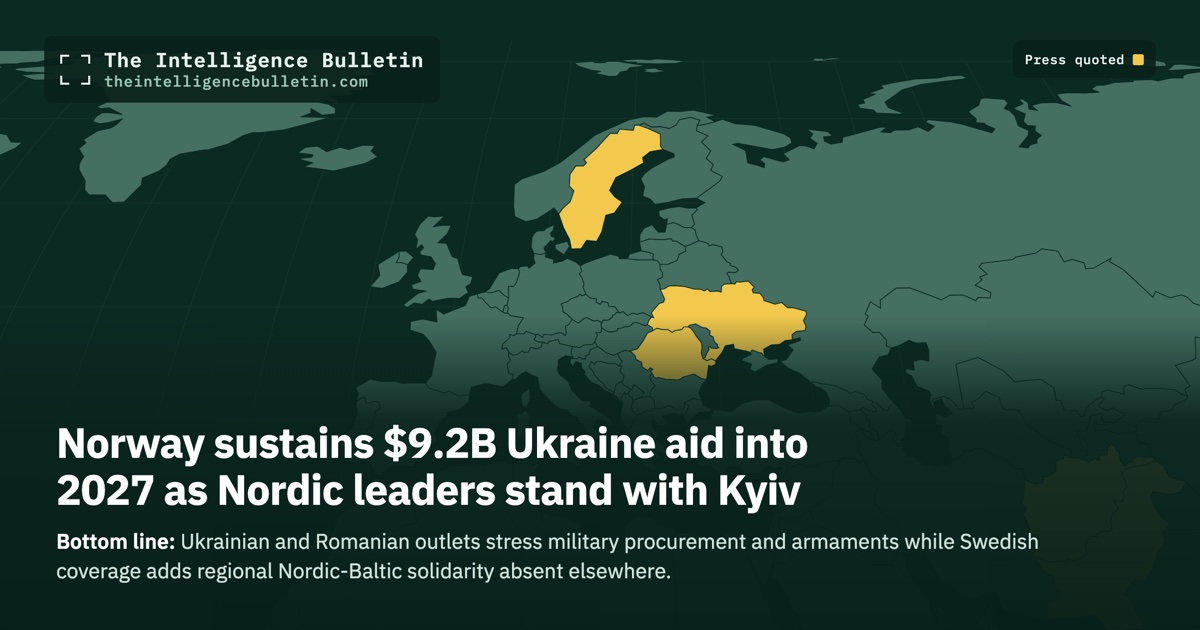
Ukrainian and Romanian outlets stress military procurement and armaments while Swedish coverage adds regional Nordic-Baltic solidarity absent elsewhere.
The reporting converges on Norway’s commitment to maintain record-level aid to Ukraine, yet the angles reveal how proximity and stakes shape emphasis. Ukrainian coverage from Kyiv Post highlights direct economic and battlefield relevance, noting procurement from Ukraine’s own industry as a lifeline. Romanian and Pakistani outlets stress the military allocation, with Digi24 specifying that the bulk targets armaments and The News International breaking out $7.5 billion for defense versus civilian uses. Swedish reporting from Göteborgs-Posten stands apart by embedding the pledge in Nordic-Baltic solidarity through the NB8 group, quoting a joint statement on supporting Ukraine until EU and NATO integration. Afghan coverage via Ariana News relays the core announcement with minimal added context, treating it as distant European news amid its own regional focus. This pattern shows how outlets closer to the conflict or region foreground military utility and collective resolve, while distant ones present it as a straightforward continuity pledge without local linkage. The absence of Norwegian domestic sourcing in the set underscores reliance on the Kyiv announcement and wire relays for the global picture.
Full analysis
Norwegian Prime Minister Jonas Gahr Støre announced on August 23 that his government would seek parliamentary approval for 85 billion Norwegian kroner, or roughly 9.2 billion dollars, in support to Ukraine for 2027. The figure matches the level already allocated for 2026 and forms the next installment of the Nansen Support Programme. Støre delivered the news in person to President Volodymyr Zelensky during a meeting in Kyiv attended by leaders from the Nordic and Baltic states. The package is described by the Norwegian government as continuing emergency assistance, with the largest share directed toward military needs and including direct purchases of equipment from Ukrainian defense manufacturers.
The timing placed the pledge inside a broader gathering of the eight Nordic-Baltic countries, known as the NB8 group. Those leaders issued a joint statement committing to support Ukraine for as long as necessary, in coordination with allies, until a just and lasting peace is reached and Ukraine advances toward membership in the European Union and NATO. Støre linked the aid explicitly to continental security, stating that support and reconstruction of Ukraine matter for Europe’s own safety. The announcement came against the backdrop of intensified drone and missile strikes on economic targets by both Russia and Ukraine, with fighting now in its fourth and a half year.
The military component receives consistent emphasis where outlets supply detail. The Norwegian statement, carried in full by Kyiv Post, specifies that the 2027 funds will prioritize military assistance and will feature procurement inside Ukraine itself. Digi24, drawing on the same government text, reports that the largest part of the sum is earmarked for armaments. The News International supplies a further breakdown, attributing 70 billion kroner, or about 7.5 billion dollars, to defense, weapons, and military equipment, with the remaining 15 billion kroner, or roughly 1.6 billion dollars, allocated to civilian reconstruction and humanitarian relief. Earlier Norwegian contributions through NATO’s Prioritized Ukraine Requirements List have already exceeded 12.5 billion kroner, providing context for the scale of the new commitment.
The Swedish coverage from Göteborgs-Posten places the pledge inside the NB8 meeting itself. It records the presence of Denmark’s prime minister, Finland’s president, and other regional leaders, notes Sweden’s participation by video link, and quotes the group’s collective pledge of continued political, military, financial, developmental, and humanitarian cooperation. The account stresses that the aid will flow mainly to Ukraine’s armed forces and frames the step as part of sustained Nordic-Baltic solidarity ahead of a wider coalition meeting on Ukraine scheduled for the following day.
Distant outlets relay the core figures with less elaboration. Ariana News presents the 85-billion-kroner commitment as a straightforward continuation of 2026 levels, situating it within the same Kyiv visit by Nordic and Baltic leaders and noting the parallel escalation of drone campaigns on both sides. Its account stays close to the government statement without additional military or regional framing.
These differences in emphasis produce distinct pictures for readers who encounter only one version. A reader limited to the Ukrainian report receives the strongest stress on direct economic benefit to Kyiv and on the unusual step of buying weapons inside Ukraine, elements presented as immediate battlefield support. A reader of the Romanian account encounters the clearest foregrounding of armaments as the dominant destination of the money. The Swedish reader sees the pledge embedded in an explicit regional consensus that ties aid to long-term goals of Ukrainian integration with Western institutions. The Pakistani reader receives the only numerical split between defense and civilian lines. The Afghan reader encounters the announcement stripped to its headline numbers and placed alongside other distant international stories.
The convergence across independent reporting chains on the headline commitment and its military priority supplies the firmest ground for any assessment. Every outlet that carried the government announcement, whether directly or through relay, records the same total, the same continuity with 2026, and the same primary focus on military use. Where outlets add context, the additions track observable proximity: Ukrainian and Romanian accounts, closest to the conflict, highlight procurement and armaments; Swedish coverage, from a neighboring Nordic state, supplies the regional grouping that the Norwegian statement itself referenced through the presence of those leaders. Outlets farther removed, such as the Afghan one, transmit the announcement without those layers. The set contains no Norwegian domestic reporting, so global readers depend on the Kyiv announcement and subsequent relays for the details that reached them.
What to Watch
The sustained scale of the commitment, now locked in for a second consecutive year at record levels, points to a durable Norwegian policy choice rather than a one-off response. Because the funds flow through an established multi-year programme and include direct support for Ukraine’s own production capacity, they reduce the lag between decision and delivery on the battlefield. Regional statements tying the aid to eventual Ukrainian membership in the European Union and NATO indicate that Oslo and its Nordic-Baltic partners view the assistance as part of a longer political trajectory, not solely as wartime relief. For Ukraine, the continuity matters because it supplies predictable revenue and equipment at a moment when both sides continue to target economic infrastructure far from the front lines. For European security calculations, the pledge reinforces the pattern of bilateral commitments that supplement collective mechanisms such as NATO’s requirements list. The reporting shows that pattern holding steady, with the military component and the regional framing both receiving consistent weight wherever outlets supplied those specifics.
That’s how the world told the story.
Get our daily open-source intelligence on world events in your inbox — one email a day, up to six stories.
Subscribe freeNo spam. One-click unsubscribe. See the latest email →