 AI-generated analysis published under the editorial responsibility of Rohit Sinnas. How it works →
Press quoted
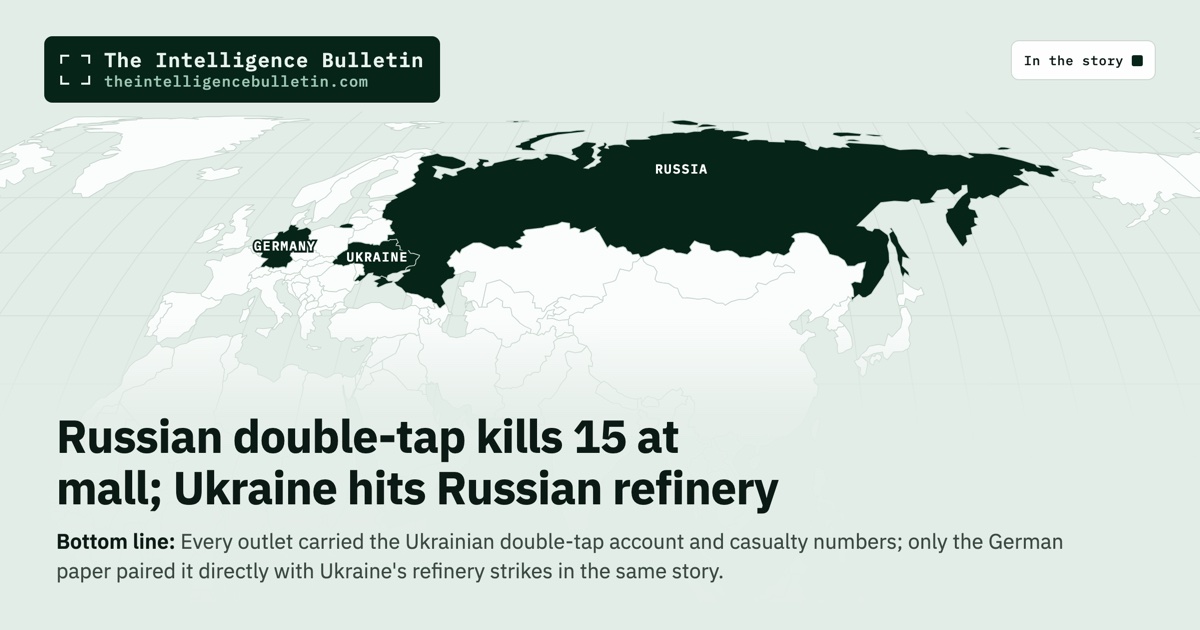
Every outlet carried the Ukrainian double-tap account and casualty numbers; only the German paper paired it directly with Ukraine’s refinery strikes in the same story.
The reporting converges on the core Ukrainian account of a deliberate Russian double-tap on the mall in Zelensky’s hometown, with consistent casualty figures and the second-strike timing across BBC, Al Jazeera, Moscow Times, ABC and Kölner Stadt-Anzeiger. That convergence is the clearest signal the event produced: outlets in the UK, Qatar, the Netherlands, Australia and Germany all carried the same timeline and the same attribution to local governor Hanzha and Zelensky without material contradiction. The German paper alone makes the counter-strike explicit in its headline, pairing the mall attack with Ukraine’s refinery hits and thereby framing escalation as mutual rather than one-sided. The Moscow Times, publishing from exile, adds the sharpest language on intent while still sourcing the same casualty numbers from Ukrainian authorities. Al Jazeera and ABC embed the story in broader context of rising civilian tolls and Ukrainian deep strikes, but none of the five introduces independent verification or Russian denials. The pattern shows how a single set of official Ukrainian claims travels intact through independent reporting chains when no counter-narrative reaches the selected outlets.
Full analysis
Russian drones struck a shopping mall in the central Ukrainian city of Kryvyi Rih on the afternoon of August 21, killing at least 15 people and wounding more than 130 others. Regional governor Oleksandr Hanzha reported that 22 children were among the wounded and that 29 people remained in serious condition, including five children. The city is President Volodymyr Zelensky’s hometown and lies roughly 60 kilometers from the front line. Ukrainian officials described the attack as a double-tap strike in which a second drone arrived about 30 minutes after the first, after fires had broken out and rescue teams had reached the site.
Zelensky called the strike “absolutely cynical and despicable” and said the second drone had deliberately targeted emergency services. He described such attacks as terrorist acts and urged the world to impose real accountability on Russia. Local defense council head Oleksandr Vilkul said the drones hit the city’s largest shopping complex and started a fire. Videos circulating on social media showed smoke rising from the building and rescuers treating people in the street outside. A separate Russian strike the same day in the Mykolaiv region killed four people, including three children, according to Ukraine’s interior minister.
Ukraine carried out its own strikes on Russian territory around the same time. Ukrainian statements reported that drones hit oil refineries, including one in the Perm region more than 1,500 kilometers from the Ukrainian border. Additional targets included a military airfield in the Volgograd region. Zelensky posted that sanctions and long-range strikes were returning the costs of the war to their origin. Russian officials have acknowledged damage to energy infrastructure from Ukrainian attacks and have said the situation remains under control, though fuel shortages have appeared at some Russian filling stations.
The five outlets that covered the mall strike in detail drew their accounts from the same Ukrainian statements and wire services. All five reported the 15-to-16 death toll, the 130 wounded, the presence of children among the casualties, and the half-hour gap between the two drone strikes. The BBC article opened on rescuers digging through wreckage and carried Zelensky’s condemnation in full. Al Jazeera placed the same numbers alongside a note that the UN Human Rights Monitoring Mission recorded 437 civilian deaths in Russian attacks in Ukraine during July, the highest monthly figure since May 2022. The Moscow Times, publishing from exile in Amsterdam, reproduced the casualty figures from Reuters and added Zelensky’s description of the second strike as an attempt to hit responders. ABC News in Australia reported 16 killed and noted Zelensky’s vow to retaliate. Kölner Stadt-Anzeiger in Germany opened its piece with the double-tap tactic and immediately paired it with Ukraine’s refinery strikes in the same paragraph.
No outlet in the set introduced independent verification of the strike sequence or carried on-record Russian denials. The German paper alone made the Ukrainian refinery attacks the second half of its headline and treated the two events as connected parts of the same day’s fighting. The Moscow Times, while using sharper language about Russian responsibility, still sourced its casualty count directly from Ukrainian authorities and the Reuters dispatch. Al Jazeera and ABC added context on Ukrainian long-range strikes against Russian logistics targets but did not alter the timeline or numbers given by Hanzha and Zelensky.
Kryvyi Rih has faced repeated Russian strikes throughout the war because of its industrial importance and proximity to the line of contact. The shopping mall attack occurred on a Friday afternoon when the complex was busy. Ukrainian officials said the second drone arrived after the first had already set the building alight and after people had begun to gather outside. Zelensky posted on Telegram that the timing indicated intent to strike responders rather than an accident of drone flight paths.
The convergence across the five accounts rests on a single reporting chain. Ukrainian regional and national officials supplied the casualty figures, the timing of the two strikes, and the description of the target. Reuters and AFP distributed those details, and the outlets reproduced them with only minor variation in the death count. The German paper’s decision to headline the Ukrainian counter-strikes alongside the mall attack is the clearest departure from that shared base. The Moscow Times, despite its editorial stance as an independent Russian voice operating abroad, aligned with the others on the factual spine and did not introduce separate sourcing.
The pattern that emerges is one in which a detailed Ukrainian account of tactics and civilian casualties moves unchanged through reporting chains in five different countries. Where the outlets diverge is in how much weight they give to the simultaneous Ukrainian strikes on Russian energy targets. The German coverage treats those strikes as an immediate part of the story. The others mention them as background or context but keep the primary focus on the mall and the double-tap claim. No source in the set supplies a competing Russian account of the mall strike itself.
What to Watch
The consistent thread across the coverage is that the mall attack and the refinery strikes occurred on the same day and that Ukrainian officials attributed the former to a deliberate second strike timed to hit rescuers. That attribution appears in every article examined. The German framing makes explicit what the others leave as separate threads: that each side is striking targets the other side values, whether civilian gathering places or energy infrastructure. The absence of any counter-narrative in the selected outlets means readers of these five publications receive one coherent timeline and one set of casualty numbers, regardless of which country’s outlet they open.
That’s how the world told the story.
Get our daily open-source intelligence on world events in your inbox — one email a day, up to six stories.
Subscribe freeNo spam. One-click unsubscribe. See the latest email →