 AI-generated analysis published under the editorial responsibility of Rohit Sinnas. How it works →
Press quoted
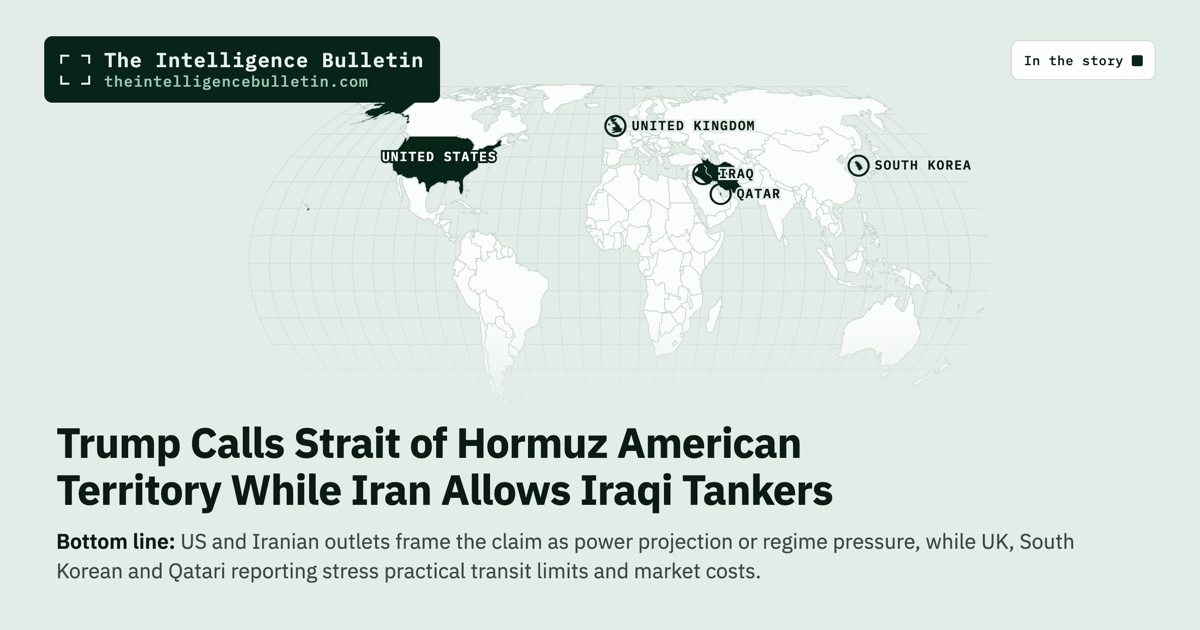
US and Iranian outlets frame the claim as power projection or regime pressure, while UK, South Korean and Qatari reporting stress practical transit limits and market costs.
Trump’s explicit assertion that the Strait of Hormuz constitutes American territory stands out because it moves beyond standard blockade language into a sovereignty claim, and the reporting shows this framing travels differently depending on the outlet’s vantage. Political Wire relayed the Guardian’s account of the rally remarks, treating the statement as an extension of domestic political posturing during an unresolved conflict. KBS World noted the repeat claim alongside prior territorial language, underscoring risks to Asian energy imports without dwelling on US domestic politics. LBC paired the same Trump quotes with Iran’s decision to permit Iraqi tankers, drawing attention to the practical gap between the US blockade and selective Iranian permissions. Al Jazeera instead anchored the episode in immediate US market losses and rising bond yields after the accompanying sanctions threats, presenting the territorial rhetoric as part of an economic campaign whose first effects landed at home. NCRI’s Iran-focused brief embedded references to the blockade and new sanctions within a narrative of regime vulnerability and internal economic strain. The consistent factual core across independent chains is Trump’s rally statement and the Iraqi tanker exception; the divergence lies in whether the story is told as American assertiveness, regional energy risk, market consequence or Iranian resilience.
Full analysis
Donald Trump stood before supporters in Myrtle Beach, South Carolina, on a Friday evening and told them he regards the Strait of Hormuz as American territory. The remark came during remarks on the continuing naval blockade of Iranian ports and shipping lanes. “We don’t even know if we won, because I view the strait of Hormuz as an American territory right now,” he said, according to accounts that reached multiple outlets. He added that the Iranians wanted a deal badly but that Washington did not yet know whether it wanted one. Later in the same appearance he joked about returning to strike Iran again: “It’s a Friday night. We have plenty of time. What the hell do I have to do? Go back and bomb Iran a little bit more?”
The declaration sits inside an active US naval operation that has redirected dozens of commercial vessels and kept most large crude carriers and liquefied natural gas tankers out of the waterway. Before the conflict began, roughly 20 million barrels a day moved through the strait; recent ship-tracking data showed only a handful of commodity ships passing on a typical day, none of them the largest classes. Trump had floated the idea of declaring the strait US territory the previous week and repeated the language at the rally. Iranian officials have not directly addressed the territorial phrasing in the material examined here, but state media reported that Tehran had granted permission for a number of Iraqi oil tankers to transit the route in recent days. Iraqi President Nizar Amedi confirmed that Baghdad had discussed the matter with Iranian officials during a recent visit, and the Iraqi government has sought alternative export routes through Turkey, Syria and Jordan to offset the disruption.
The same day brought fresh US economic pressure. Treasury Secretary Scott Bessent signaled that new sanctions measures against Iran would be announced the following week. Trump had already warned on social media that any country whose banks, businesses or airports provided support to Iran would face “tremendous economic consequences.” Hours after those statements, US equity markets posted their steepest losses in three weeks, with the Dow Jones Industrial Average falling 703.84 points to close at 52,759.21. Brent crude held near $93 a barrel while US crude traded around $86. The 30-year Treasury yield climbed above 5.25 percent, a level not seen in two decades, as investors sold longer-dated debt. US total public debt crossed $40 trillion for the first time.
These elements appear across the reporting, yet the weight each outlet assigns them differs sharply. Outlets focused on American domestic politics placed the territorial language at the center of a narrative about unresolved conflict and presidential rhetoric aimed at a home audience. Reporting that reaches Asian readers foregrounded the risk that selective control of the strait poses to energy imports that have historically supplied a fifth of global oil consumption. Coverage centered on financial markets treated the same remarks as the latest step in an economic campaign whose immediate costs were registering in US bond yields and equity prices rather than in Tehran. An opposition Iranian outlet folded references to the blockade and impending sanctions into accounts of domestic economic hardship, water shortages affecting 40 million people across twelve provinces, and executions that continued even as external pressure mounted.
A reader limited to any single national lens therefore misses the practical tension between the declared blockade and the documented exceptions. The accounts that noted Iraqi tankers passing under Iranian permission also recorded that overall traffic remained far below pre-conflict levels and that ship operators appeared more concerned about Iranian interdiction than about the US naval presence in the same waters. The accounts that tracked market movements recorded that the Federal Reserve cannot easily cut rates to support a slowing economy without adding to the inflation already driven by higher fuel prices. The accounts that emphasized Iranian internal conditions recorded that the regime’s own state-linked media could no longer conceal the scale of power outages and polluted water reaching major cities.
The most consistent factual spine across independent reporting chains is the rally statement itself and the narrow Iraqi tanker permission. The market decline and the selective transit each rest on a single reporting chain and should be treated as such. Where the coverage converges, it is on the narrow point that the strait remains contested space whose partial reopening for one country’s exports does not restore the volume or reliability that existed before the blockade. Where the coverage diverges, it tracks the vantage of the audience each outlet serves: domestic American politics, regional energy security, global financial stability, or the internal stresses inside Iran.
What to Watch
The reporting that pairs the territorial claim with the Iraqi tanker exception comes closest to capturing the operational reality on the water. It shows both the assertion of control and the limits of that control in the same frame, without requiring readers to assemble the pieces from separate national accounts. The next development likely to test that picture is whether the announced sanctions package produces measurable additional pressure on Iranian exports or whether further selective permissions continue to leak through the blockade, a pattern that would matter most to the Asian economies that still depend on Gulf crude and to the US Treasury officials who must calibrate secondary sanctions against third-country buyers.
That’s how the world told the story.
Get our daily open-source intelligence on world events in your inbox — one email a day, up to six stories.
Subscribe freeNo spam. One-click unsubscribe. See the latest email →