 AI-generated analysis published under the editorial responsibility of Rohit Sinnas. How it works →
Press quoted
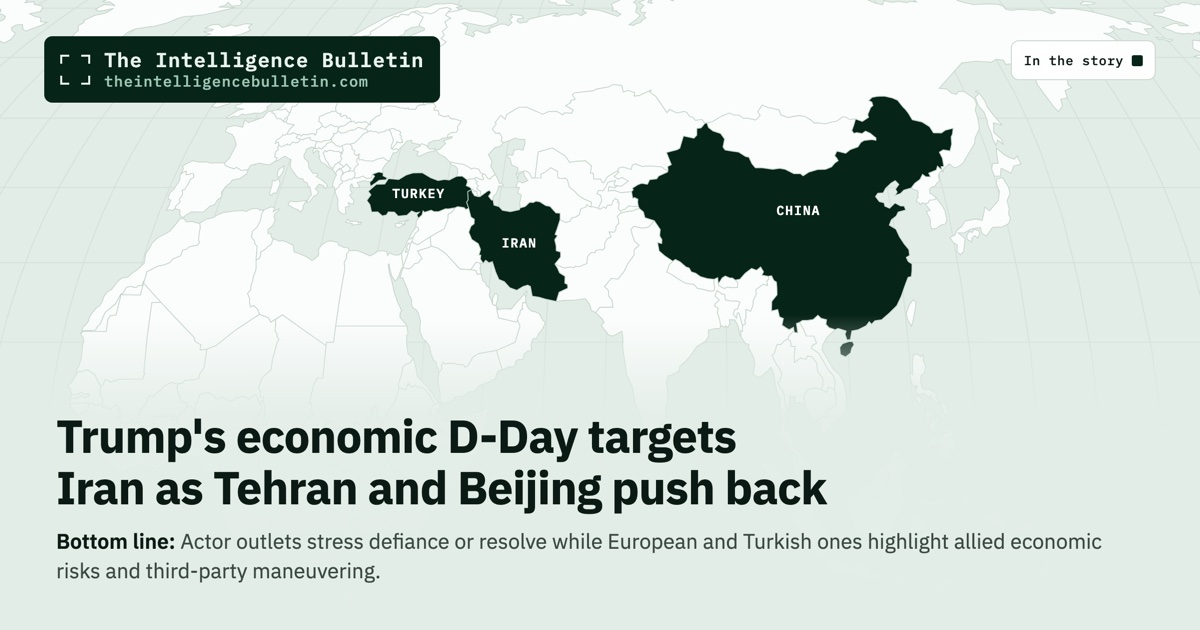
Actor outlets stress defiance or resolve while European and Turkish ones highlight allied economic risks and third-party maneuvering.
Trump’s Truth Social post frames the move as a historic economic blockade that will cripple Iran’s military and nuclear path while forcing global compliance, an account carried directly in Italian and German reporting. Iranian responses in the Jerusalem Post portray the campaign as economic terrorism that exposes US weakness and will unify opposition, a direct rebuttal absent from the wire-style Italian summary. Deutsche Welle’s live coverage adds US Treasury statements that maximum sanctions will achieve regime change without kinetic operations, underscoring Washington’s preference for economic tools over military ones. Anadolu’s headline on Chinese pushback reveals Beijing’s stake in preserving trade routes, an angle that People’s Daily’s failed link leaves unexamined here but that aligns with broader economic-alliance concerns. The Italian outlet’s reliance on ITALPRESS wire copy keeps the piece neutral and factual, relaying Trump’s claims without local commentary, while the Jerusalem Post centers Tehran’s rejection. This pattern shows actor-driven sources emphasizing defiance or resolve, whereas European and Turkish coverage stresses third-party fallout and mediation stakes rather than binary victory claims.
Full analysis
US President Donald Trump posted on his Truth Social platform on August 19 announcing what he called the launch of the most crushing economic operation ever taken against any country. He labeled the effort an ECONOMIC D-DAY and said the United States needed all its allies to help isolate Iran over its nuclear ambitions and support for groups the US describes as terror organizations. Any country whose financial institutions, businesses, airports or government entities provided any type of lifeline to Iran would face tremendous economic consequences, Trump wrote, listing targets that included oil smuggling, swap lines, cash transfers, exchange houses, ship registries and front companies. He described Iran as maniacs on the ropes whose navy had disappeared, air force been destroyed, military factories reduced to rubble, currency rendered worthless and country left hanging by a thread. The historic measures would cripple Iran’s ability to project terror worldwide, he added, and Iran would never acquire a nuclear weapon.
Iranian Foreign Minister Abbas Araghchi responded the next day on X that the so-called Economic D-Day amounted to a diversion from America’s own crisis of unprecedented debt and surging interest costs. Doubling down on failed policies would only bring further defeat and the enmity of Iranians, he wrote, while US economic terrorism threatened the global economy and sovereignty worldwide. An Islamic Revolutionary Guard Corps spokesman warned separately that if another war broke out, Iran’s warheads would prove far more destructive than those used in previous conflicts and its weapons would differ completely in every respect. Iran’s Foreign Ministry condemned the new sanctions as economic terrorism and crimes against humanity that would hurt ordinary Iranians, stating that sanctions and economic pressure were the other side of the coin of war and military aggression.
US Treasury Secretary Scott Bessent told CNBC on August 20 that the coordinated economic isolation would be the greatest in the history of the world and would collapse the Iranian regime. He said the United States would tell other nations they were either with Washington or against it, and that maximum economic pressure made large-scale military operations unnecessary. Special Envoy Jared Kushner told Fox News that Trump was emphasizing economic pressure over military action, that the prior blockade had already left Iran’s economy far worse off, and that the president remained patient and open to a deal if Iran agreed to give up its ability to create a nuclear weapon.
The Jerusalem Post reported the exchange through Iranian statements that framed the campaign as destined to fail and to expose American weakness. Deutsche Welle’s live blog carried Trump’s original language alongside Bessent’s remarks on regime change through sanctions alone and noted the dilemma facing European allies who might face energy market shocks if forced to choose sides. Padova News published an ITALPRESS dispatch that relayed Trump’s announcement in neutral terms, describing the offensive as a complete isolation of Iran and repeating his claims about the devastated state of its military and economy without additional commentary. Anadolu Agency highlighted China’s pushback against the campaign, an angle that placed third-party geopolitical maneuvering at the center rather than the direct exchanges between Washington and Tehran.
These accounts converge on the core content of Trump’s post and on the fact that Iranian officials rejected it as economic aggression that would not succeed. They diverge in emphasis once the reporting moves beyond the initial statements. The Jerusalem Post placed Iranian rebuttals in the lead and foregrounded Araghchi’s characterization of the move as a diversion from US debt problems. Deutsche Welle added US Treasury assertions that sanctions would achieve regime change without kinetic operations, an element that underscores Washington’s stated preference for economic tools. Padova News stayed with the wire account of what Trump himself wrote, offering readers the announcement stripped of subsequent reactions. Anadolu’s framing directs attention to China’s stake in preserving existing trade networks, a vantage that appears in the headline even though the available text provides limited further detail.
The pattern shows that outlets based in countries directly involved as actors foreground the statements of their own officials or the opposing side, while European and Turkish coverage widens the frame to include implementation challenges and third-party interests. Italian readers of Padova News encountered the announcement as a straightforward report of US policy without the Iranian counter-claims that appeared in the Jerusalem Post or the US Treasury details carried by Deutsche Welle. Turkish readers following Anadolu saw the story routed through China’s response, an approach that aligns with Ankara’s regional mediation role rather than with binary claims of success or defeat.
What to Watch
The corroborated record of Trump’s announcement and the single-source record of Araghchi’s reply and Bessent’s assessment together indicate that the immediate contest is over whether economic isolation alone can force Iranian concessions on the nuclear file. Trump’s description of Iran’s military and economic position as already broken rests on his own assessment rather than independent confirmation in these articles. Iranian officials reject that premise outright and cast the measures as self-defeating for the United States. Bessent’s claim that the campaign will collapse the regime stands as an administration prediction rather than an observed outcome. The reporting leaves open how many countries will comply with the demanded cutoff of financial lifelines and what effect any partial compliance would have on Iran’s oil revenues or broader economy. What the coverage establishes is that the United States has escalated its declared economic campaign, that Iran has rejected it as ineffective and illegitimate, and that at least one senior US official has tied the effort to regime change without renewed large-scale military action. Readers who follow only one national press will see either the Iranian rebuttal, the US implementation details, the neutral relay of the announcement, or the Chinese angle, but not the full set of competing claims that appear when the reports are placed side by side.
That’s how the world told the story.
Get our daily open-source intelligence on world events in your inbox — one email a day, up to six stories.
Subscribe freeNo spam. One-click unsubscribe. See the latest email →