 AI-generated analysis published under the editorial responsibility of Rohit Sinnas. How it works →
Press quoted
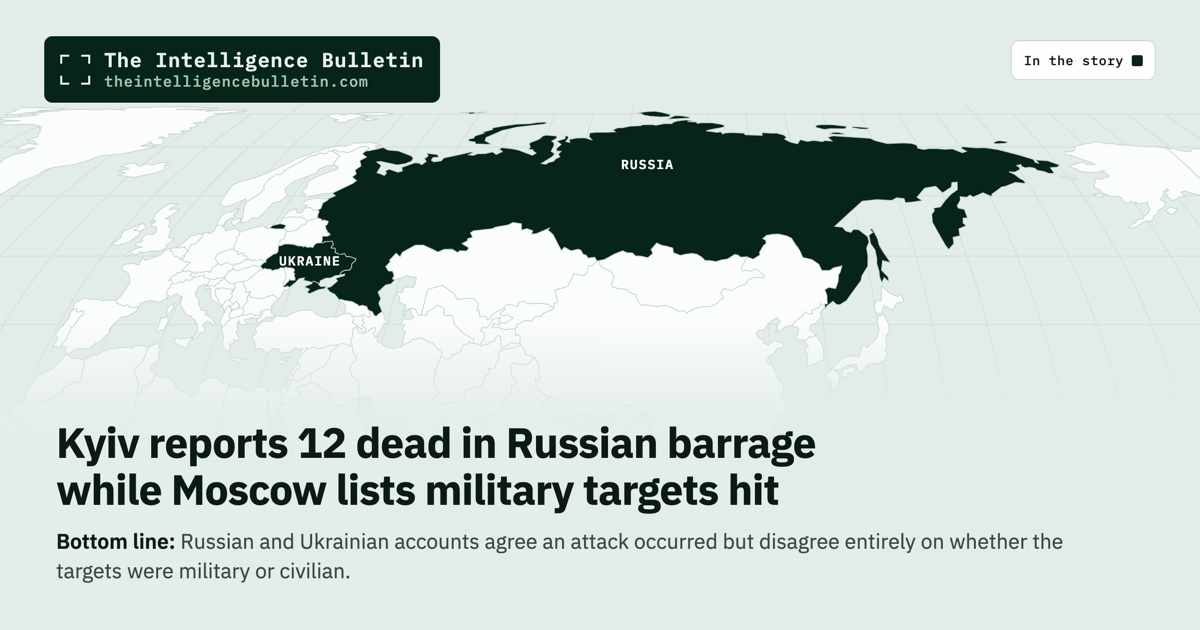
Russian and Ukrainian accounts agree an attack occurred but disagree entirely on whether the targets were military or civilian.
The reporting splits cleanly on intent and impact. Ukrainian sources and officials describe a deliberate assault on civilian infrastructure that left markets, homes, a children’s hospital and a school damaged or destroyed, with the death toll rising through the morning. Russian state media and the Defence Ministry publish detailed lists of military enterprises struck, framing every hit as precise and legitimate. European outlets such as the Swiss Watson and Czech České noviny relay the Ukrainian casualty figures and mourning announcement while noting Moscow’s competing military-target claim, without endorsing either version. The Pakistani Samaa headline alone ties the strike to Ukraine’s intensifying domestic election debate, an angle absent elsewhere. No outlet examined here carried identical agency copy; the contrast therefore reflects genuine editorial choices rather than syndication overlap. The single corroborated element across independent chains is the occurrence of the attack and the Ukrainian-reported death toll of twelve in Kyiv.
Full analysis
Russian forces struck Kyiv with a barrage of missiles and drones in the early hours of 20 August 2026. Ukrainian mayor Vitali Klitschko reported that the death toll in the capital reached twelve by morning, with more than thirty people injured. One additional person died and seven were wounded in the surrounding Kyiv region. Officials described damage across three districts to residential buildings, including a nine-storey apartment block where a fire broke out, a children’s hospital, a school and warehouses. President Volodymyr Zelensky stated that Russia had prepared the operation for some time with the goal of maximising harm to civilian infrastructure, and that ballistic missiles, cruise missiles and drones had also struck sites in Odesa and Chernihiv regions.
Russian Defence Ministry statements, carried in detail by Lenta.ru, listed the intended targets as military-industrial sites. These included the Fire Point enterprise, described as producing components for strike drones and assembling and storing accelerators for Flamingo cruise missiles; the Ukrspetsystems trading and warehouse complex involved in drone manufacture and storage; the Antonov plant, where manned aircraft and heavy An-196 Lyuty kamikaze drones were said to be developed and assembled; an aviation assembly plant and an ammunition depot holding thermobaric aerial bombs, anti-tank mines and ammunition for Baba-Yaga drones. Further strikes hit the Martusovka transport and logistics centre in Kyiv region, which handled dual-use goods including drone parts, robotic systems and electronic warfare equipment, and a fuel depot in Brovary storing up to eight thousand cubic metres of fuel for Ukrainian armed forces. Additional targets in the ports of Chornomorsk and Yuzhny were reported as military stores.
Kyiv declared 21 August a day of mourning, with flags lowered on municipal buildings and a recommendation for the same on state and private structures. Rescue operations continued at damaged sites, and power outages and fires were recorded in several districts. Ukrainian officials noted that the country faces an acute shortage of Patriot interceptor missiles, which limits its ability to counter ballistic threats.
The accounts diverge most sharply on the purpose of the attack. Ukrainian reporting and statements from Klitschko and Zelensky present the strikes as having hit civilian objects, with the rising death toll and damage to homes, a hospital and a school offered as direct evidence. Russian coverage presents every listed target as a military-industrial or logistics node supporting Ukrainian drone and missile production and operations. The two versions cannot both be accurate about the character of the same sites.
A reader limited to Ukrainian outlets would see the night primarily through its human and economic cost. The Kyiv Post article foregrounds vendors at the Pochaina flea market still trying to sell salvaged goods ten days after an earlier strike destroyed their permanent building, with similar scenes at other markets damaged since 2022. That focus places the latest barrage inside a pattern of repeated disruption to ordinary livelihoods rather than a one-off escalation. A reader limited to Russian sources would encounter only the Ministry of Defence inventory of enterprises and depots, with no mention of civilian casualties or damage to homes and hospitals. European reporting in Watson and České noviny places the Ukrainian casualty figures and mourning declaration first, then records the Russian target list in the same dispatch without reconciling the two. The Czech outlet additionally notes Ukrainian difficulties intercepting ballistic missiles due to ammunition shortages. The Pakistani Samaa piece is the only one among the five to connect the strike in its headline to Ukraine’s intensifying domestic election debate, an angle that does not appear in the actor or European selections.
The corroborated elements across independent reporting chains are the occurrence of the attack, the death toll of twelve in Kyiv and the damage to residential buildings, a children’s hospital and a school. These details reach the reader through Ukrainian officials quoted directly in Watson, České noviny and the Kyiv Post, with the casualty count also referenced in the Samaa headline. The specific Russian target list remains a single-source claim resting on the Ministry of Defence statement. No independent reporting chain in the set examined here verified or contradicted the listed enterprises by name.
What to Watch
The Ukrainian account of civilian impact rests on on-record statements from the Kyiv mayor and the president, repeated across multiple outlets in different countries. The Russian account rests on an official ministry release published in full by one state-aligned outlet. A reader weighing which description is closer to the event therefore has a clearer basis for the civilian-damage side, because that side appears in separate reporting chains that name the same injuries and the same damaged buildings. Moscow has a clear interest in framing the operation as limited to military production, while Kyiv has an interest in highlighting civilian harm to maintain international pressure for air-defence support. The next development most likely to shift the balance is whether subsequent reporting from any independent chain can confirm or refute the specific enterprises named by the Russian ministry, or whether further casualty updates from Ukrainian emergency services alter the death toll.
That’s how the world told the story.
Get our daily open-source intelligence on world events in your inbox — one email a day, up to six stories.
Subscribe freeNo spam. One-click unsubscribe. See the latest email →