 AI-generated analysis published under the editorial responsibility of Rohit Sinnas. How it works →
Press quoted
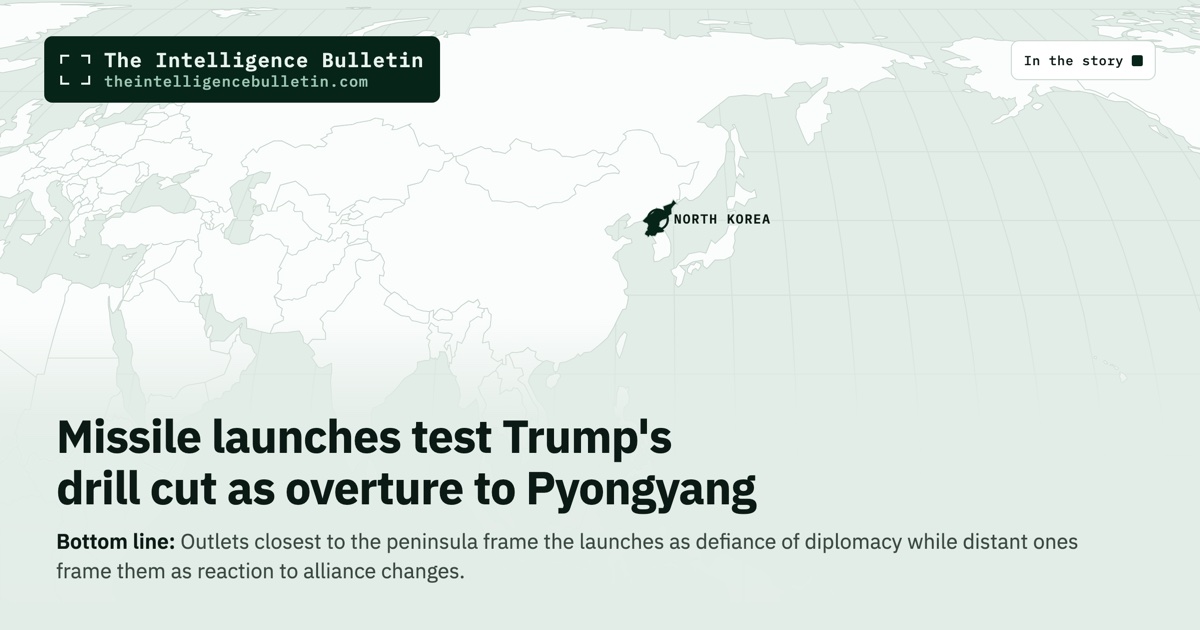
Outlets closest to the peninsula frame the launches as defiance of diplomacy while distant ones frame them as reaction to alliance changes.
The reporting converges on the timing and mechanics of the launches but diverges on emphasis, revealing how proximity shapes the frame. South Korea’s Korea Herald places the barrage squarely against Trump’s overture, quoting Kim Yo-jong’s blunt rejection and underscoring Seoul’s readiness posture as the direct response. Australian, British and South African outlets instead foreground the scaled-back drills themselves as the immediate context, treating the missile firings as a predictable reaction to an alliance adjustment rather than a standalone provocation. Turkey’s Anadolu Agency narrows to Japan’s detection, foregrounding a neighbor’s security alert. This pattern shows that domestic outlets stress defiance toward diplomacy while distant and regional observers embed the event inside US policy shifts. The common thread across independent chains is that no source claims the tests were provoked by the drills’ original scale; all note Pyongyang’s consistent opposition to any joint exercises. The absence of North Korean primary sourcing in the set leaves Kim Yo-jong’s statement as the clearest signal of intent, relayed uniformly but interpreted differently by distance from the peninsula.
Full analysis
North Korea launched roughly 10 short-range ballistic missiles from the Pyongyang area toward eastern waters at around 5 p.m. local time on August 20, according to South Korea’s Joint Chiefs of Staff. The projectiles flew approximately 300 kilometers before landing in the sea. South Korea’s military reported that it had detected the launches, stepped up surveillance for possible follow-on tests, and was sharing information in real time with the United States and Japan while maintaining a full readiness posture. The presidential national security office convened an emergency meeting immediately afterward and issued a statement describing the tests as a grave violation of United Nations Security Council resolutions.
The launches took place on the second day of a sharply reduced annual Ulchi Freedom Shield exercise between South Korea and the United States. The drill, normally scheduled for 11 days, had been cut to five days after President Donald Trump directed the Pentagon to scale back participation. Trump had framed the reduction as a signal that the United States sought improved relations with North Korean leader Kim Jong-un. He stated publicly that he planned to meet Kim later in the year and cited what he described as a good personal relationship between the two leaders. Trump also mentioned a figure of 57 North Korean nuclear weapons in one public appearance, a number he had not used before.
North Korea’s response to the drill reduction came through Kim Yo-jong, the leader’s influential sister. In a statement issued the previous day she said the reduction was “unworthy of comment” and would not alter Pyongyang’s assessment of the exercises as provocative. She noted that the drills’ aggressive character remained unchanged even after the shortening and pointed to other recent allied training activities as well as South Korea’s pursuit of nuclear-powered submarines. At the same time she observed that personal relations between her brother and Trump were “still excellent,” language that avoided the sharper rhetoric Pyongyang has used in past exchanges.
South Korea’s Joint Chiefs of Staff said it was tracking the missiles in coordination with Washington and Tokyo. The Japanese prime minister’s office separately confirmed detection of a suspected ballistic missile launch. Chinese Foreign Minister Wang Yi, who was visiting Seoul that week, urged South Korea to avoid taking sides between Beijing and Washington and called on the United States to drop what he termed its hostile policy toward North Korea. South Korean officials, for their part, continued to stress the defensive nature of the exercises and the need to maintain combined readiness against potential North Korean aggression.
The pattern of reporting across the five outlets shows broad agreement on the core sequence of events but clear differences in emphasis that track the geographic position of each publication. The Korea Herald opened its account by placing the missile barrage directly against Trump’s diplomatic overture, quoting Kim Yo-jong’s rejection and noting that Seoul’s national security office had immediately reviewed the implications for readiness during the ongoing exercise. In contrast, the Australian, British and South African pieces foregrounded the timing of the launches relative to the drill reduction itself. They presented the tests as a response to an alliance adjustment rather than as an independent challenge to the possibility of renewed talks. The Turkish account narrowed further still, highlighting Japan’s detection and the security implications for a neighboring state.
These framing choices are not contradictory on the facts. Every account that addressed the question noted Pyongyang’s long-standing opposition to any joint South Korea–United States military exercises, regardless of scale. None of the five pieces claimed that the original, longer version of the drills had provoked the tests; all located the North Korean reaction inside a consistent pattern of protest against the exercises as such. The single most widely carried detail across independent reporting chains is therefore Kim Yo-jong’s statement rejecting the overture while preserving the possibility of future personal contact between the two leaders.
Because the source set contains no direct North Korean reporting beyond the relayed statement from Kim Yo-jong, the clearest signal of intent available here remains that single on-record comment. Outlets closer to the peninsula used it to underscore defiance. Outlets farther away used it to illustrate that Pyongyang was waiting for larger concessions before engaging. Both readings rest on the same text. The absence of any North Korean primary source in the collected coverage means readers must rely on this one window into Pyongyang’s position, interpreted through the lens of each outlet’s distance from the event.
The most reliable inference supported by the reporting is that the missile launches served as a concrete test of the diplomatic window Trump had attempted to open. The reduction in exercise duration did not produce a reciprocal gesture from Pyongyang. Instead it produced an immediate demonstration that North Korea retains the capacity and the willingness to conduct weapons tests even while exercises are under way and even while the United States signals interest in renewed contact. South Korea’s estimate that North Korea possesses between 80 and 120 nuclear warheads, offered in the same reporting cycle, supplies additional context for why both sides continue to treat even scaled-back drills as high-stakes events.
What to Watch
Looking ahead, the next moves will likely turn on whether Washington offers further adjustments or whether Pyongyang responds with additional tests. The reporting shows that every independent chain agrees on the sequence: the drill cut, the dismissal, and the launches. What remains unsettled is how large a concession would be required to shift that sequence. The coverage from five countries supplies the same factual spine while revealing that proximity continues to shape which part of the sequence receives the strongest emphasis.
That’s how the world told the story.
Get our daily open-source intelligence on world events in your inbox — one email a day, up to six stories.
Subscribe freeNo spam. One-click unsubscribe. See the latest email →