 AI-generated analysis published under the editorial responsibility of Rohit Sinnas. How it works →
Press quoted
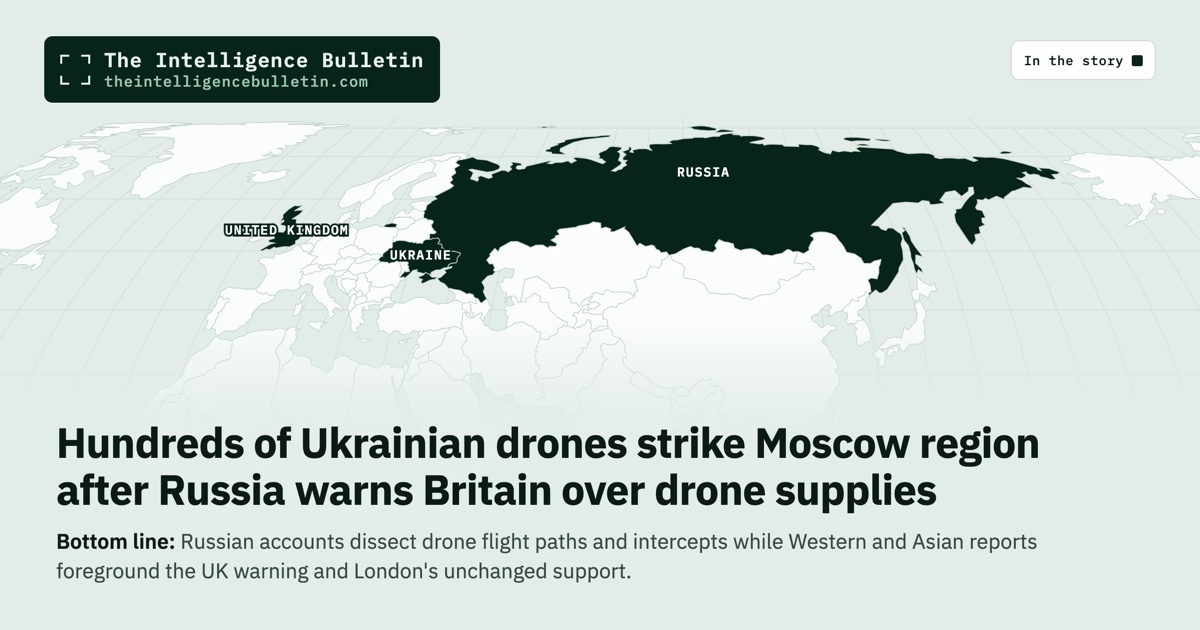
Russian accounts dissect drone flight paths and intercepts while Western and Asian reports foreground the UK warning and London’s unchanged support.
Russian reporting centers on the technical provenance of the drones, with experts tracing likely launch points from Ukrainian-held territory and emphasizing intercepted hardware to frame the attack as a contained security matter. Western accounts, by contrast, treat the embassy warning as the core development, quoting the precise language about London paying a price and pairing it with British officials’ explicit refusal to alter policy. Coverage from the US and Qatar adds context on prior UK drone packages and recent Wildberries hits, showing the threat follows repeated Russian warnings about long-range systems. The Taiwanese wire relays the embassy statement without local strike details, treating the standoff as a standalone diplomatic signal. What stands out is the absence of contradiction on the numbers of drones or the embassy text itself; outlets diverge only in emphasis, with Russian sources omitting the UK political response that dominates elsewhere. This pattern reveals how the same facts serve different narratives: one of defensive capability, the other of allied resolve against escalation.
Full analysis
Ukraine launched 637 drones toward the Moscow region in an overnight barrage that began on the evening of 18 August and extended into the following morning. Moscow mayor Sergei Sobyanin stated that Russian air defenses shot down at least 180 of them inside the region itself, while more than 150 were intercepted elsewhere in the country. Fires broke out at a high-rise building and at a Wildberries warehouse east of the capital. No fatalities were confirmed, though authorities reported some injuries. The attack formed part of a pattern in which Ukrainian forces have struck logistics and industrial sites inside Russia, including multiple Wildberries facilities that Ukrainian officials describe as supplying military components.
Russian officials responded by pointing to debris they said showed British-made drones had been used in recent strikes. The Russian embassy in London issued a statement declaring that London’s actions would inevitably carry consequences for which it would have to answer. The embassy added that the deeper its involvement in the conflict and the greater its support for Kiev’s terrorist machinery, the higher the price it would pay. It described Britain as deliberately opting for escalation while professing a desire for peace. Maria Zakharova, the Russian Foreign Ministry spokeswoman, cited drones containing UK components or configurations in attacks on facilities such as the Kamensky Plant in the Rostov region.
Britain’s Ministry of Defence did not confirm that its drones had struck Russian territory. A ministry spokesperson told CBS News that Britain stands shoulder to shoulder with Ukraine and is committed to providing the equipment Ukraine needs to defend itself. Prime Minister Andy Burnham told Sky News that the UK would support Ukraine 100 percent against the invasion, describing the policy as consistent across successive governments and not subject to change because of the warning. In April Britain had announced its largest drone package to date, pledging 120,000 drones including long-range strike models, with deliveries already under way. In June it announced an additional 150,000 drones as part of a £752 million funding package.
The Taipei Times carried a Reuters dispatch that framed the embassy statement as a direct response to a report in The Times of London indicating that British-made drones had been used for long-range strikes against Russia for the first time. The dispatch noted that Britain had repeatedly been warned since 2022 that long-range weapons supplies could be viewed as escalation. Al Jazeera’s explainer placed the warning in the context of repeated earlier Russian statements against long-range systems and listed the sequence of UK drone commitments, including co-production talks that began after a June 2025 meeting between Volodymyr Zelenskyy and then-prime minister Keir Starmer.
Russian domestic coverage, illustrated by the Bloknot article, concentrated on the technical question of launch points. Expert Vasily Dandykin discussed the territories from which the drones could most plausibly have originated, treating the episode as a matter of air-defense performance and geographic analysis rather than a diplomatic exchange. The Independent’s live blog on the wider war mentioned the drone wave in a headline reference to one of Kyiv’s biggest attacks yet on Moscow but placed the main body of its updates on unrelated developments such as cash withdrawals from Russian banks amid fears of state seizure to finance the war.
The accounts converge on the raw scale of the launch—637 drones according to the Moscow mayor—and on the precise wording of the embassy warning. They also align on Burnham’s public reaffirmation of full support. Where they diverge is in emphasis. Russian reporting foregrounds interception rates and probable flight paths while omitting the British political response. Western and Middle Eastern accounts quote the embassy text at length and pair it immediately with UK officials’ rejection of any policy shift. The East Asian wire treatment isolates the diplomatic signal without reference to the specific Moscow strikes that prompted it.
This pattern shows that the same set of facts can be assembled to stress either defensive resilience or allied political constancy. The absence of dispute over the drone count or the embassy language itself indicates that both sides are operating from a shared factual baseline on those points. The single-source element—the claim that debris proved British drones were involved—rests on Russian assertions and the Times investigation cited in Al Jazeera and CBS reporting; it has not been independently corroborated in the other accounts examined.
What to Watch
The convergence on numbers and on-record statements supplies the strongest warrant for treating the event as a genuine deepening of Ukrainian reach inside Russia coupled with a predictable Russian diplomatic counter. Britain’s explicit refusal to adjust its drone deliveries signals that the warning is unlikely to alter the flow of equipment in the near term. The episode therefore illustrates how the conflict’s geographic and material boundaries continue to expand even as the diplomatic rhetoric remains anchored in positions each side has maintained for years.
That’s how the world told the story.
Get our daily open-source intelligence on world events in your inbox — one email a day, up to six stories.
Subscribe freeNo spam. One-click unsubscribe. See the latest email →