 AI-generated analysis published under the editorial responsibility of Rohit Sinnas. How it works →
Press quoted
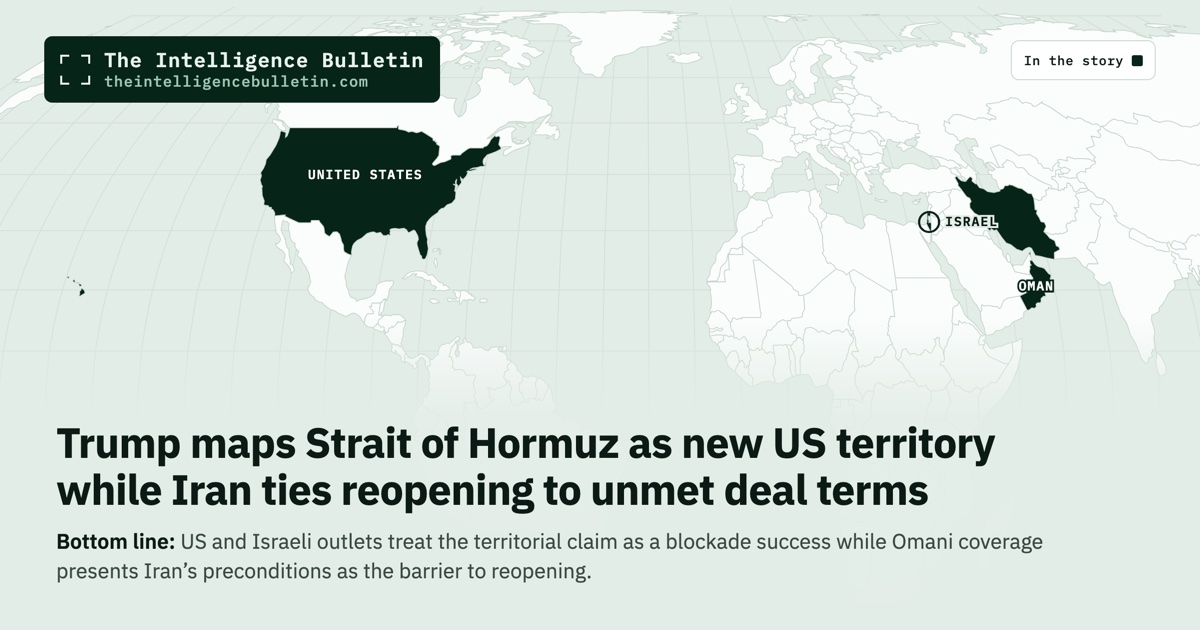
US and Israeli outlets treat the territorial claim as a blockade success while Omani coverage presents Iran’s preconditions as the barrier to reopening.
US and Israeli reporting centers Trump’s social media map and blockade assertions as a direct assertion of control after the MoU deadline passed, with the Jerusalem Post adding Qatari mediator comments on needing an Iran-Oman Hormuz agreement first. South China Morning Post coverage links the move to broader global oil transit stakes and notes Trump’s prior territorial threats elsewhere. The Oman Observer instead foregrounds Iran’s top negotiator Mohammad Baqer Qalibaf stating the waterway stays closed until Washington fulfills interim deal terms including ending the blockade and sanctions. The National Council of Resistance of Iran outlet largely omits the Trump declaration, focusing on internal regime crises and citing Reuters data on halted tanker traffic. This split shows actor-country outlets treating the claim as operational fact while the affected littoral state frames reopening as conditional on unmet US concessions, with no domestic Iranian state media appearing in the set.
Full analysis
President Donald Trump posted a map on his Truth Social account on August 18 labeling the Strait of Hormuz “NEW U.S. Territory.” In follow-up posts the same day he stated there are no talks or conversations going on or scheduled with the Islamic Republic of Iran, that the naval blockade remains in full force, that the strait is open and operating, and that all water mines have been removed or detonated. The posts came one day after the 60-day window of a June 17 memorandum of understanding between the United States and Iran expired without extension. That memorandum had committed both sides to negotiate a final deal covering issues including Iran’s nuclear program. Trump had declared the deal over on July 7; Iran’s foreign ministry suspended it a week later.
The map and statements built on remarks Trump made the previous Friday at a campaign event on Long Island, where he said that after defeating Iran he would declare the strait a territory of the United States. He had also told reporters in the Oval Office on August 17 that he liked the idea of declaring it US territory because the United States already controlled it through the blockade. In the same exchange he said Tehran wants a deal but not the kind he considers necessary, and that Iran cannot be allowed a nuclear weapon after the damage already inflicted by B-2 bombers.
Iran’s parliament speaker, Mohammad Baqer Qalibaf, addressed the same waterway on August 18 in comments carried by state media. He said the strait will not be opened until the United States implements the commitments in the June memorandum, specifically lifting the blockade of Iranian ports, lifting oil sanctions, releasing Tehran’s frozen assets, and ending threats and military operations on all fronts. Qalibaf described the shift to a fully offensive posture now that diplomatic efforts have stalled. A senior Iranian official told Reuters the same day that Iran would move to that posture because the talks had failed to secure a permanent end to the conflict.
Reporting from the South China Morning Post placed the territorial claim in the context of a nearly six-month war that began February 28 and noted that the strait normally carries a fifth of global oil and liquefied natural gas shipments. The same account recorded Trump’s threat on August 17 to “bomb the s***” out of US ally Oman if it interfered with a Hormuz deal, and it recorded Qatari Foreign Ministry spokesperson Majed al Ansari saying mediators were waiting for Iran and Oman to reach a bilateral agreement on the strait before broader US-Iran talks could resume. An agreement on Hormuz, al Ansari said, would make resuming those talks much easier.
The National Council of Resistance of Iran published shipping data on the same day showing commercial traffic through the strait had fallen to five cargo vessels on Saturday and none on Sunday, compared with 31 the previous weekend. The figures came from maritime tracking company Kpler via Reuters. The same outlet devoted the rest of its August 18 brief to Iranian domestic issues, including a daily gasoline deficit of 14 to 15 million liters, $127 billion in government and state oil company debt to the National Development Fund, and recent drone attacks attributed to Iranian forces against the office of the prime minister of Iraq’s Kurdistan region.
Three outlets—the New York Post, the Jerusalem Post, and the South China Morning Post—each carried the details of Trump’s map and his explicit statement that no talks were planned or scheduled. The Jerusalem Post added that Trump pointed to the blockade’s effect of removing millions of barrels of oil a week from the market and said oil prices were already falling. The New York Post quoted Trump’s earlier Long Island remarks about declaring the strait US territory after defeating Iran. The South China Morning Post noted that Trump’s envoy and son-in-law Jared Kushner had described “very positive and active conversations” the day before, only for the president to deny any such talks existed.
The Oman Observer carried Qalibaf’s full list of preconditions without reference to the territorial map. It described the June memorandum as having unraveled over the dispute about control of the strait and placed the Iranian conditions in the immediate local context of Omani waters adjacent to the waterway. The National Council of Resistance of Iran brief contained no mention of the map, the territorial declaration, or Trump’s no-talks statement.
A reader limited to US or Israeli accounts would encounter the territorial claim and the blockade presented as operational facts that have already cleared the strait for traffic and reduced Iranian oil exports. That reader would not encounter the Iranian preconditions for reopening or the Qatari mediator’s statement that an Iran-Oman bilateral understanding must precede any return to broader talks. A reader limited to the Oman Observer would see the strait’s continued closure framed as dependent on specific US actions still unmet, without the counter-claim that the United States has already asserted sovereignty through the map and the blockade. A reader limited to the National Council of Resistance of Iran brief would receive no account of the territorial declaration at all and would instead see only data on reduced shipping alongside Iranian internal economic and security problems.
The corroborated record shows Trump’s map and no-talks statements appearing in three independent English-language chains on the same day, while Iran’s preconditions appear in two chains that also quote Qalibaf directly from state media. The single-source shipping count of five vessels on Saturday comes solely through the National Council of Resistance of Iran’s citation of Reuters and Kpler. No domestic Iranian state outlet appears among the accounts examined.
What to Watch
The US and Israeli framing treats the declaration as an extension of an already effective blockade that has produced measurable reductions in Iranian oil movements. The Omani framing treats reopening as conditional on concessions that have not yet been delivered. The National Council of Resistance of Iran framing treats the episode as secondary to regime vulnerabilities at home. Each vantage aligns with the outlet’s location and audience: actor-country outlets foreground the power asserted after the deadline passed, the affected littoral state foregrounds the conditions attached to its adjacent waters, and the exile opposition outlet foregrounds evidence of regime strain. The most complete picture available from the set combines the territorial claim with the listed preconditions, because both rest on named statements from the principals and appear in more than one independent chain. The immediate stakes remain the flow of oil through the narrow channel that links the Persian Gulf to the open sea.
That’s how the world told the story.
Get our daily open-source intelligence on world events in your inbox — one email a day, up to six stories.
Subscribe freeNo spam. One-click unsubscribe. See the latest email →