 AI-generated analysis published under the editorial responsibility of Rohit Sinnas. How it works →
Press quoted
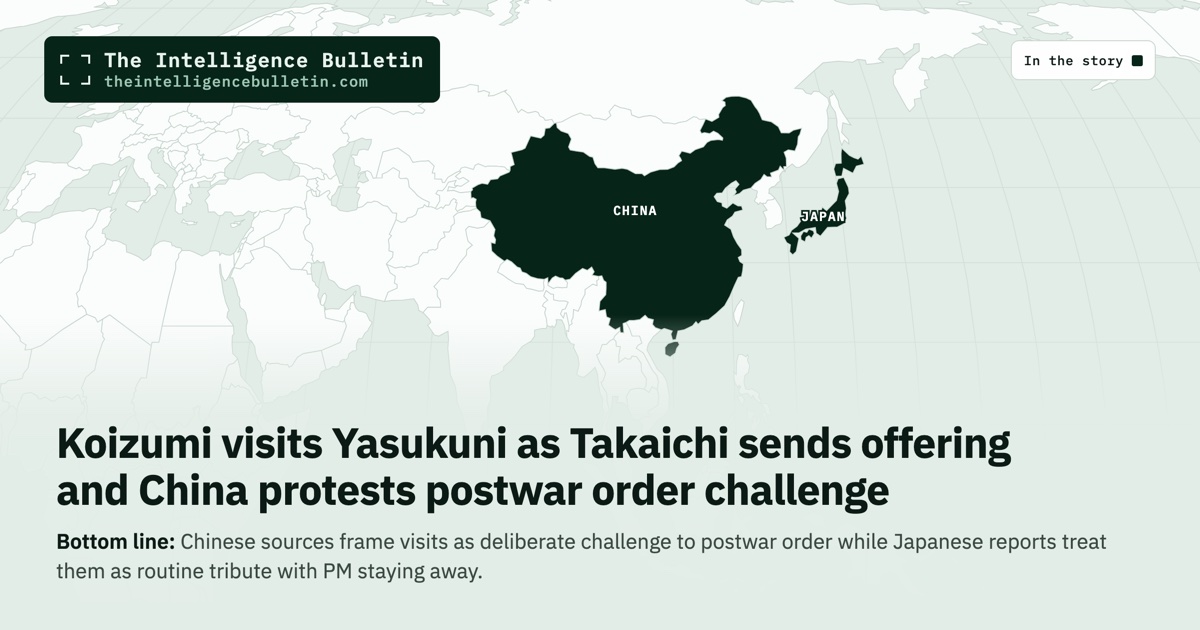
Chinese sources frame visits as deliberate challenge to postwar order while Japanese reports treat them as routine tribute with PM staying away.
The reporting reveals a clear split in framing rather than disputed facts. Chinese state outlets and the embassy statement treat the visits and offering as deliberate political acts that rehabilitate war criminals and undermine the Tokyo Trials’ legacy, linking them explicitly to Japan’s recent defense spending increases and Taiwan comments. Japanese domestic coverage presents the same attendance as routine personal or ministerial tribute to war dead, with the prime minister’s absence noted as a deliberate choice amid diplomatic sensitivities. Outlets like SCMP and Al Jazeera bridge the two by recording both the visits and the resulting regional protests, showing how the same events trigger accusations of remilitarization from Beijing and Seoul while Tokyo frames restraint through the PM’s non-attendance. Taipei Times adds the detail of Taiwanese soldiers among the enshrined dead, underscoring why neighbors see the shrine as unresolved history. No source disputes who attended or what China said; the divergence lies in whether these are standard commemorations or provocations that reopen wartime wounds eighty-one years later.
Full analysis
On August 15, 2026, Japan marked the 81st anniversary of its surrender in World War II. Defense Minister Shinjiro Koizumi visited Yasukuni Shrine that day, joined by three other cabinet ministers. Prime Minister Sanae Takaichi did not attend in person but sent a ritual offering, a step previous prime ministers have taken on the date. The shrine honors 2.5 million Japanese war dead from conflicts including the 1930s and 1940s invasions of Asia, among them 14 men convicted as Class-A war criminals at the postwar Tokyo Trials.
Chinese authorities responded immediately with formal protests. The foreign ministry stated that the visits and offering constituted a serious challenge to the outcomes of World War II and the postwar international order. It described Yasukuni as a spiritual instrument of Japanese militarism and noted that this year marked the 80th anniversary of the Tokyo Trials, which had convicted the war criminals. The defense ministry added that the actions gravely hurt the feelings of peoples in victimized Asia-Pacific countries and warned that Japan risked facing the trial of justice if it failed to draw lessons from history. The Chinese embassy in Tokyo lodged solemn representations with the Japanese side and urged Japan to reflect on its wartime crimes, break with militarism, and avoid remilitarization.
South Korea also registered its disapproval. Its foreign ministry called the moves anachronistic and expressed deep regret, urging Japanese leaders to demonstrate humble reflection and sincere remorse through concrete actions. Both China and South Korea have long viewed visits to the shrine by senior Japanese officials as symbols of insufficient atonement for Imperial Japan’s atrocities.
Japanese accounts placed the same attendance in a domestic context. Koizumi, who has visited the shrine regularly as a private citizen and earlier as a minister, went on the anniversary for the first time in his current role. The last defense minister to do so was Minoru Kihara in 2024. Takaichi, described in Japanese reporting as a China hawk who had visited before taking office in October, chose not to attend despite earlier speculation that she might follow the example of her mentor Shinzo Abe, who visited in 2013. Local coverage noted that she had sent an offering for a spring festival earlier in the year as well. Three additional ministers—Minoru Kiuchi for economic and fiscal policy, Kimi Onoda for economic security, and Hitoshi Kikawada for Okinawa and Northern Territories issues—also went to the shrine. Japanese reporting recorded crowds at the site, including a small number in military-style uniforms, and noted the shrine’s request that visitors avoid such attire to allow peaceful worship.
The shrine itself had drawn attention earlier in the week for appealing to visitors to refrain from military-style uniforms. Around 20 to 30 people were observed wearing them despite the guidance. Koizumi later posted on Instagram that he had offered condolences to the heroic spirits who sacrificed their lives for the nation and reaffirmed Japan’s postwar path as a peaceful country that renounces war.
Coverage from Hong Kong and Qatar recorded both the Japanese actions and the immediate Chinese and South Korean responses without adding new details on the visits themselves. Taipei reporting added one element absent from the Chinese and Japanese accounts: among those enshrined at Yasukuni are 30,304 Taiwanese soldiers killed in World War II. It framed Takaichi’s decision to stay away as an apparent effort to prioritize diplomatic relations with China and South Korea, and it quoted her separate remarks at a national war memorial ceremony where she mourned victims in Hiroshima, Nagasaki, and Okinawa, thanked those who perished overseas, and pledged that Japan would never repeat the tragedy of war.
The accounts converge on the core sequence of events and statements. Every outlet that covered the day reported Koizumi’s presence, the three other ministerial visits, Takaichi’s offering without her attendance, and China’s formal protest calling the moves a challenge to the postwar order. South Korea’s expression of regret appears in the same set of reports. No source disputes the identities of the visitors or the content of the Chinese statements.
Where the accounts differ is in the significance attached to those facts. Chinese state coverage presents the visits and offering as deliberate political signals that aim to rehabilitate war criminals, distort historical facts, and advance remilitarization. It ties the episode directly to Japan’s rising defense budget—preparing to submit a record 8.9 trillion yen for 2027—and to Takaichi’s earlier comments that a Taiwan conflict could constitute a survival-threatening situation for Japan, prompting Chinese sanctions and travel warnings. Japanese domestic reporting presents the same attendance as routine tribute consistent with past practice by defense ministers and other officials, while highlighting the prime minister’s restraint as evidence of diplomatic caution. It places the episode against the background of improved Japan-South Korea ties in recent months, including joint cultural gestures between the two leaders.
External reporting from Hong Kong and Qatar shows how the identical set of actions produces sharply different interpretations in the two capitals. The same visits that Chinese statements describe as a provocation appear in Japanese accounts as personal or ministerial commemoration that the prime minister deliberately kept at arm’s length. Taipei coverage inserts the additional fact of Taiwanese war dead at the shrine, explaining why the site carries particular resonance for a neighbor that was itself under Japanese colonial rule until 1945. None of these framings contradict the documented events; they differ in what weight to assign the shrine’s history versus the political context of 2026.
What to Watch
The factual record across independent reporting chains supports the view that the visits occurred exactly as described and that China’s protest was a direct and public response to them. Chinese authorities have an interest in presenting the episode as evidence of Japanese backsliding on historical issues, because that narrative justifies continued pressure on defense spending and Taiwan policy. Japanese officials have an interest in treating the shrine visits as private or customary acts, because that framing minimizes diplomatic cost while preserving domestic political support among those who see the visits as legitimate remembrance. The convergence on who attended, what was sent, and what China said publicly leaves little room for doubt about the sequence itself. What remains open is whether the pattern of annual visits by cabinet members, even when the prime minister stays away, will continue to generate formal protests from Beijing and Seoul or whether the restraint shown this year will be read in those capitals as sufficient to limit escalation. The next test will come on future anniversaries or when new defense budget figures and Taiwan-related statements surface again.
That’s how the world told the story.
Get our daily open-source intelligence on world events in your inbox — one email a day, up to six stories.
Subscribe freeNo spam. One-click unsubscribe. See the latest email →