 AI-generated analysis published under the editorial responsibility of Rohit Sinnas. How it works →
Press quoted
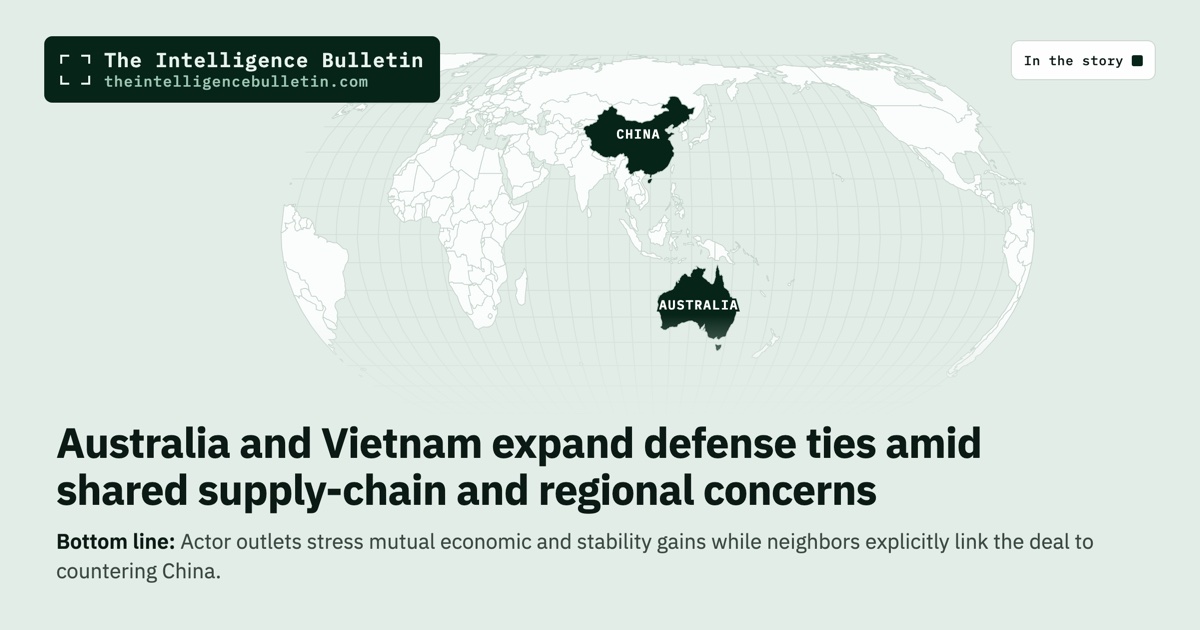
Actor outlets stress mutual economic and stability gains while neighbors explicitly link the deal to countering China.
The reporting reveals a consistent core event—Albanese and To Lam committing to closer defense, maritime and supply-chain links during the Vietnamese leader’s state visit—yet the framing splits sharply along national vantage points. Australian Financial Review coverage stays tightly on economic resilience and critical minerals from Canberra’s perspective. Vietnamese Thanh Tra reporting quotes Albanese directly on shared peace and stability values while listing concrete trade and defense steps. Singapore’s Straits Times and the Philippines’ Manila Times explicitly tie the moves to hedging against China, with Manila noting military expansion and joint training. Taiwan’s Liberty Times adds Vietnamese naval modernization details to frame the same steps as countering Beijing’s South China Sea reach. These differences are not contradictions but evidence of distinct strategic positions: the two principals emphasize mutual benefit and stability, while neighbors read the partnership through the lens of their own exposure to Chinese assertiveness. No outlet disputes the announced cooperation; the variation lies in how much weight each assigns to the China dimension that the principals themselves left largely implicit.
Full analysis
Australian Prime Minister Anthony Albanese met Vietnamese President and Communist Party General Secretary To Lam at Parliament House in Canberra on August 11. The two leaders committed to deeper defense and maritime security cooperation along with joint efforts on resilient supply chains for critical minerals, semiconductors and clean energy. They described the steps as advancing the comprehensive strategic partnership elevated in March 2024.
The visit produced concrete targets and mechanisms. Leaders set a goal of US$20 billion in two-way trade, building on a doubling of trade over the previous five years that reached more than A$30 billion in 2025. They agreed to remove barriers for businesses, expand high-quality investment and cooperate in green economy, digital economy and future industries. Defense forces and industries on both sides would increase coordination, including joint training and maritime security activities. Australian Defense Minister Richard Marles stated that the deepening cooperation would directly contribute to the stability and security of the region.
Vietnamese reporting recorded progress across all six pillars of the partnership. Defense and security ties had moved into cybersecurity and responses to transnational crime, while trade, education, science and technology, and people-to-people exchanges had each recorded breakthroughs. To Lam conveyed greetings from Vietnamese Prime Minister Le Minh Hung and expressed Vietnam’s view of Australia as a trusted friend and partner. Albanese, in turn, praised To Lam’s Shangri-La Dialogue speech for its regional vision and noted that peace and stability constituted shared values for the two countries.
Additional practical outcomes emerged during the visit. VietJet announced new direct flights from Ho Chi Minh City to Sydney’s new western airport starting in January 2027. The sides also reopened market access for Australian game meat to Vietnam and confirmed plans for RMIT University to establish a campus in Hanoi. These measures sat alongside the broader supply-chain commitments aimed at reducing disruption risks in energy, critical minerals and technology.
Regional outlets placed the same announcements in a different frame. Singaporean coverage described the partnership as a hedge against China’s growing assertiveness and willingness to employ economic coercion. Analysts cited there noted both nations’ anxiety over Beijing’s military projection and the erosion of the international order that protects smaller states. Philippine reporting highlighted expanded military cooperation and joint training explicitly in the context of China’s claims in the South China Sea. Taiwanese coverage added that Vietnam had begun construction of its largest and most advanced domestically built anti-submarine patrol vessels at the Song Thu Shipyard in Da Nang, framing the Australian partnership as part of a broader effort to counter Chinese expansion through defense modernization and diversified supply chains.
The two governments themselves left the China dimension largely implicit. They spoke of an uncertain world, the need for resilient supply chains and the value of an Indo-Pacific that is peaceful, stable and prosperous. Albanese told reporters that the new supply-chain arrangements would be good for economies, security and the region. To Lam expressed confidence that bilateral ties would continue to thrive given shared resolve. Neither side presented the agreements as directed against any third party.
The accounts converge on the substance of what was announced. All five outlets reported the same core commitments on defense cooperation, maritime security and supply-chain resilience reached during the August 11 meeting. They agree that trade has roughly doubled in five years and that the leaders set a US$20 billion target. They agree that military and maritime steps were part of the package. The variation lies in emphasis and added context rather than in conflicting facts about the event itself.
Where the reporting diverges is in the weight given to strategic positioning. Australian coverage stayed within an economic and supply-chain resilience lens, foregrounding critical minerals and semiconductors from the host government’s perspective. Vietnamese coverage stressed shared values of peace and stability while listing Vietnamese objectives such as the trade target and six-pillar progress. Outlets in Singapore, the Philippines and Taiwan each supplied independent analyst commentary or claimant-state context that explicitly connected the moves to concerns over Chinese military and economic behavior. These three accounts drew on separate reporting chains and added details—such as Vietnamese naval shipbuilding—not present in the actor accounts.
The hedging interpretation therefore rests on corroboration across multiple independent chains rather than on any single source. The governments’ own statements supply the primary evidence for the narrower mutual-benefit reading. The practical limits of the relationship also appear consistently: analysts noted that cooperation would focus on maritime security, disaster relief and technology rather than formal defense treaties, reflecting Australia’s alliance with the United States and Vietnam’s non-aligned posture.
What to Watch
The agreements point toward incremental projects in critical minerals processing and limited joint maritime activities rather than rapid alliance formation. Supply-chain work carries immediate economic stakes for both sides given global disruptions, while defense steps remain bounded by the political realities each capital faces. Readers following only one national press would miss either the concrete economic deliverables or the regional strategic reading that multiple neighbors applied to the same events.
That’s how the world told the story.
Get our daily open-source intelligence on world events in your inbox — one email a day, up to six stories.
Subscribe freeNo spam. One-click unsubscribe. See the latest email →