 AI-generated analysis published under the editorial responsibility of Rohit Sinnas. How it works →
Press quoted
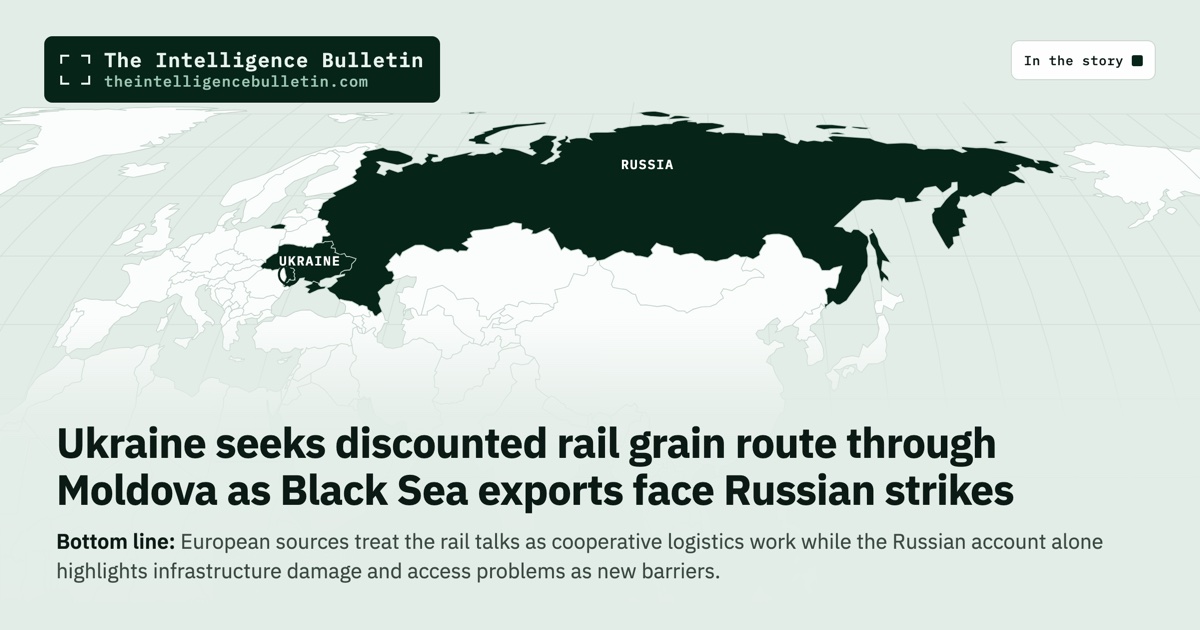
European sources treat the rail talks as cooperative logistics work while the Russian account alone highlights infrastructure damage and access problems as new barriers.
The core reporting across Ukrainian, Moldovan and Romanian outlets traces directly to the same Reuters dispatch on tariff negotiations and volume talks, with local additions confirming the temporary nature of any discount and the route’s link to Solidarity Corridors. Russian coverage stands apart by adding details of a destroyed Dniester bridge and Moldovan Railways locomotive shortages that complicate access, while framing the effort as already encountering blockages. Taiwanese reporting distances itself by tying the shift squarely to Russian port attacks as part of broader war logistics. The pattern shows European sources converging on practical economic and security benefits for the three countries involved, with the Russian account alone introducing infrastructure damage as a new obstacle and the sole non-European source treating the story as one more instance of wartime rerouting. No outlet contradicts the basic fact of ongoing talks; the divergence lies in what each chooses to foreground as the immediate constraint or opportunity.
Full analysis
Ukraine is discussing a rail corridor for its grain exports that would run through Moldova and onward to Romania’s Constanta port. The talks center on a Ukrainian request for a 50 percent reduction in Moldovan rail tariffs, with Moldova responding that any discount must be matched by guaranteed cargo volumes and would apply only temporarily. Sources in both governments told Reuters that the two sides are also sorting out timing and quantities, while a senior Ukrainian industry official said the country is still collecting data on potential shipper volumes.
The proposed route revives a path used in 2022 and 2023 after the full-scale invasion disrupted Black Sea shipping. Former Moldovan Railways chief Oleg Tofilat told Reuters the line could move roughly 4.5 million metric tons of grain each year. Ukrainian officials estimate a working corridor might eventually carry about 10 percent of the country’s total exports. Moldova’s Prime Minister Vasile Tofan has publicly welcomed the prospect of earning several million euros in transit revenue and has dismissed concerns from local farmers that Ukrainian grain would undercut domestic prices.
The urgency comes from Russian strikes on Ukrainian Black Sea ports and shipping infrastructure in the Odesa region. Ukraine’s Agriculture Minister Taras Vysotskyi told Reuters that the government has lowered its 2026-27 grain export forecast to 38-40 million metric tons from an earlier 43 million ton projection. More than 90 percent of Ukrainian grain normally leaves by sea, so the attacks directly threaten the country’s largest export category. Ukrainian estimates also show analysts at APK-Inform cutting their own forecast by 8.6 percent to 39.4 million tons for the same reason.
Moldovan Infrastructure and Regional Development Minister Vladimir Bolea visited Odesa region on the day the Reuters reporting appeared and met his Ukrainian counterpart Mykola Kalashnyk to discuss rail connections and expanded transit. The Moldovan ministry later issued a statement confirming it is examining the Ukrainian request and underscoring that any tariff relief would be a short-term mechanism linked to the EU’s Solidarity Corridors. The statement explicitly ruled out a permanent reduced rate and noted that the additional volumes would still generate a solid profit for Moldovan Railways even after the temporary adjustment.
Russian reporting on the same developments adds concrete obstacles not mentioned in the Reuters-based accounts. Nezavisimaya Gazeta reported that a bridge over the Dniester River near Mayaky in Odesa region has been damaged, forcing traffic bound for Moldova to detour through northern crossings and adding roughly 500 kilometers. The paper also noted that Moldovan Railways has only 56 locomotives on its books, most of them aging, and that Ukrainian negotiators have been asked to supply their own traction power or rely on a limited number of newer units. Ukrainian Railways deputy director Valery Tkachev confirmed the discount request and said talks cover both ministry and operator levels, including traction questions. The same account quoted Moldovan Railways as seeking volume assurances equivalent to 10 percent of planned shipments.
Taiwan’s Central News Agency framed the rail option strictly as a wartime rerouting driven by repeated Russian attacks on ports and navigation, without dwelling on tariff percentages or local economic gains. It reported the same core figures—50 percent discount request, 4.5 million ton capacity estimate, lowered Ukrainian export forecasts—and placed the story inside the larger pattern of logistics adjustments during the conflict.
The Reuters dispatch therefore supplies the shared factual spine across the Ukrainian, Moldovan, Romanian and Taiwanese pieces, while Nezavisimaya Gazeta supplies the only independent details on physical infrastructure constraints. No outlet disputes that discussions are underway or that the 50 percent discount figure has been tabled. The Moldovan government’s on-record clarification that any relief remains temporary and conditional on volumes appears only in the Ziarul de Gardă article and the ministry statement it quotes. The Romanian coverage foregrounds the corridor’s connection to Constanta and EU markets. The Ukrainian account stresses export pressure from port strikes. The Russian account alone presents the route as already encountering physical and equipment barriers.
These differences shape what a reader would take away from any single source. A reader limited to the Kyiv Post piece would see an urgent Ukrainian initiative to protect exports but would miss the explicit Moldovan insistence on temporary terms and volume guarantees. A reader of only the Nezavisimaya Gazeta article would encounter the bridge damage and locomotive shortages as central facts yet would not learn that the Moldovan ministry has already ruled out a permanent tariff cut or linked the talks to the Solidarity Corridors framework. The Taiwanese treatment would leave out both the discount mechanics and the infrastructure complications.
What to Watch
The Reuters-derived accounts converge on the existence and basic terms of the negotiations because they draw from the same reporting chain. The Russian account’s additional claims about the destroyed bridge and locomotive shortages stand as the sole independent sourcing on physical impediments; whether those details prove decisive will depend on further reporting from either side’s operators. Ukrainian officials have an interest in presenting the rail option as a viable workaround that can restore export flows. Moldovan officials have an interest in showing both solidarity and commercial prudence. Russian coverage has an interest in underscoring that Ukrainian export routes remain vulnerable. The immediate test will be whether the two governments can agree on volumes, traction and a temporary tariff adjustment before the next harvest season begins to move.
That’s how the world told the story.
Get our daily open-source intelligence on world events in your inbox — one email a day, up to six stories.
Subscribe freeNo spam. One-click unsubscribe. See the latest email →