 AI-generated analysis published under the editorial responsibility of Rohit Sinnas. How it works →
Press quoted
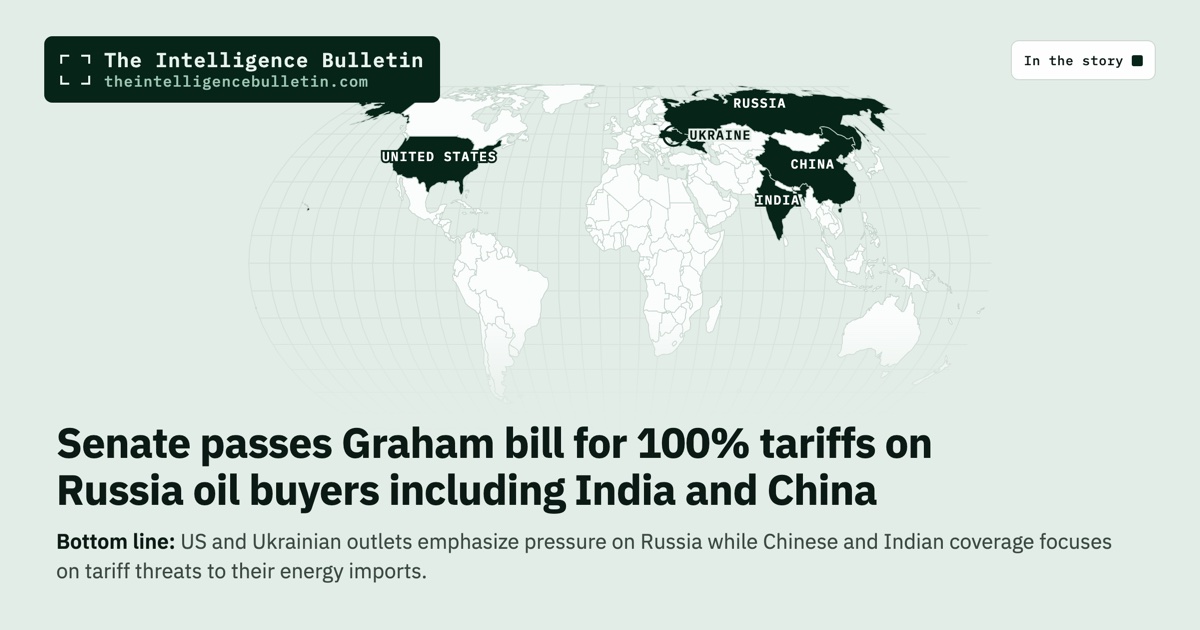
US and Ukrainian outlets emphasize pressure on Russia while Chinese and Indian coverage focuses on tariff threats to their energy imports.
The reporting converges on the Senate’s 86-11 passage and the bill’s core provisions but parts company immediately on stakes and framing. US coverage centers the late Lindsey Graham’s legacy and bipartisan determination to hit Russia’s war economy, with RFE/RL underscoring energy revenue targeting from a perspective attuned to Moscow’s finances. Ukrainian reporting through Interfax-Ukraine treats the vote as an initial success requiring House follow-through, tying it directly to ending Russian aggression. Chinese analysis in Global Times casts the tariffs as US political coercion disrupting legitimate energy trade, quoting experts on spillover harm to importers and noting Beijing’s opposition to unilateral measures. Indian coverage leads with the concrete threat of 100 percent tariffs on New Delhi’s purchases, detailing how Russian crude has become critical amid other supply disruptions and warning of export damage. The fault line runs through the tariff authority itself: American and Ukrainian accounts present it as necessary leverage, while affected-party outlets in China and India frame it as overreach that could force sovereign choices between US markets and affordable energy. This pattern shows how proximity to the sanctions’ targets shapes emphasis far more than any shared wire text.
Full analysis
The US Senate approved the Lindsey O. Graham Sanctioning Russia and Iran Act of 2026 on August 7 by a vote of 86 to 11. The measure imposes sanctions on Russian President Vladimir Putin, senior political and military officials, oligarchs, financial institutions, and energy projects tied to the war in Ukraine. It expands sanctions on older and reflagged tankers that Russia uses to move oil and adds pressure on Iran’s weapons and energy sectors through an extension of the Iran Sanctions Act of 1996 until 2031. A central provision gives the president authority to impose tariffs of up to 100 percent on goods from the top five purchasers of Russian crude oil or natural gas. China and India rank among those buyers. The bill now advances to the House of Representatives, which remains in recess until September.
The legislation is named for the late Republican senator from South Carolina, who had pushed for stronger measures against Moscow for years before his death in July. Senate Minority Leader Chuck Schumer described the vote as an unmistakable message that Washington would continue supporting Ukraine and would not be deterred by Russian pressure. Senate Majority Leader John Thune noted that Russia’s energy revenues sustain its ability to finance the conflict. Democratic Senator Richard Blumenthal, a co-author, said the measure would target Russia’s shadow fleet and countries buying discounted Russian crude. Republican Senator Katie Britt argued it would hit Putin where it hurt most by striking energy revenues. An amendment offered by Republican Senator Rand Paul and Democratic Senator Ron Wyden to strip the new tariff authority failed. Paul warned that sympathy for Ukraine should not blind lawmakers to the reality of tariffs, while Wyden called the provisions an economic wrecking ball that could harm Americans.
Ukrainian officials treated the Senate action as a concrete step toward increasing the cost of Russian aggression. Verkhovna Rada Chairman Ruslan Stefanchuk thanked the Senate for the bipartisan signal and expressed hope that the House would act quickly so the bill could take effect. He linked consistent sanctions to compelling Russia to end the war and establish a just peace, describing the measure as part of Lindsey Graham’s political legacy. Ukraine’s sanctions policy commissioner, Vladyslav Vlasiuk, said the vote sent a strong signal that Russia must face a higher price for its actions and that support for Ukraine remained firm. Advocacy groups such as Razom for Ukraine also welcomed the outcome, noting it marked the second piece of pro-Ukraine legislation to pass a chamber of Congress in just over two months.
Coverage from outlets based in China and India placed the tariff provisions at the center of their accounts. Chinese reporting quoted Yang Jin of the Chinese Academy of Social Sciences describing the bill as driven by domestic political motives and amounting to economic coercion that weaponizes tariffs against normal global energy trade. Yang observed that many economies maintain market-based cooperation with Russia for practical energy security reasons and warned of severe spillover risks to the global economy if the tariffs take effect. India’s reporting detailed how Russian crude imports have risen sharply since 2022, with a 34 percent increase in June 2026 alone, partly because disruptions through the Strait of Hormuz have reduced supplies from the Gulf. The piece outlined that a 100 percent tariff on Indian goods could raise costs for engineering products, pharmaceuticals, chemicals, textiles, and auto components in the US market, potentially forcing Indian exporters to absorb losses or lose competitiveness.
The accounts diverge most sharply on the tariff authority itself. American and Ukrainian reporting presents the provision as a narrowly targeted tool to reduce Russia’s war financing and to give the president leverage in negotiations. Chinese and Indian reporting frames the same authority as an overreach that overrides sovereign economic decisions and risks broader market damage. US Senate debate recorded explicit concerns from both parties about giving the executive sweeping new tariff powers, with some lawmakers noting that President Trump already possesses broad sanctions authority and that the bill would add an additional layer. House Democrats Gregory Meeks and Don Beyer stated after the vote that they retained fundamental concerns about the tariff provisions and the president’s ability to waive sanctions. They argued the measure could damage alliances and increase costs for Americans.
A reader limited to any single national press would miss the scale of the internal US disagreement over implementation. The Senate record shows the tariff language survived an amendment challenge by a clear margin, yet the same record also shows repeated warnings that enforcement would determine whether the bill materially affects Russia’s energy revenues. Ukrainian accounts correctly note the vote as an advance but do not address the House calendar or the specific objections already voiced by House Democrats. Chinese and Indian accounts correctly identify the direct exposure of their energy purchases and export sectors but do not detail the bipartisan Senate majority that supported the overall package or the explicit linkage several senators drew between Russian oil income and continued fighting in Ukraine.
What to Watch
The most complete picture of what the bill actually contains and what obstacles it still faces comes from the reporting that captured both the floor debate and the reactions of the directly affected parties. The 86-11 margin demonstrates broad congressional willingness to escalate economic pressure on Russia. The survival of the tariff provisions despite vocal opposition inside the Senate shows that lawmakers viewed the authority as essential rather than incidental. At the same time, the explicit concerns raised by senators from both parties and by House Democrats indicate that passage in the House is not assured and that any final text may require further negotiation over waiver authority and scope. Countries that continue large-scale purchases of Russian oil now face a documented choice between maintaining those volumes and preserving unrestricted access to the US market, a choice the bill’s authors framed as deliberate pressure on Russia’s war economy.
That’s how the world told the story.
Get our daily open-source intelligence on world events in your inbox — one email a day, up to six stories.
Subscribe freeNo spam. One-click unsubscribe. See the latest email →